
Egypt has started trial operations at the first phase of a new general cargo and dry-bulk terminal at Sokhna Port, putting another element of its Red Sea–Mediterranean freight strategy into operational testing as the country expands port, rail and road links between industrial centres and global shipping routes.
The terminal received its first general-cargo vessel, Gambella, which discharged 1,460 tonnes of battery units for an energy-storage project. Suez Mechanical Stevedoring handled the unloading as authorities tested berthing, cargo handling, storage and inland-movement systems ahead of full commercial operation.
The first phase covers about 397,000 square metres and includes two berths with a combined length of 1,200 metres and an 18-metre draft. Planned handling capacity is around 10mn tonnes annually, broadening Sokhna’s ability to handle dry bulk, industrial inputs and project cargo alongside container traffic.
No fixed date has yet been announced for full commercial operation. The current phase remains a commissioning programme, with activity expected to expand progressively after technical and operating tests are completed.
The terminal forms part of the wider redevelopment of Sokhna into a roughly 29-square-kilometre port and logistics complex. Its strategic significance lies increasingly in the transport network being built behind the quays.
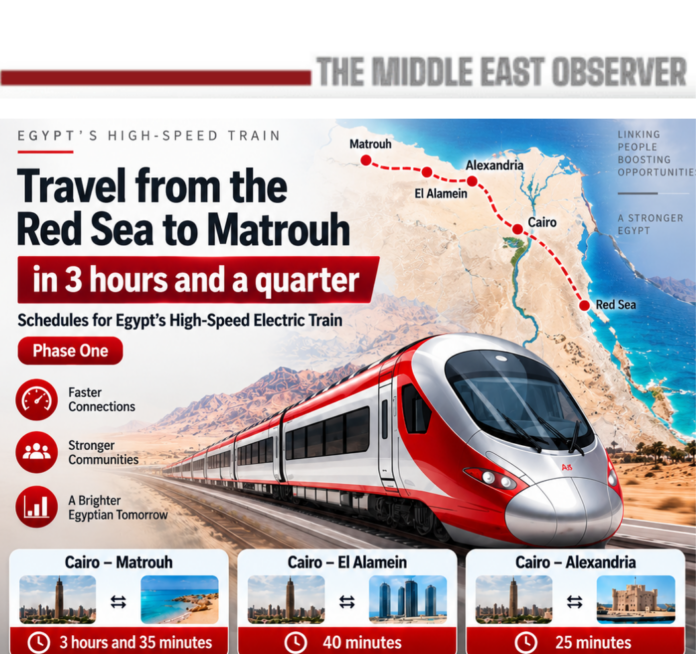
Under the government’s planned Sokhna–Alexandria logistics corridor, cargo would move from Sokhna Port through an approximately 6-km rail connection to Ain Sokhna station on Egypt’s first high-speed electric railway. The line then runs west through the New Administrative Capital, Greater Cairo and Giza to the 6th of October area and towards Greater Alexandria and Borg El Arab, before continuing along the Mediterranean coast.
The corridor is not a single dedicated railway. It is designed as an integrated network combining the high-speed freight line with conventional rail, dry ports and industrial zones. The 10th of Ramadan dry port and industrial area are being connected through the 63.5-km Robeiki–10th of Ramadan–Belbeis railway, providing another freight link into the national network and towards Greater Alexandria.
The Transport Ministry defines the corridor as an integrated chain linking Sokhna Port, High-Speed Rail Line 1, the 10th of Ramadan dry port, the Robeiki–10th of Ramadan–Belbeis railway and Greater Alexandria Port.
Testing of the high-speed railway is expected to proceed in stages before full commercial passenger and freight services begin, subject to systems testing, safety certification and completion of the wider network.
The project’s commercial significance will depend on whether the new infrastructure cuts inland transit times and logistics costs while improving manufacturers’ and exporters’ access to Red Sea and Mediterranean shipping routes.
The next test is integration: whether new berths, rail connections, customs facilities and logistics zones can operate as a single freight system with sufficient cargo volumes to translate infrastructure investment into faster and lower-cost trade flows.
Related news:
Egypt, Senegal Advance Alexandria–Dakar Shipping Plan With Atlantic Trade Potential
Egypt, Oman Plan Maritime-Industrial Corridor Linking Africa and Asia
Read also:
UAE Plans €40bn Germany Investment Push Across AI, Industry and Energy
Egypt Deepens Sudan Power Rebuild With Solar Projects and 300MW Grid Link