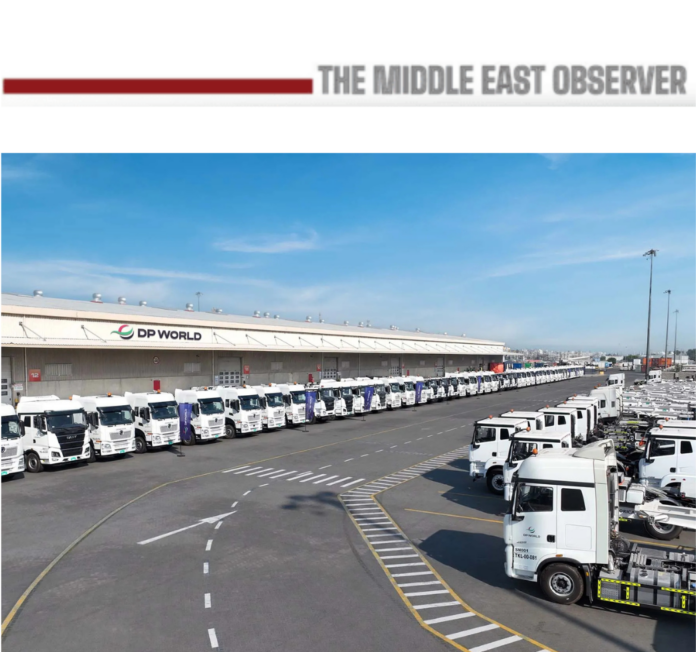
DP World plans to expand its regional truck fleet by about 40% to 1,000 vehicles as the UAE logistics group scales alternative land and multimodal routes linking the Gulf with Europe, Asia and the US, reinforcing a shift from emergency rerouting towards longer-term supply-chain diversification.
The fleet will rise from about 700 trucks, Stephen Whittingham, DP World’s COO Freight-Europe, told Bloomberg. The company launched a Western Europe-GCC road service through Turkey within days of disruption to traffic through the Strait of Hormuz. The route now handles up to 50 trucks a week, mainly automotive parts and consumer goods.
DP World has also established hybrid sea-road services and is developing a Europe-Iraq-Gulf corridor, with talks underway with Iraqi authorities over making that service permanent. Its existing inland network connects Gulf markets with gateways including Fujairah in the UAE, Salalah in Oman and Jeddah on Saudi Arabia’s Red Sea coast.
The new target follows DP World’s July deployment of 700 trucks across its GCC network, designed to add as many as 35,000 trips a month. By August, the company said it had moved 500,000 TEUs by road and rail since March, while its regional network was supporting around 3,000 truck movements a day.
The strategy is increasingly backed by port infrastructure on both sides of the Arabian Peninsula. DP World has agreed in principle to develop two terminals in Fujairah under a 50-year concession, including the Al Rugaylat terminal with planned capacity of up to 2.5mn TEUs annually, strengthening access to the UAE from outside Hormuz. Its Jeddah South Container Terminal meanwhile handled a record 221,200 TEUs in July, with first-half volumes rising nearly 79% year-on-year.
Economics nevertheless limit the extent to which land routes can displace shipping. Moving freight by road from Europe to the GCC costs roughly three to four times as much as ocean transport, according to Whittingham. Their longer-term role is therefore more likely to lie in high-value and time-sensitive cargo, where speed and route certainty can justify the premium.
For Egypt, the emerging network represents logistics diversification rather than a direct substitute for Suez. DP World is simultaneously expanding at Sokhna, where it launched an integrated Logistics Distribution Centre in July to serve Egyptian, regional and international markets. The broader strategy points towards a trade system in which companies retain multiple sea, road and rail options rather than depend on a single maritime corridor.
DP World’s fleet expansion therefore signals a wider structural shift: routes built to keep cargo moving during disruption are becoming durable supply-chain options. Ocean shipping retains its decisive cost advantage for mass trade, but Gulf logistics operators are increasingly investing in the capacity to route around disruption when reliability commands a premium.
Related news:
DP World Opens Egypt’s First Integrated Logistics Distribution Centre at Sokhna
Syria and DP World Sign Pivotal $800 Million Agreement for Tartus Expansion
Read also:
Egypt High-Speed Rail Moves Into Commissioning With October Tests
Nine UNESCO Designations Broaden MENA’s Tourism Bet Beyond Monuments