
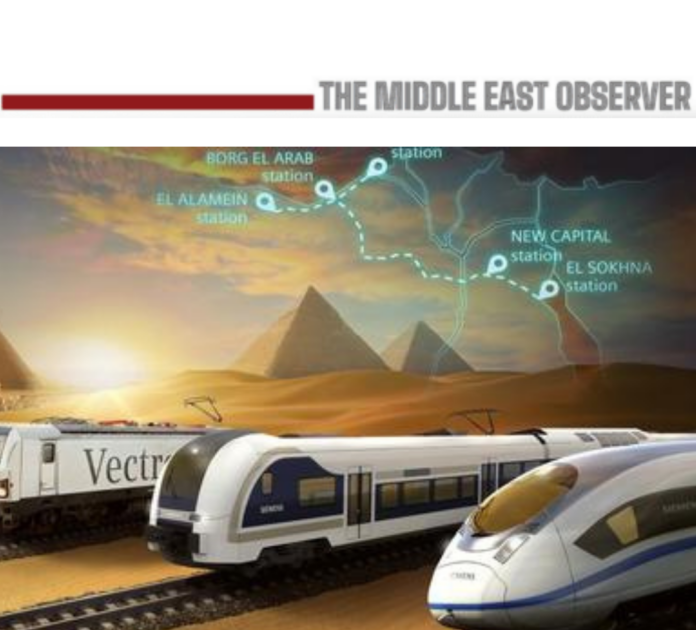
Passenger-free trials on part of Egypt’s 660-km Sokhna–Matrouh line are due to start in early October, shifting attention from construction progress towards operating readiness, pricing, passenger demand and freight economics.
Egypt plans to begin passenger-free trials on a section of its first high-speed electric railway in early October 2026, marking the start of a phased transition from construction into commissioning for one of the country’s largest transport projects.
Transport Minister Kamel El-Wazir said testing would begin on one section of the Ain Sokhna–Alamein–Matrouh corridor before being extended progressively across the line. Commercial passenger operations will follow only after technical and security requirements are completed, including remaining work on fencing, bridges and road crossings.
The timetable has slipped modestly. Officials had previously targeted September for the start of trials, while the latest schedule puts the first passenger-free sectional test in early October.
The economic case, however, extends beyond faster passenger journeys.
The 660-km first line links Ain Sokhna on the Red Sea with Greater Cairo, Alexandria, New Alamein and Matrouh, while a dedicated connection to Sokhna Port is intended to carry freight between the railway and one of Egypt’s major maritime gateways.
That gives the network a broader logistics role: connecting industrial areas and population centres with domestic markets and export ports while potentially shifting part of Egypt’s cargo traffic from roads onto electrified rail.
Siemens Mobility, working with Orascom Construction and Arab Contractors, is supplying 41 Velaro high-speed trains, 94 Desiro regional trains and 41 Vectron freight locomotives across the first three lines, alongside signalling, electrification and associated rail systems.
Siemens’ cumulative contract share is valued at €8.1 billion, but that figure represents its portion of the programme and should not be treated as the total cost of Egypt’s wider high-speed rail investment.
Operational preparations are also advancing. DB-ELSEWEDY ELECTRIC for Rail Operations began implementing its 15-year agreement to operate and maintain the network in April 2026, adding an important operational layer as the project moves beyond civil construction.
Egypt is developing three electric rail lines totalling about 2,000 kilometres, linking the Mediterranean and Red Sea corridors with Cairo and Upper Egypt. A proposed 250-kilometre Port Said–Alexandria line, planned with private-sector participation, would expand the network to roughly 2,250 kilometres.
The government expects the first three high-speed lines eventually to provide capacity for about 2.5 million passengers a day. Combined with conventional railways, which currently carry around 1.1-1.2 million passengers daily and are targeted to reach 1.5 million by 2030, officials project total rail passenger capacity of about 4 million passengers a day by the end of the decade.
That figure is a capacity target, not a ridership forecast.
Actual utilisation will depend on fares, train frequency, station accessibility, feeder transport and competition from private cars, coaches and domestic aviation.
Pricing will therefore be central to the demand equation. El-Wazir has said high-speed rail fares would be well below air travel and broadly comparable with travelling by private car or air-conditioned coach, although a detailed tariff schedule has not yet been published.
The freight case faces a similar test. The network’s economic value will depend not simply on track length, but on whether manufacturers, ports and logistics companies move meaningful cargo volumes onto rail.
A wider commercial question also remains unresolved. The government has not publicly presented a consolidated business case detailing expected passenger revenue, freight income, annual operating costs or the utilisation levels required for the system to recover its costs.
October is therefore an important milestone, but not the measure of success.
As Egypt’s high-speed railway enters phased commissioning, the focus will increasingly shift from kilometres built to reliability, pricing, passenger uptake, freight volumes and operating economics — the indicators that will determine whether the network translates its infrastructure scale into measurable economic gains.
Related news:
Etihad Rail Launches UAE Passenger Network, Reshaping Mobility and Economic Growth
Egypt’s New Cities: Can They Become Economies, Not Just Real Estate?
Read also:
Telecom Egypt, City Edge Expand Fibre Services Across New Alamein Flagships
“Egypt Estimates EGP 1.3 Million Cost for Residential Rooftop Solar Station”