
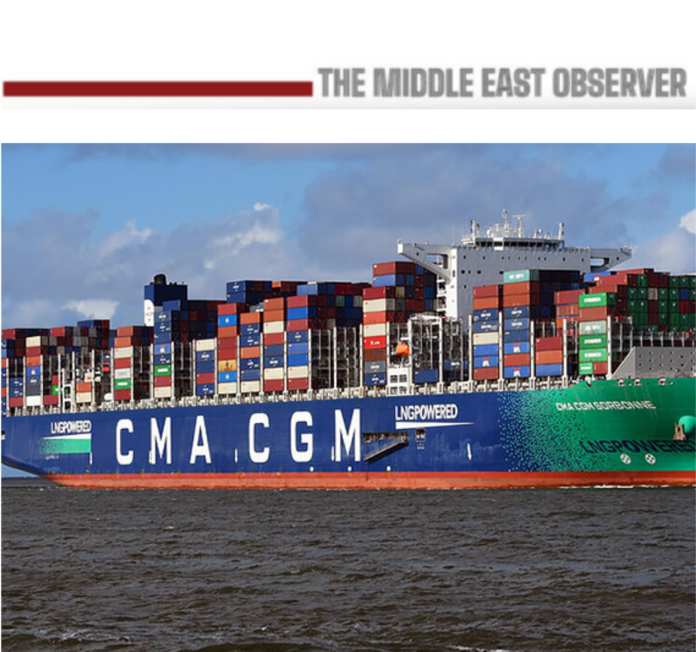
French shipping giant CMA CGM plans to expand its use of the Suez Canal, adding to evidence that major container carriers are gradually returning to the waterway after more than two years of disruption in the Red Sea.
The group told the Suez Canal Authority (SCA) that it intends to accelerate the return of vessels, expand shipping services through the canal and increase the number of vessels deployed on its services. The announcement followed talks on August 18 between SCA Chairman Osama Rabie and Christine Cabau, CMA CGM’s executive vice-president for assets and operations.
CMA CGM’s traffic figures show a marked increase. Some 199 of its vessels have transited Suez since the start of 2026, representing 25.2mn tonnes of Suez Canal net tonnage, compared with 212 vessels and 18.8mn tonnes during all of 2025.
The group has therefore generated about 34% more net tonnage so far this year than during the whole of 2025 despite fewer transits.
The recovery has been uneven. CMA CGM began cautiously restoring some Suez sailings after carriers diverted ships around the Cape of Good Hope in response to Houthi attacks on Red Sea shipping. It subsequently rerouted services as geopolitical risks increased, before suspending Suez passages more broadly at the end of February as the widening regional conflict sharply increased security risks.
Other major carriers are also returning. Maersk and Hapag-Lloyd have progressively restored selected Suez services, while Maersk said on August 13 that about one-third of its normal canal or Red Sea traffic was again using the route, covering four of 13 services. Chief executive Vincent Clerc said conditions for a full return during 2026 were in place, but the company was proceeding gradually to avoid adding pressure to already congested terminals.
For Egypt, sustained traffic recovery would help rebuild one of its major sources of foreign currency. Suez Canal revenues reached $4.67bn in FY 2025/26, up 23% year on year, according to Rabie. The recovery remains partial: receipts were still roughly half the record $9.4bn generated in FY 2022/23, before the Red Sea shipping disruptions that began in late 2023.
A broader return to Suez would shorten voyages and release vessel capacity, potentially reducing logistics costs. However, port congestion and strong container demand continue to support freight rates, with Maersk identifying infrastructure bottlenecks rather than Middle East disruption as the principal driver of recent rate increases.
The key test is whether carriers move from selected sailings to restoring scheduled services through Suez at scale. That will depend primarily on whether security conditions in the Red Sea and wider region remain stable.
Related news:
Egypt Advances Integrated Ports and High-Speed Rail Strategy to Strengthen Regional Trade
Egypt Revises Suez Canal Transit Surcharges Across Major Vessel Classes
Read also:
Beyond Hotel Rooms: MENA’s Tourism Race Shifts to Visitor Value
Egypt Tightens SIM Controls as Court Case Sparks Nationwide Telecom Scrutiny