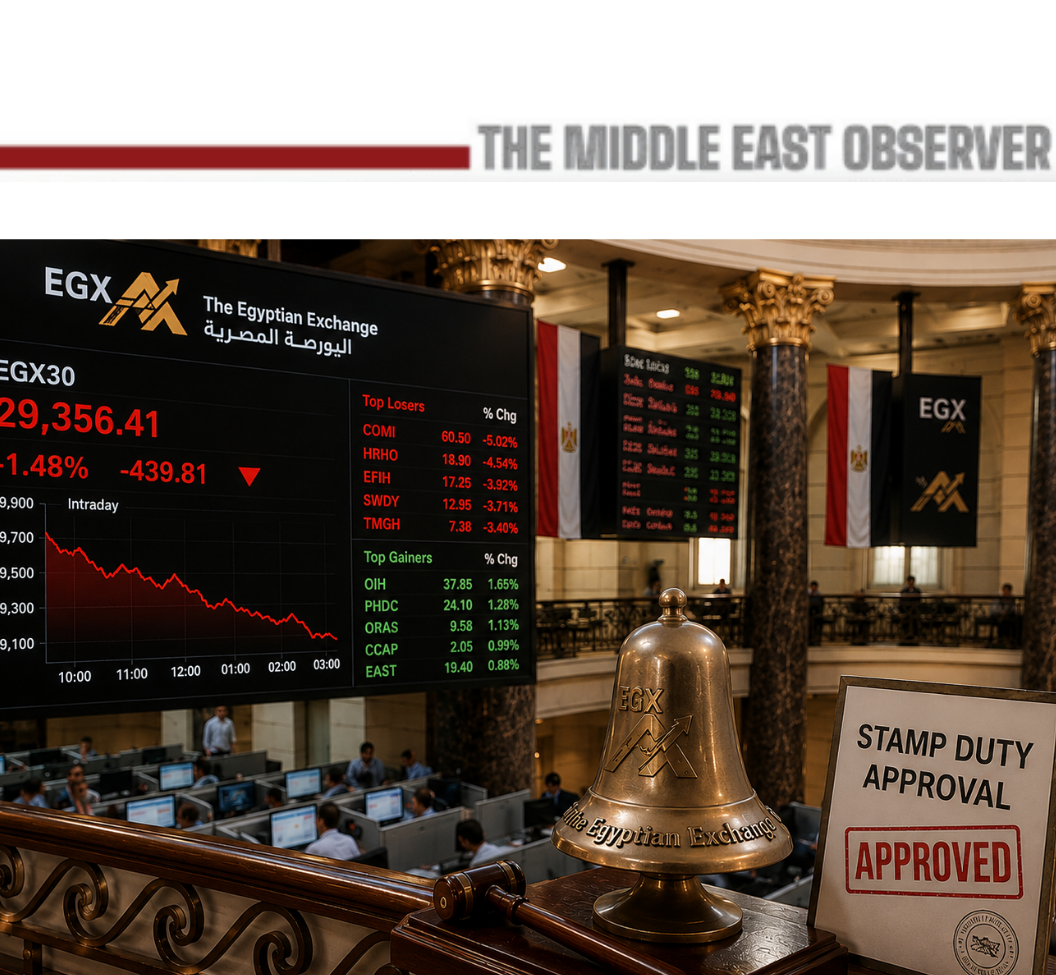
Egyptian equities produced their strongest evidence yet that the correction is entering a stabilization phase on Wednesday: the EGX30 plunged below 51,000 intraday before recovering almost 900 points, while small- and mid-cap stocks reversed into gains and foreign investors returned decisively to the buy side. The benchmark still closed lower — making this capitulation-and-recovery, not yet a reversal.
CAIRO — The Egyptian Exchange ended September with an unusually important divergence on Wednesday: the blue-chip benchmark remained under pressure, but the broader market finally broke away from it.
The EGX30 fell 0.77% to 51,894 points, extending its decline from Tuesday’s 52,297. In contrast, the EGX70 EWI rose 1.11% and the EGX100 EWI gained 0.64% — the first convincing separation of broader-market performance from the benchmark during the latest phase of the correction.
That divergence matters more than the EGX30’s closing loss.
Below 51,000 — Then a 900-Point Recovery
Wednesday initially looked considerably worse.
The EGX30 fell 2.52% to 50,981 around midday, breaking below 51,000. At that point the EGX70 was down 2.33%, EGX100 had lost 2.42%, and 180 stocks were declining against only 23 advancing. Trading value had reached EGP4.59bn.
The market then changed direction sharply.
By the close, EGX30 had recovered approximately 913 points from that intraday reading to 51,894. More significantly, EGX70 moved from a 2.33% intraday loss to a 1.11% closing gain, while EGX100 reversed from minus 2.42% to plus 0.64%.
This is materially different from Tuesday’s failed rebound.
Tuesday began positively but surrendered its gains into the close. Wednesday did the opposite: the market absorbed a severe sell-off and strengthened into the closing phase.
That is the most important development of the session.
Foreign Buyers Return After Tuesday’s Retreat
Investor flows reinforced the reversal.
Foreign investors recorded EGP412mn of net equity purchases, while Arab investors bought a net EGP34.9mn. Egyptian investors were net sellers of EGP446.9mn.
The foreign shift is particularly important.
Foreign institutions had been substantial buyers on Monday before foreign investors turned modest net sellers on Tuesday. Wednesday’s EGP412mn return to net foreign buying therefore restores one of the more constructive signals seen during the correction.
It does not establish sustained foreign accumulation. But the combination of foreign buying, an intraday recovery and broader-market outperformance is materially stronger than any one of those signals in isolation.
Reliable closing sources reviewed for this report did not yet provide a sufficiently granular institutional-versus-retail breakdown for Wednesday. It is therefore not inferred.
Small Caps Deliver the Signal the Market Needed
The EGX70 provides perhaps the clearest evidence that the character of the correction is changing.
On Monday it plunged 2.89% as the EGX30 lost 1.06%. On Tuesday its decline narrowed to 0.51%, while EGX30 fell 0.33%. Wednesday then produced the first outright divergence: EGX70 +1.11% against EGX30 −0.77%.
The sequence is significant:
Monday: broad liquidation.
Tuesday: selling pressure narrows.
Wednesday: broader market reverses higher despite another EGX30 loss.
That is a much stronger stabilisation pattern than simply observing that the benchmark’s rate of decline has slowed.
It also weakens the previous 53,000 recovery test as the only relevant signal. Wednesday established a new downside reference when EGX30 briefly broke 51,000, but the forceful recovery suggests that buyers are prepared to defend substantially lower prices.
FX Remains Orderly; High Carry Still Competes With Equities
The currency market did not replicate the violence in equities. The dollar was quoted around EGP52.06 buying and EGP52.19 selling at the CBE, broadly around Tuesday’s EGP52 level.
That relative FX stability remains important. It suggests the equity correction has not developed into a simultaneous disorderly repricing of Egyptian financial assets.
The monetary hurdle nevertheless remains high. The Central Bank of Egypt kept its overnight deposit, lending and main-operation rates at 19%, 20% and 19.5%, respectively, at its Sept. 24 meeting. High domestic yields continue to impose a demanding opportunity cost on equity exposure.
A reliable Sept. 30 closing observation for the EGX Treasury Bond Index was not available from the sources reviewed, so no daily bond-index move is inferred.
Correction Gives Its Strongest Stabilisation Signal Yet
The EGX30 has now fallen from 55,371 on Sept. 20 to 51,894, a decline of roughly 6.3%.
Yet Wednesday materially altered the internal evidence.
The benchmark broke below 51,000 but recovered almost 900 points. Small- and mid-cap stocks moved from severe intraday losses to positive closes. Foreign investors returned with EGP412mn of net buying. And the broader EGX70 and EGX100 finally rose while the EGX30 remained negative.
This is not confirmation that the correction has ended. The EGX30 still produced another lower close and remains below the 53,000 area rejected earlier this week. Moreover, the opening sell-off demonstrated that downside volatility remains substantial.
But the sequence has changed.
Monday showed indiscriminate liquidation. Tuesday showed narrowing losses but a failed rebound. Wednesday showed capitulation followed by genuine intraday repair.
The next test is therefore more demanding than another positive opening. A credible reversal now requires the EGX30 to stop producing lower closes, broader-market strength to persist and foreign demand to survive beyond a single session.
For the first time in this correction, Wednesday supplied evidence not merely that selling is weakening, but that falling prices are attracting enough demand to reverse broad-market losses before the close.
Related news:
Gold Prices Ease in Egypt as Global Markets Stabilize
AFAQ Targets $146m Romeit Development as Aton Eyes 2028 Gold Start
Read also:
EGX Extends Recovery as Foreign Investors Rebuild Egyptian Positions
EGX rebounds as domestic buying lifts market after recent correction