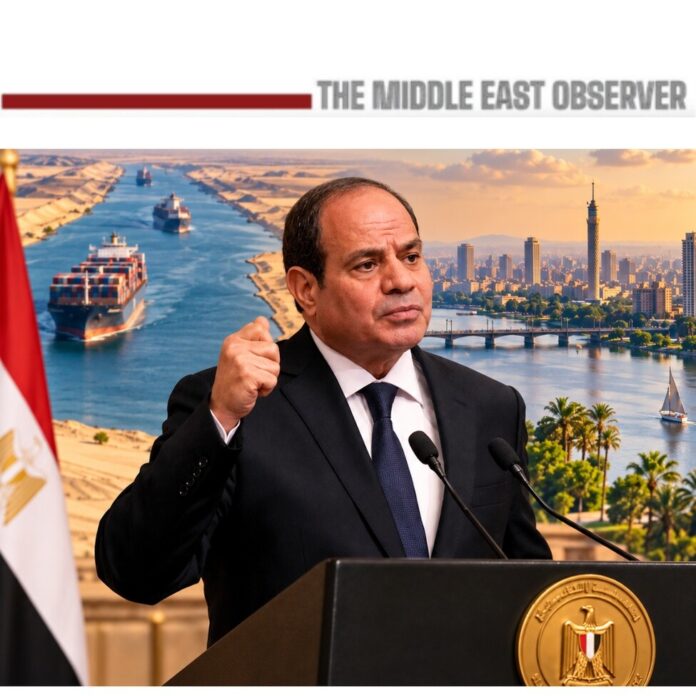
CAIRO — President Abdel-Fattah El-Sisi used a high-level policy meeting at the Strategic Command headquarters in Egypt’s New Capital on September 29 to frame Middle East instability increasingly as an economic-policy challenge, warning that regional conflict is eroding Suez Canal dollar revenues, raising energy and commodity costs and intensifying longer-term risks around maritime and Nile-water security.
Addressing the cabinet, governors, senior officials and security commanders, El-Sisi said the gathering aimed to assess mounting pressures on the state and strengthen coordination across government. He said Egypt had lost about $20 billion in Suez Canal revenues during recent years of regional instability, while higher oil and basic commodity prices were feeding directly into domestic prices. He also reaffirmed Egypt’s support for Gulf security and freedom of navigation through international waterways.
For Cairo, regional instability is therefore no longer principally a temporary foreign-policy problem. It has become a concurrent balance-of-payments and fiscal challenge, with conflict reducing hard-currency earnings while higher energy, freight and commodity costs widen Egypt’s external bill, intensify inflationary pressures and increase demands on public finances.
Oil Shock Adds to the Pressure
El-Sisi linked successive shocks since 2020—including Covid-19, the Russia-Ukraine war and the Gaza conflict—to mounting pressure on the Egyptian economy, arguing that the latest regional escalation had pushed petroleum and basic commodity prices higher.
His reference in fuller remarks to oil around $105-$110 a barrel broadly matched contemporary markets. Brent settled at $105.28 on September 28, although it subsequently retreated below $97 on October 1 as Gulf exports recovered—underlining both the severity and volatility of Egypt’s imported-energy exposure.
Nile Diplomacy, With a Strategic Limit
On Ethiopia’s dams, El-Sisi said Egypt would continue to give diplomacy and peaceful solutions room to work, but stressed that this would not be allowed to come at the expense of Egypt’s existence and its people. Cairo is simultaneously expanding desalination, water treatment and recycling to increase available resources.
The remarks did not announce a new military or operational policy. Rather, they restated Cairo’s existing dual position: negotiations remain the declared route, but Egypt continues to treat Nile-water security as a fundamental national interest.
Palestine, Gulf Security and the Domestic Front
El-Sisi reiterated Egypt’s rejection of Palestinian displacement and support for a two-state settlement, while describing Gulf security as integral to Egyptian national security. He reaffirmed support for the security and stability of Gulf states and for freedom of navigation through the Strait of Hormuz, Bab El-Mandeb and the Red Sea.
At home, he linked regional resilience to stronger institutions, public confidence and social cohesion, while warning against misinformation and stressing the need to prepare for the opportunities and risks of artificial intelligence.
He also called for better education capable of preparing younger generations for rapid technological change, including artificial intelligence.
The larger policy signal is that Egypt increasingly views regional security and economic management as inseparable. Cairo cannot control many of the conflicts surrounding it, but their costs now arrive directly through foreign-exchange earnings, energy imports, inflation, shipping and strategic resources—making resilience at home an increasingly important component of foreign policy.
Separately, the House of Representatives approved legislation delaying implementation of the new Criminal Procedure Law until October 1, 2027, after which President El-Sisi promulgated the amendment. Parliament cited incomplete institutional, technological and personnel readiness. The measure is separate from the regional-security themes of the presidential address.
Related news:
Water Innovation Becomes Agriculture’s New Competitive Advantage
Sudan Turns to Digital Procurement as War Erodes State Finances
Read also:
EGX Rebounds as Foreign Buying Reinforces Confidence in Egyptian Assets
Egypt, Saudi Arabia, Turkey & Pakistan Signal Push for New Regional Security Framework