Sudan has launched a national electronic procurement platform aimed at tightening control over public spending and increasing transparency in government contracting, as the war-hit country attempts to rebuild financial-management systems after a collapse in economic activity and state revenues.
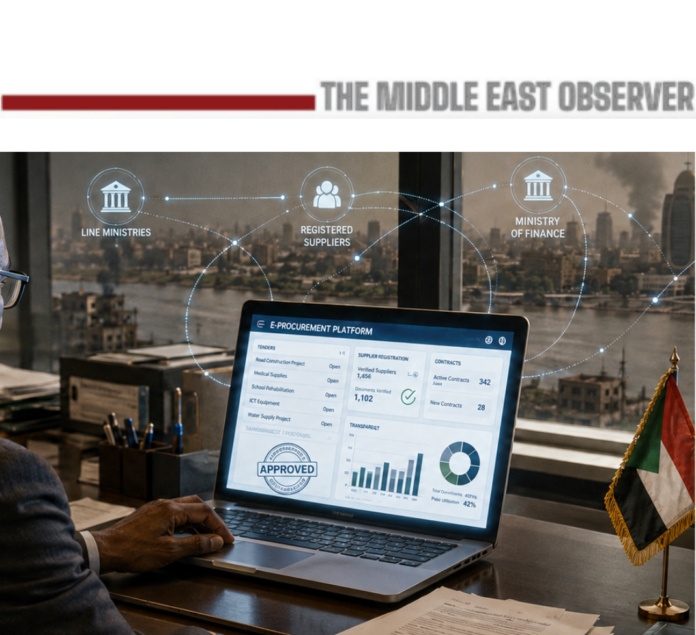
The Nazaha National Digital Public Procurement and Contracting System was launched on August 8 by Mohamed Nour Abdeldaim, Sudan’s Minister of State for Finance. The platform is designed to digitise and centralise government procurement procedures, including tendering and contract awards, while reducing reliance on paper-based administrative processes.
Sudanese authorities say the system is intended to improve the traceability of public transactions, widen businesses’ access to government tenders and encourage greater competition for state contracts. It forms part of a broader public-financial-management reform programme that includes budget reforms, moves towards a Treasury Single Account and wider digitisation of government financial operations.
The initiative comes as Sudan confronts a severe erosion of its fiscal capacity following more than three years of conflict between the Sudanese Armed Forces and the Rapid Support Forces.
The economy contracted by 29.4 per cent in 2023 after fighting erupted in April that year, followed by another decline of about 14 per cent in 2024, according to World Bank estimates. The conflict has disrupted production and trade, damaged infrastructure and weakened the government’s ability to collect revenue and provide public services.
The pressure on state finances has made tighter expenditure controls increasingly important. Government revenues fell sharply after the outbreak of the conflict, leaving authorities with fewer resources to meet spending requirements and increasing the importance of how public funds are allocated.
Nazaha is intended to address part of that challenge by creating a common digital framework for government entities and companies participating in public procurement. Earlier government reporting on the project said the system had been designed to cover the procurement cycle through a dedicated portal for government tenders and bids, while connecting public entities with suppliers and financial and national reporting systems.
Sudan’s General Administration for Procurement, Contracting and Disposal of Surplus, which operates under the Ministry of Finance, is responsible for supervising government procurement under the country’s 2010 procurement law. The authority identifies transparency, equal treatment of suppliers, economic efficiency and the development of electronic procurement systems among its principal objectives.
The transition is also consistent with wider government efforts to digitise public administration. Sudan has introduced electronic systems in several areas of state activity, while some public bodies already use electronic procurement procedures for individual tenders.
Nazaha could assume greater significance in any eventual reconstruction programme. Rebuilding damaged infrastructure and restoring public services would require substantial volumes of government contracting, increasing the need for systems capable of recording procurement decisions and providing greater visibility over how public resources are spent.
For now, however, the launch represents the beginning of the institutional test rather than evidence that the reform has achieved its objectives.
Publicly available information has yet to establish the timetable for nationwide deployment, the number of ministries and government agencies initially covered, or whether use of Nazaha will become mandatory across the public sector. Details also remain limited on supplier obligations, oversight arrangements and the extent to which tender and contract-award information will be publicly accessible.
Those questions will determine whether the system develops into an effective public-finance control rather than principally an administrative digitisation programme.
Nazaha’s effectiveness will ultimately depend on adoption across government, competitive access for suppliers, disclosure of procurement decisions and integration with Sudan’s wider financial-management architecture. Delivering those safeguards will be particularly challenging while conflict continues to constrain the state’s administrative and fiscal capacity.
Related news:
Sudan’s Gold Trade Shifts Toward Egypt Amid Regional Realignment
Sudan Turns to China to Modernise Red Sea Ports as Beijing Expands Strategic Maritime Presence
Read also:
Saudi, Omani Logistics Firms Sign Cross-Border Land Freight Deal
Egypt’s Handball Success Shows the Cost of Looking Only at Football