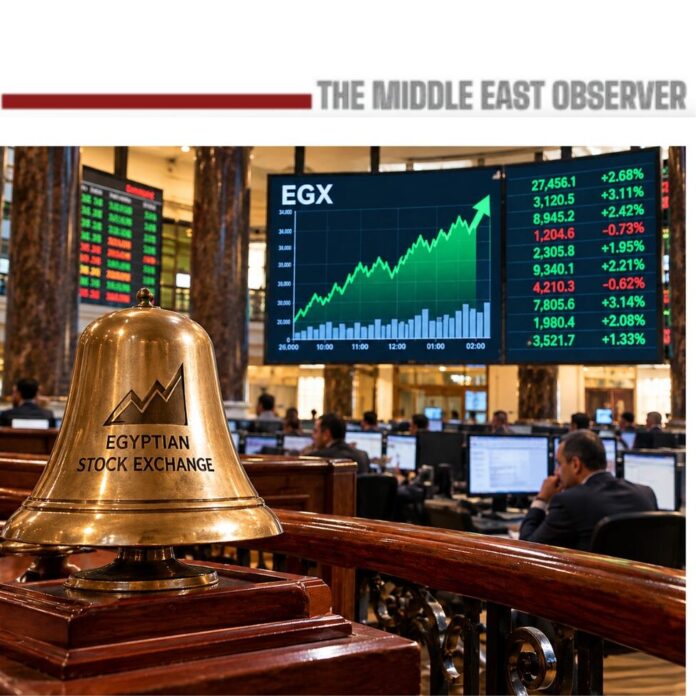
The Egyptian Exchange delivered its strongest reversal of the correction on Thursday, with the EGX30 reclaiming 53,000, small caps surging almost 4% and breadth turning overwhelmingly positive. But the rally carried an important qualification: Egyptian individuals drove the buying while institutions across Egyptian, Arab and foreign accounts were net sellers.
CAIRO — Egyptian equities shifted from stabilisation into an initial recovery phase on Thursday, Oct. 1, as a broad rally ended the EGX30’s nine-session losing streak and recovered a substantial part of the damage accumulated during the late-September correction.
The EGX30 jumped 2.24% to 53,055.03, while the EGX70 EWI surged 3.96% to 19,363.53 and the EGX100 EWI gained 3.55% to 25,655.63. Reuters independently confirmed that the benchmark’s 2.2% advance ended nine consecutive declining sessions.
The important development was not simply that prices rose. Thursday combined higher prices with dramatically stronger breadth and rising turnover — confirmation absent from the earlier rebound attempts.
Rebound Finally Holds
Thursday completed a three-session change in market behaviour.
Tuesday’s early rebound failed into the close. Wednesday’s severe intraday sell-off was absorbed, with the broader indices recovering into positive territory. Thursday finally converted that absorption into a broad closing advance.
The EGX30 also reclaimed 53,000, the area around which previous rebound attempts had failed. But at 53,055, the benchmark closed only narrowly above that threshold; its conversion from resistance into durable support remains unconfirmed.
The stronger evidence came from outside the blue-chip benchmark.
Breadth Confirms the Turn
198 stocks advanced against just 13 decliners, with 10 unchanged, according to Hapi’s closing data.
That compares with only 40 gainers against 175 decliners on Monday, when liquidation was at its most indiscriminate.
The shift is exceptional: the advance-to-decline ratio moved from roughly 0.23 on Monday to more than 15 on Thursday.
EGX70’s 3.96% advance, substantially exceeding the EGX30’s 2.24% gain, provides further confirmation. Small- and mid-cap stocks — the segment hit hardest during the correction — led rather than followed the rebound.
Equity trading value simultaneously increased to EGP9.357bn, involving 1.973bn shares through 256,826 transactions.
The combination matters: prices rose, participation broadened and liquidity increased simultaneously.
Market capitalisation consequently recovered approximately EGP129bn to EGP4.185tn, from EGP 4.056 tn Wednesday.
Retail Buys; Institutions Sell
The flow data provide the strongest reason for caution.
Egyptian investors recorded EGP318.5mn of net buying, but that figure was almost entirely attributable to individuals, who purchased a net EGP327.2mn. Egyptian institutions actually sold a net EGP 8.7mn.
Foreign investors sold EGP 225.7mn, including EGP 220.7mn of net selling by foreign institutions. Arab investors sold another EGP92.8mn, including EGP 74.3mn from institutions.
The conclusion is therefore more precise than simply describing Thursday as a domestically driven recovery.
The rebound was Egyptian-retail led, while institutions across all three nationality groups remained net sellers.
That distinction matters because it separates confirmation in price and breadth from confirmation in institutional positioning. Thursday supplied the former emphatically; it did not yet supply the latter.
Equities Rally Despite Renewed FX Pressure
The currency signal also requires attention.
CBE data showed the dollar’s average selling rate rising by about 43 piastres to EGP52.47 on Thursday, from EGP52.04 Wednesday, while the average buying rate increased to EGP 52.37.
Thursday’s equity rebound therefore occurred despite renewed pressure on the pound, rather than alongside currency stability.
That makes the equity move more notable, but it also adds another test for its durability. Continued FX weakening could raise inflation and valuation pressures if sustained.
The monetary environment remains restrictive. The Central Bank of Egypt held its overnight deposit rate at 19%, lending rate at 20% and main-operation and discount rates at 19.5% on Sept. 24. The CBE said policy remained sufficiently tight to support disinflation while warning that risks were tilted upward amid regional tensions and higher energy and food prices.
Recovery Confirmed; New Uptrend Is Not
Thursday materially changed the correction’s structure.
Monday: indiscriminate liquidation.
Tuesday: narrower losses, but a failed rebound.
Wednesday: deeper intraday selling successfully absorbed.
Thursday: broad recovery with stronger turnover and overwhelming positive breadth.
That progression is sufficient to move the market from stabilisation into an initial recovery phase.
It is not sufficient to establish a new uptrend.
The EGX30 has only narrowly reclaimed 53,000; the pound weakened Thursday; and, critically, institutional investors did not validate the rally with net buying.
Thursday changed the market’s direction, but not yet the quality of its sponsorship. Prices, breadth, turnover and market capitalisation delivered the strongest rebound signal of the correction; institutional flows did not. The next test is whether EGX30 can hold above 53,000 while institutional capital shifts from selling strength to participating in it.
Related news:
Market Modernisation Push Sends EGX Capitalisation Above EGP 3.29 Trillion
US Dollar Prices Reflect Local Liquidity Pressures Amid Global Strength
Read also:
EGX Rebound Fails at 53,000 as Foreign Institutions Turn Sellers
Egypt’s North Coast Gold Rush: Tourism Booms as Al-Jafira Joins the Investment Map