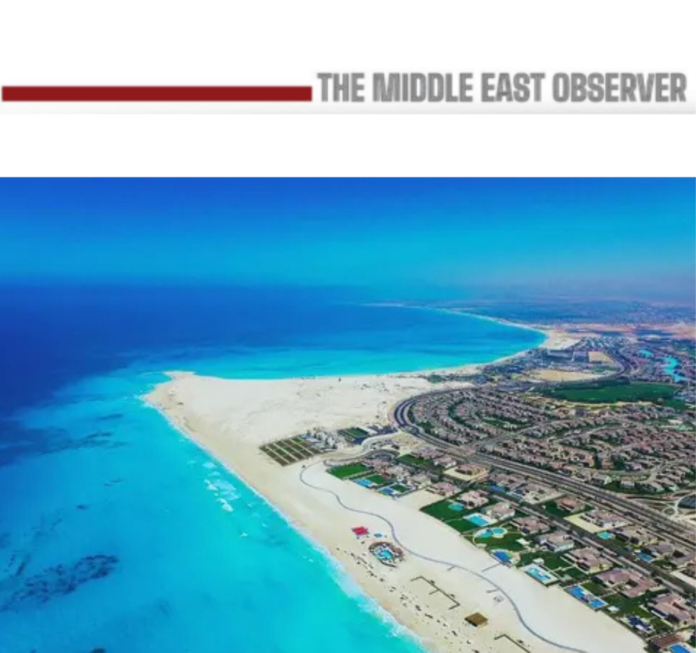
A prospective EGP135bn Emirati development at Al-Jafira follows Ras El-Hekma and Qatar’s Alam Al-Roum, as rising tourism, premium rents and billions of dollars of construction reshape Egypt’s Mediterranean coastline.
Egypt’s North Coast is experiencing a sharp acceleration in investment as rising tourism, Gulf capital and a pipeline of mega-projects transform a coastline long dominated by seasonal holiday homes.
Egypt received 6.1mn international visitors in the first four months of 2026, up 7 per cent from a year earlier, according to government figures. Tourism Minister Sherif Fathy has said the country could receive about 20mn visitors this year, as it works towards a longer-term target of 30mn annual arrivals by 2030.
Demand intensifies sharply along the Mediterranean during summer. Tourism-industry representatives have forecast hotel occupancy above 95 per cent in New Alamein and some North Coast destinations during July and August.
Short-term rental data point to similar pricing power at the premium end. AirROI puts average nightly rates across the North Coast at about $240, rising to roughly $353 in Marassi and $304 in Mountain View Ras El-Hekma.
The figures measure different segments and should not be confused with average hotel rates or year-round utilisation. But they illustrate the value concentrated in the coast’s premium summer market.
Behind that demand is a much larger construction cycle. New Alamein is expanding as a permanent city; Abu Dhabi-backed Ras El-Hekma is moving through its development programme; Talaat Moustafa Group is building SouthMED; and Qatar has launched the first phase of its $29.7bn Alam Al-Roum development.
Now another potentially large Gulf-backed project is taking shape at Al-Jafira.
Al-Jafira: another Emirati deal takes shape
An unidentified Emirati investor is in talks to develop about 642 feddans at Al-Jafira on the north-western coast in a transaction valued at roughly EGP135bn ($2.7bn), according to officials cited by Asharq Business with Bloomberg.
Under preliminary terms, the investor would pay for the land over six years while developing a tourism and hotel project. The proposed structure could give the Egyptian government 20-30 per cent of project revenues alongside an in-kind allocation of hotel units.
The investor has reportedly paid EGP100mn as a reservation deposit while government agencies complete legal procedures and negotiate final contracts. Officials expect an agreement could be reached before the end of 2026, although neither the investor nor the final terms have been disclosed.
Al-Jafira should therefore not yet be counted as completed foreign investment. Its reported valuation is nevertheless significant.
Officials familiar with the negotiations said the land’s value had risen sharply since 2023, partly because of nearby Ras El-Hekma, suggesting large developments are establishing new benchmarks for surrounding Mediterranean land.
Ras El-Hekma sets a new benchmark
A decisive shift came in February 2024 with Egypt’s agreement with Abu Dhabi investment company ADQ over Ras El-Hekma.
The transaction involved $24bn for development rights and the conversion of $11bn of existing UAE deposits into Egyptian investments, producing a $35bn package.
The foreign-currency inflow arrived during an acute dollar shortage and helped ease pressure on Egypt’s external finances ahead of a broader international stabilisation programme.
Abu Dhabi-listed Modon Holding was subsequently appointed master developer of the roughly 170mn sq metre site. Plans envisage an integrated city combining tourism, residential and commercial districts with hotels and supporting infrastructure.
Development preparations are progressing. In April, Prime Minister Mostafa Madbouly chaired a government review covering Ras El-Hekma and Shams El-Hekma, including land handovers and infrastructure requirements.
Ras El-Hekma demonstrated that Egypt’s Mediterranean coast could attract investment on a scale previously unseen in the market — and provided a benchmark for neighbouring development land.
Alam Al-Roum pushes investment farther west
Qatar has since extended that investment geography towards Marsa Matrouh.
Egypt and Qatari Diar signed an agreement in November 2025 to develop Alam Al-Roum across approximately 4,900 feddans, or 20.6mn sq metres, with projected investment of $29.7bn.
The agreement included a $3.5bn cash payment to Egypt, real estate worth about $1.8bn and a 15 per cent share of net profits after the developer recovers its investment costs.
On August 9, Qatari Diar launched the first phase in the presence of Prime Minister Madbouly. Covering about 4mn sq metres, it carries planned investment of EGP220bn and is targeted for completion by 2030.
The wider project envisages an integrated Mediterranean city incorporating hotels, housing, marinas, commercial and leisure facilities, education and healthcare.
Alam Al-Roum extends large-scale Gulf investment considerably farther towards Matrouh. Al-Jafira would add another substantial development to the emerging western North Coast corridor.
A coastline under construction
Gulf investors are not alone in committing capital.
Talaat Moustafa Group’s SouthMED covers about 23mn sq metres west of Alexandria and carries planned investment of approximately $21bn, combining residential property with hotels, retail, restaurants, golf and marina facilities.
New Alamein provides the principal state-led urban anchor. Extending across more than 49,000 feddans and 14km of coastline, the city was about 45 per cent developed by May 2026, according to the Housing Ministry.
It contained 28 residential towers, more than 46,000 housing units and about 2,000 hotel units, alongside universities and medical facilities. The government is also seeking greater utilisation of Alamein International Airport to strengthen international tourism links.
Such infrastructure is important because the investment proposition increasingly depends on more than selling holiday homes.
Beyond the summer peak
The concentration of demand remains both the North Coast’s strength and its central challenge.
Hotel occupancy forecast above 95 per cent in some destinations during July and August contrasts with substantially weaker activity outside the peak. AirROI, which tracks short-term rentals rather than hotels, puts average occupancy across the wider North Coast market at about 36 per cent over the year to June 2026 and identifies August as the strongest month.
The datasets are not directly comparable, but together they illustrate the coast’s pronounced seasonality.
Extending the economic calendar will require more hotels and direct international flights, alongside restaurants, marinas, entertainment and events. Universities, healthcare and permanent employment can also create reasons to live and work on the coast throughout the year.
The distinction matters. Residential sales generate revenue during development; tourism and hospitality can provide recurring employment and foreign-currency receipts long after properties have been sold.
The strategic opportunity is therefore to build a longer economic season around an already powerful summer market.
Reading the billions carefully
Headline project values are not equivalent to immediate foreign direct investment.
Alam Al-Roum’s $29.7bn represents projected investment across its development programme. The identified cash payment to Egypt was $3.5bn, supplemented by real estate and a future profit share.
Ras El-Hekma’s $35bn transaction comprised $24bn for development rights and the conversion of $11bn in existing UAE deposits.
SouthMED’s $21bn refers to projected investment, while its roughly $35bn figure represents anticipated sales rather than capital entering Egypt. Al-Jafira, meanwhile, remains a prospective EGP135bn transaction whose final valuation and terms have yet to be agreed.
Separating land proceeds, immediate capital inflows, development expenditure and projected sales is essential to assessing the economic scale of the North Coast expansion.
The test of a year-round economy
The scale of investment is now clear. Egyptian, Emirati and Qatari developers are pursuing projects covering tens of millions of square metres, supported by rising tourism and premium summer pricing.
Al-Jafira is the latest potential addition. Its significance is that a 642-feddan site can now command a reported valuation of EGP135bn in a market being reshaped by Ras El-Hekma, Alam Al-Roum, New Alamein and SouthMED.
Yet the success of this investment cycle will ultimately be measured by more than land prices and construction spending. Water and infrastructure capacity will have to keep pace, environmental pressures will require management, and international connectivity and hotel demand will need to extend beyond the peak months.
For now, the contrast is striking: selected destinations can approach full hotel occupancy and premium rentals can exceed $300 a night at the height of summer, while utilisation falls sharply outside the season.
Closing that gap may prove more consequential than the next record land transaction.
If new hotels, airports, marinas, businesses and permanent communities can keep more of the coast active for longer, Egypt’s North Coast gold rush could evolve from a property and construction cycle into something more durable: a Mediterranean tourism and investment economy.
Related news:
North Coast Fee Cuts Redefine Egypt’s Real Estate Investment Framework
Qatar’s $4bn North Coast Deal Sets Stage for a Gulf Riviera Across Egypt’s Northcoast
Read also:
Egypt Launches Saqqara Infrastructure Upgrade to Expand Cultural Tourism
Valu Partners with Wego to Offer Egyptian Travellers Installment Plans