From genomics and artificial intelligence to vertical farming and smart irrigation, precision technologies are helping Egypt use its most valuable resources more efficiently while creating new opportunities for higher-value healthcare, agriculture and food production.
Egypt’s long-term economic competitiveness may depend less on acquiring additional resources than on using existing ones with far greater precision. Across healthcare, agriculture and food manufacturing, a new generation of technologies is helping achieve exactly that.
Rather than relying on greater consumption of land, water or healthcare resources, precision technologies seek to maximise productivity, reduce waste and improve outcomes. For Egypt, where water scarcity, rapid population growth and rising healthcare demand present long-term structural challenges, these innovations are becoming not only scientific advances but also strategic economic assets capable of supporting sustainable growth.
Precision Healthcare: More Personalised, More Accurate
Medicine is steadily moving away from the traditional “one-size-fits-all” approach toward treatments tailored to each patient’s genetic, biological and clinical characteristics.
Egypt is laying important foundations for this transition through its national genomics programme. In April 2026, the Ministry of Higher Education and Scientific Research announced the results of the country’s largest whole-genome sequencing study, analysing 1,024 Egyptians from 21 governorates and identifying nearly 17 million previously unrecorded genetic variants. The project establishes Egypt’s first national genetic reference, supporting more accurate disease prediction, diagnosis and future development of precision medicine while reducing reliance on genetic models derived primarily from European populations.
Genomics represents only one pillar of precision healthcare.
Artificial intelligence is increasingly assisting physicians in interpreting medical images, identifying disease patterns and supporting clinical decision-making. AI-enabled radiology, digital pathology and predictive analytics are improving diagnostic speed while helping clinicians prioritise high-risk patients. Rather than replacing medical professionals, these systems function as decision-support tools that enhance clinical accuracy and operational efficiency.
Robotic-assisted surgery is introducing another layer of precision. By providing surgeons with enhanced visualisation, stability and dexterity during minimally invasive procedures, robotic systems can improve surgical precision while reducing blood loss, shortening hospital stays and accelerating patient recovery. Egypt continues to expand robotic surgery capabilities across leading public and private healthcare institutions as part of broader healthcare modernisation.
Healthcare is also extending beyond hospitals through digital therapeutics—clinically validated software-based interventions designed to prevent, manage or treat specific medical conditions. Unlike general health applications, digital therapeutics complement physicians by supporting chronic disease management, medication adherence and remote patient monitoring.
Digital Infrastructure Powers Precision
Behind many of these innovations lies an equally important technological foundation. Cloud computing, high-performance data infrastructure, advanced semiconductors and secure digital networks enable artificial intelligence, genomic analysis, connected medical devices and precision agriculture to operate at scale. Continued investment in digital infrastructure will therefore be as important as investment in the technologies themselves, ensuring that data can be collected, analysed and translated into faster, more informed decisions across multiple industries.
AI Becomes the Common Technology Platform
Artificial intelligence is increasingly becoming the common technology platform connecting healthcare, agriculture and food manufacturing.
In healthcare, AI supports diagnosis, clinical decision-making and personalised medicine. In agriculture, machine learning analyses satellite imagery, weather patterns and soil conditions to optimise irrigation schedules, predict disease outbreaks and improve crop management. Across food manufacturing, AI helps automate quality inspection, optimise production lines, predict equipment maintenance and reduce manufacturing waste.
Rather than replacing skilled professionals, AI is increasingly augmenting expertise by enabling faster, more consistent and better-informed decision-making throughout the value chain.
Smarter Agriculture: Producing More with Less
Agriculture faces a similar challenge: increasing production despite finite land and growing water scarcity.
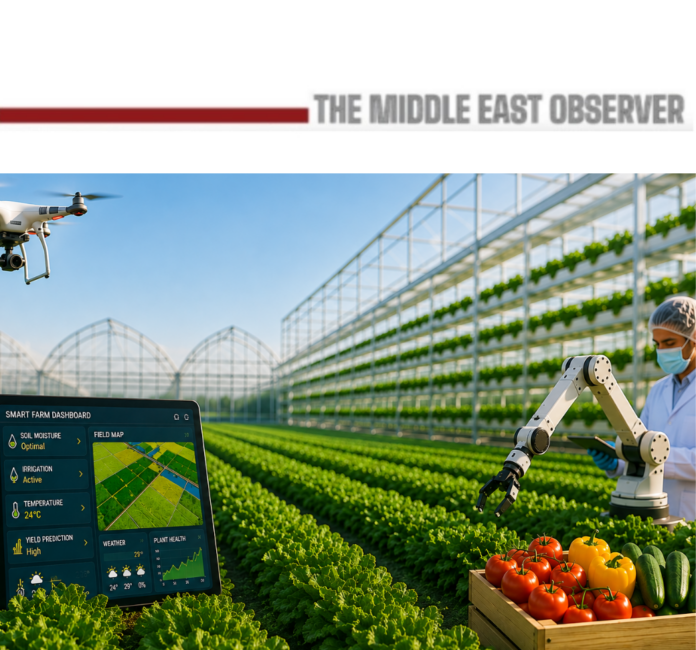
Vertical farming offers one solution by producing crops in stacked, climate-controlled environments that operate independently of traditional farmland. Combined with hydroponic or aeroponic systems, vertical farming can reduce water consumption by up to 90–95% for certain crops while enabling year-round production closer to urban consumers.
Egyptian agritech companies are increasingly experimenting with soilless cultivation systems designed to produce leafy vegetables, herbs and specialty crops using significantly less water than conventional farming.
Precision agriculture extends well beyond controlled environments.
Smart irrigation systems increasingly combine soil-moisture sensors, Internet of Things (IoT) devices, satellite imagery, weather forecasting and AI-driven analytics to deliver water only when and where crops require it. These technologies reduce evaporation, minimise fertiliser losses, improve yields and lower operating costs while making agriculture more resilient to climate variability.
In Upper Egypt, Food and Agriculture Organization (FAO)-supported programmes have promoted climate-smart agriculture, including modern irrigation systems and solar-powered irrigation projects in Qena. These initiatives demonstrate how technology can improve agricultural productivity while conserving one of Egypt’s most constrained natural resources: freshwater.
Food Technology: Creating More Value After Harvest
Innovation does not end once crops leave the field.
Food technology increasingly focuses on improving preservation, extending shelf life, enhancing nutritional value and converting agricultural raw materials into higher-value food products.
Modern food manufacturing now incorporates artificial intelligence, automated quality inspection, advanced packaging technologies and digital traceability systems that improve food safety while reducing production losses.
Emerging technologies such as precision fermentation, functional foods, nutraceutical ingredients and smart packaging are creating new opportunities for higher-value food manufacturing. Digital traceability systems based on IoT sensors and blockchain technologies are also helping producers verify product origin, quality and handling conditions—capabilities that are becoming increasingly important for meeting international export standards and strengthening Egypt’s competitiveness in premium food markets.
For Egypt, these advances matter because food security is no longer measured solely by agricultural output. It increasingly depends on reducing post-harvest losses, improving processing efficiency and creating products with greater nutritional and commercial value.
Innovation as an Economic Strategy
Although these technologies serve different sectors, they pursue the same objective: achieving greater productivity through precision rather than increased resource consumption.
Precision medicine enables more targeted healthcare. Artificial intelligence improves diagnosis and operational efficiency. Robotic surgery enhances complex procedures, while digital therapeutics extend care beyond hospitals. Vertical farming and smart irrigation help agriculture operate within land and water constraints, and advanced food technologies increase the value extracted from domestic agricultural production.
Collectively, these innovations can improve productivity, lower production costs, strengthen export competitiveness and attract investment into higher-value industries. They also support broader sustainability goals by reducing water consumption, minimising food waste, improving resource efficiency and, in many cases, lowering energy and carbon intensity across production systems.
Turning Technology into National Resilience
The challenge now lies not in demonstrating technological potential but in scaling adoption.
Investment in research and development, digital infrastructure, specialised talent, affordable energy, supportive regulation and public-private partnerships will determine how rapidly these innovations move from pilot projects to widespread commercial application.
In the coming decade, competitive advantage will depend less on the abundance of natural resources than on the efficiency with which countries deploy them. Precision technologies allow economies to generate more value from every unit of water, land, energy and healthcare investment.
For Egypt, these technologies offer an opportunity to deliver better healthcare, more efficient agriculture and higher-value food manufacturing without proportionally increasing resource consumption. As the country advances toward its Vision 2030 objectives, innovation is evolving from a technological upgrade into a strategic driver of productivity, industrial competitiveness, food security and long-term economic resilience.
Related news:
Egyptian Mineral Resources Company Reports Strong Profit Growth in FY 2024/25
Egypt’s FY2026/27 Budget Targets Lower Debt as Record Surplus Funds Service Expansion
Read also:
Egypt launches a smart project of agriculture land tenure
Simplex Invests $50mn in Egypt CNC Plant to Expand Manufacturing Capacity