
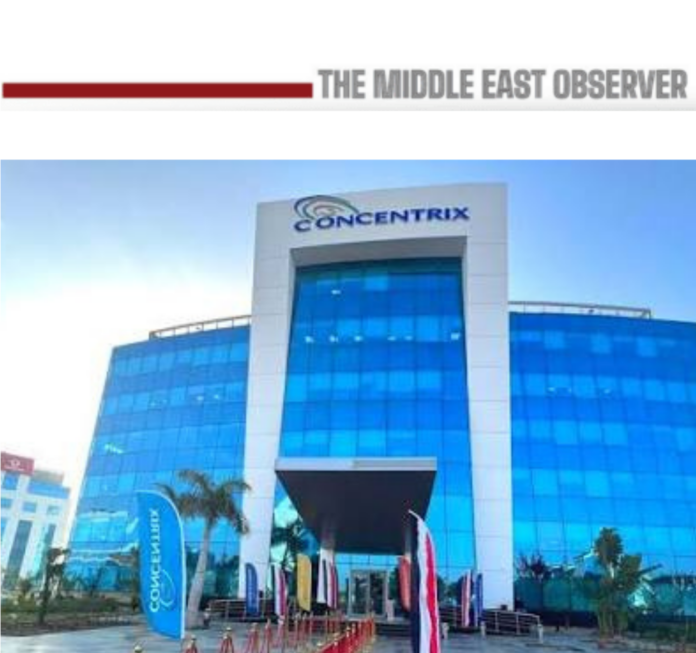
Concentrix is pushing ahead with a $1 billion expansion in Egypt that could take its workforce to 35,000 by 2028, providing a significant test of whether the country can turn its outsourcing scale into higher-value digital exports as artificial intelligence transforms the industry.
The US-listed customer-experience and technology services group now employs about 24,500 people across 13 centres in Egypt, up from more than 19,000 when it agreed a four-year expansion programme with Egypt’s Information Technology Industry Development Agency (ITIDA) in January 2025.
That agreement envisaged about $1 billion of investment and nearly 16,000 additional jobs, taking Concentrix’s Egyptian workforce to 35,000 by 2028. Based on its current headcount, roughly 10,500 further positions would be required to reach that target.
The expansion is particularly important for Egypt because Concentrix operates overwhelmingly as an exporter. Amr Sobhi, head of Concentrix Egypt, said during Prime Minister Mostafa Madbouly’s visit to its Alexandria operations that about 98.8% of revenues generated by the company’s Egyptian business are export-related.
That makes the investment part of a larger foreign-currency story. Egypt’s digital exports reached $4.8 billion in 2025, twice their 2022 level, according to ITIDA, as the country expanded its role as a delivery base for business-process services, IT, knowledge services and engineering research and development.
The sector is still expanding. ITIDA’s latest industry outlook points to more than 270 export delivery centres, while agreements reached with international and domestic companies are expected to generate more than 75,000 additional jobs.
AI Changes the Equation
Concentrix’s expansion also exposes the central tension confronting the outsourcing industry.
The company is adding thousands of employees while simultaneously integrating generative AI, automation and other digital technologies into its operations. AI is increasingly capable of handling parts of routine customer-service and back-office workflows, challenging an outsourcing model traditionally built around large pools of comparatively low-cost labour.
For Egypt, the response cannot simply be to compete on wages.
Its opportunity increasingly lies in shifting towards software development, engineering R&D, data services and AI-enabled business operations, where technical skills and productivity carry greater weight than labour costs alone.
Concentrix provides an early test of that transition. Its simultaneous investment in automation and people does not establish whether AI will ultimately create or eliminate outsourcing jobs. It does, however, suggest that the more immediate transformation could concern the composition and productivity of those jobs.
That distinction matters for Egypt. The economic prize is not merely employing more people in outsourced services, but generating more foreign-currency revenue and greater value from each worker as the industry becomes increasingly technology-intensive.
With almost all of Concentrix Egypt’s revenues linked to exports, its expansion offers an unusually clear measure of that challenge.
Reaching 35,000 employees would demonstrate Egypt’s ability to retain outsourcing scale. Moving those workers towards higher-value, AI-enabled services would demonstrate something more important: whether the country can convert its labour advantage into a sustainable digital-export advantage.
Related news:
MCIT Pushes Outsourcing Expansion as Concentrix Plans 35,000-Strong Egypt Workforce
MCIT Pushes AI-Driven Outsourcing Expansion as Foundever Scales Operations
Read also:
The New Mining Race Is About Control, Not Just Resources
Eni Plans 230-Well Egypt Campaign to Boost Oil and Gas Output