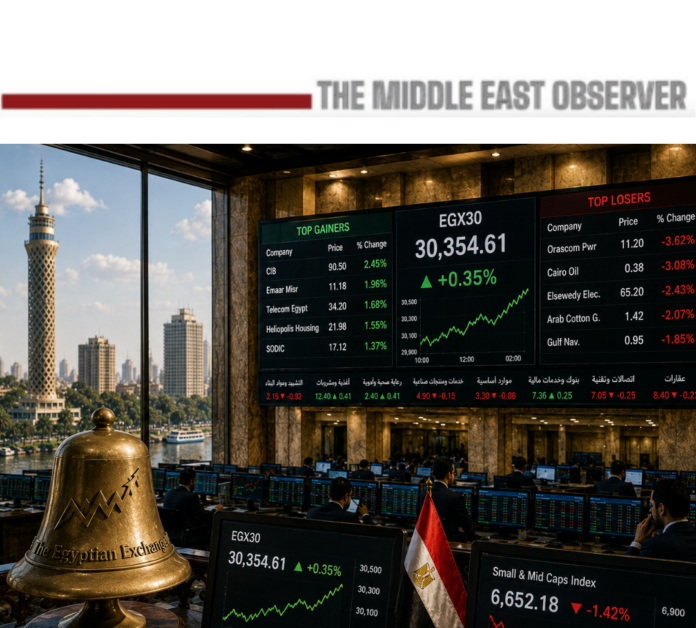
Egyptian blue-chip stocks edged higher on Tuesday, while smaller shares fell sharply for a second session and foreign investors remained net sellers, widening the gap beneath an EGX30 still trading close to record territory.
The EGX30 rose 0.20% to 55,277.03 points on August 25, recovering part of Monday’s 0.34% decline. The broader market was considerably weaker: the EGX70 fell 1.27% to 21,101.43, the EGX100 lost 0.94%, the EGX35-LV dropped 0.84% and the EGX33 Shariah index slipped 0.03%.
Market capitalization fell by about EGP3bn to EGP 4.272 tn, despite the benchmark’s advance.
The divergence has become the week’s clearest market signal. Across Monday and Tuesday, the EGX30 declined only about 0.14%, while the EGX70 lost roughly 2.4% and the EGX100 about 1.9%.
The figures suggest the rally has become increasingly selective: large-cap stocks are supporting the headline index while selling pressure is considerably stronger among smaller companies.
Foreign Flows Remain the Missing Piece
Tuesday also highlighted the market’s continuing reliance on domestic liquidity.
Published session data show Egyptian investors were net buyers of about EGP422mn, while non-Arab foreign investors recorded net sales of roughly EGP403mn and Arab investors about EGP19mn.
The previously circulated figures of EGP6.333bn for foreign investors, EGP3.448bn for Egyptians and EGP2.885bn for Arabs should not be classified as net flows. They conflict with the reported net nationality positions and appear to represent gross transaction values or another trading classification.
Domestic buying therefore offset foreign selling at the market level, even as international participation remained subdued.
That matters because the next stage of the rally will require more than domestic liquidity and further EGX30 records. A sustained improvement in foreign participation would provide stronger evidence that Egypt’s equity re-rating is broadening beyond locally driven demand.
S&P Decision Removes a Significant Risk
One structural uncertainty has meanwhile receded.
S&P Dow Jones Indices decided to retain Egypt’s Emerging Market classification after a consultation launched in June had considered moving the country to Frontier Market status. The proposed downgrade had raised concerns over market accessibility and capital mobility.
EGX chairman Omar Radwan said the decision reflected improvements in Egypt’s investment environment and the resilience of its capital market.
For investors, however, the significance should not be overstated. Keeping emerging-market status removes a potential source of benchmark disruption; it does not guarantee fresh foreign inflows. International allocations will continue to depend on currency convertibility, market liquidity, valuations and the depth of Egypt’s investable equity universe.
Telecom Egypt Adds an Index Catalyst
Telecom Egypt has also secured inclusion in the FTSE Emerging Markets Index after being promoted from Small Cap to Mid Cap in the FTSE Global Equity Index Series as part of the September 2026 semi-annual review.
The company’s market capitalisation has risen to about $3.9bn, while the FTSE Emerging Markets Index now contains three Egyptian companies, including Telecom Egypt.
The upgrade could increase index-linked demand and international visibility, but it should not be treated as a guarantee of new capital. Its broader importance is that another Egyptian stock has met FTSE requirements covering market capitalisation, liquidity, trading volumes and free float.
Short Selling Could Deepen the Market
The EGX is also preparing a revamped short-selling framework, another step towards expanding the instruments available to investors.
Its significance is not that it will necessarily lift valuations. Rather, an effective securities-borrowing and short-selling mechanism could improve price discovery, hedging and two-way liquidity — characteristics increasingly important to institutional investors.
Combined with prospective listings and greater representation in international indices, the reform could help deepen a market whose headline performance has run ahead of its breadth.
A Strong Index, but a Narrower Rally
The picture emerging from the week is therefore more nuanced than the EGX30 alone suggests.
Egypt has avoided an S&P Dow Jones downgrade, Telecom Egypt has gained FTSE Emerging Markets inclusion and market infrastructure continues to develop. These are meaningful improvements to the investment backdrop.
Trading conditions are less convincing. The EGX30 remains close to record territory, but the EGX70 and EGX100 have retreated considerably faster, market capitalisation slipped on Tuesday and foreign investors remained net sellers.
The next test is consequently not simply whether the EGX30 crosses another psychological threshold. Investors should watch whether smaller stocks stabilise, market breadth improves and foreign flows turn more supportive.
Egypt’s equity rally remains intact, but its next test is broader participation. Another EGX30 record would matter less than evidence that the rest of the market — and eventually foreign capital — is beginning to follow.
Related news:
Egypt Approves Fujairah-Alamein Oil Storage and Trading Free Zone
Egyptian Stocks Split as CIB Block Trade Clouds a Surge in Foreign Buying
Read also:
Africa Tops World Cup Continents with Record 90% Knockout Qualification Rate
Egyptian Stocks Split as CIB Block Trade Clouds a Surge in Foreign Buying