CAIRO — Egyptian equities delivered a divided session on Monday, with the benchmark retreating from Sunday’s record while smaller stocks advanced, continuing the rotation between blue-chip and broader-market leadership that has characterised August.
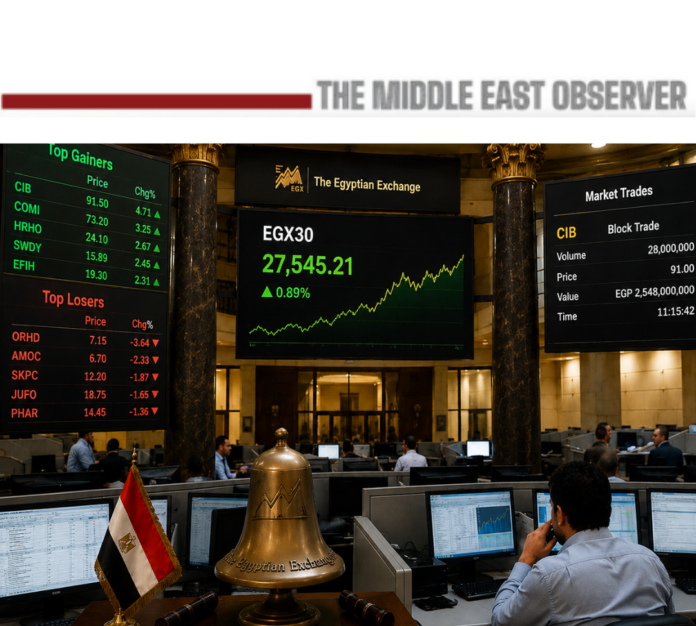
The EGX30 fell 0.79% on August 17 to 55,415.07 points, surrendering part of Sunday’s 1.09% advance to 55,854.74. The EGX33 Shariah Index declined 0.87% to 6,636.63, while the EGX35-LV slipped 0.24% to 6,882.03.
The broader market moved in the opposite direction. The EGX70 Equal Weight Index gained 0.63% to 21,771.03, while the EGX100 advanced 0.33% to 28,106.43. Market capitalisation eased about EGP22bn to EGP 4.288 tn, while trading value reached roughly EGP17.7bn.
The divergence points to profit-taking in selected large caps rather than a market-wide retreat. The EGX30 remains above its August 13 close of 55,251.59, while gains among smaller shares indicate that broader risk appetite has not disappeared.
CIB Block Trade Complicates Foreign-Flow Picture
Monday’s investor-flow figures were unusually large. Non-Arab foreign investors recorded net purchases of EGP13.27bn, while Egyptians and Arab investors were net sellers of EGP9.77bn and EGP3.50bn respectively.
The session also included a sizable block transaction in Commercial International Bank, Egypt’s largest listed lender and the EGX30’s most influential constituent.
A block trade involving 18.45mn CIB shares was executed at about EGP133.10 per share, valuing the transaction at approximately EGP2.46bn.
The transaction reinforces the need for caution when interpreting Monday’s nationality data. At EGP2.46bn, it represents only a fraction of the EGP13.27bn reported foreign net-buying figure, while the disclosed block-trade notice did not identify the buyer or seller. The broader foreign-flow number therefore cannot be attributed to the CIB transaction alone.
Large negotiated transactions can materially influence aggregate trading statistics without representing the same type of directional demand visible in ordinary screen trading. The appropriate conclusion is therefore that Monday recorded unusually large foreign net buying in a session containing significant transaction-specific activity, rather than evidence by itself of a sudden shift in foreign portfolio appetite.
Market Leadership Remains Fluid
Monday reversed Sunday’s large-cap dominance.
The EGX30 had risen 1.09% on Sunday against just 0.21% for the EGX70. A day later, the benchmark fell 0.79% while smaller stocks gained 0.63%.
The move does not establish another sustained rotation towards small caps, but it shows that liquidity below the EGX30 remains resilient after the powerful broader-market rally earlier in August.
Across the first two sessions of the week, the EGX30 remained about 0.3% higher, the EGX70 roughly 0.8% higher, and market capitalization approximately EGP52bn above Thursday’s level.
The market is therefore consolidating near recent highs rather than displaying a uniform reversal.
State Offerings Could Add Institutional Depth
The next structural catalyst could come from Egypt’s state-asset programme.
Misr Life Insurance and Banque du Caire remain among the prospective transactions as the government seeks to broaden private ownership and deepen the domestic capital market.
EFG Hermes has been appointed sole global coordinator and bookrunner for a planned offering of up to 20% of Misr Life Insurance on the EGX. The transaction is being prepared as part of the government’s broader state-asset programme.
Banque du Caire also remains among the prospective offerings, although timing and transaction structure remain critical variables.
Their significance extends beyond privatisation proceeds. With EGX capitalisation approaching EGP4.3tn, sizable offerings could increase free float, expand the pool of liquid institutional securities and provide new destinations for domestic and international capital.
But execution will determine their value to the market. Timing, valuation, free float and incremental investor demand matter more than the headline size of the privatisation programme. Successful offerings could deepen the exchange; poorly timed transactions could merely redistribute existing liquidity.
Qalaa Trims ASCOM Stake
Elsewhere, Qalaa Holdings reduced its stake in ASEC Company for Mining — ASCOM — to 50.76% from 51.06%, selling 150,000 shares at an average EGP65.38 for about EGP 9.81 mn.
The transaction leaves Qalaa firmly in control and is best viewed as a modest ownership adjustment rather than a change in corporate control.
From Recent Highs to a Test of Market Quality
Monday’s retreat does not materially change the broader August picture.
The EGX30 remains above its August 13 level, market capitalization is holding near EGP4.3tn, and smaller shares continue to attract liquidity even when the large-cap benchmark weakens.
Investors increasingly need to distinguish between earnings-driven repricing, broader-market momentum, transaction-specific flows and forthcoming index rebalancing. Monday demonstrated why those forces cannot be read interchangeably: the EGX30 declined while smaller stocks advanced, while unusually large foreign net purchases coincided with significant transaction activity.
The next test is whether Egypt can translate higher market values into deeper institutional liquidity, successful new offerings and a broader supply of investable companies — shifting the market’s development from price appreciation towards durable capital formation.
Related news:
Egypt to Launch Listings of Banque du Caire and Misr Life Insurance by Mid-2026
Egypt Pivots to Bank IPOs as Privatisation Drive Regains Momentum
Read also:
Egyptian startups secure $3.5mn as investors favour infrastructure
Egypt to Launch Listings of Banque du Caire and Misr Life Insurance by Mid-2026