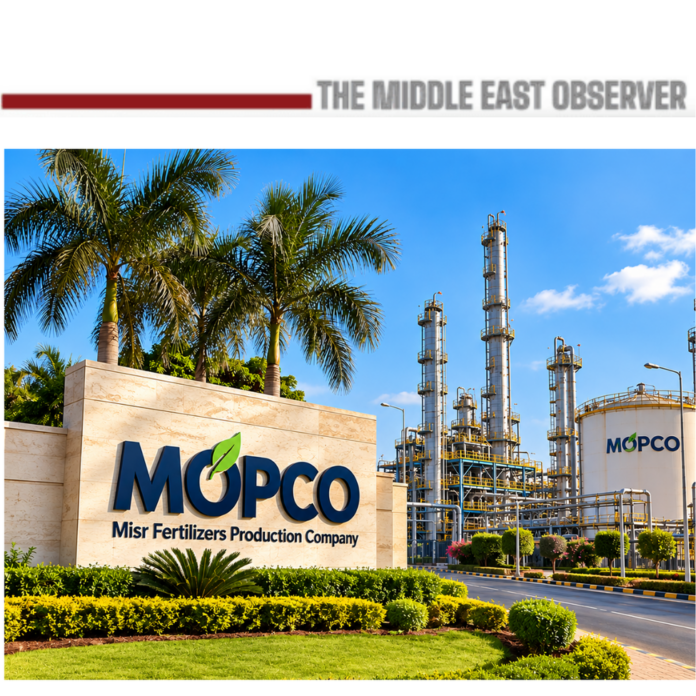
CAIRO — Misr Fertilizers Production Company (MOPCO) has exceeded 90% in the International Fertilizer Association’s Protect & Sustain assessment, earning the programme’s Product Steward Excellence level for its ammonia and urea operations.
The certification was issued by DNV Business Assurance B.V. – Belgium Branch on Sept. 28 and is valid until Sept. 27, 2029. MOPCO said it was the first company among those assessed to exceed 90%, a claim not independently confirmed by IFA.
What the Score Covers
Protect & Sustain assesses fertilizer producers across six areas: management systems, product development and planning, sourcing and contractor management, manufacturing, supply chain to customers, and marketing, sales and application.
The programme uses 100 process-related performance measures and independent certification bodies, including DNV and SGS. Product Steward Excellence requires more than 80% of applicable requirements to be met, putting MOPCO’s score more than 10 percentage points above the programme’s threshold.
MOPCO has not disclosed how its score was distributed across the six areas. Its existing ESG and TCFD disclosures include climate risks, carbon emissions and environmental management, but these reports do not show which factors drove the certification score.
A Europe-Heavy Export Business
The certification comes as MOPCO maintains a strongly Europe-oriented urea export business.
The company produced 1.718 million tonnes of urea in 2024 and exported 947,000 tonnes, while supplying 795,000 tonnes to the Egyptian market. Europe accounted for 89% of MOPCO’s urea exports that year. Annual urea production capacity stands at around 2 million tonnes.
That export profile gives product stewardship certification potential commercial relevance as European fertilizer trade faces tighter environmental reporting requirements.
The EU’s Carbon Border Adjustment Mechanism entered its definitive regime on Jan. 1, 2026 and covers fertilisers. However, Protect & Sustain certification is not proof of CBAM compliance: the IFA programme assesses product stewardship, while CBAM addresses embedded carbon emissions in covered imports.
Certification, Then Commercial Proof
For MOPCO, the immediate result is an independently issued certification and a score above 90%. The certificate can serve as documented evidence of product stewardship and supply-chain practices, but its commercial impact remains unproven.
It does not establish new contracts, higher export volumes or CBAM compliance.
With Europe accounting for 89% of MOPCO’s urea exports in 2024, the certification’s commercial value will ultimately depend on whether customers and supply-chain partners factor it into their assessments. The 18-month review will provide the next formal test of whether MOPCO can sustain the standards behind its 90%+ result.
Related news:
China’s Strategic Investment in Egypt: A $10 Billion Boost to Phosphate Fertilizer Industry
Egypt Opens Philippine Market to Five Agricultural Exports
Read also:
Aquaculture: Balancing the Benefits and Risks of Fish Farming
New Giza Project to Convert Waste into Biofuels and Fertilizers