CAIRO — Egypt’s new mining regime has drawn 403 investment offers from 119 companies for 118 exploration blocks, providing the first substantial market test of reforms intended to turn the country’s mineral potential into producing mines and a larger source of foreign investment.
The figures were disclosed Monday as President Abdel Fattah El-Sisi opened the fifth Egypt Mining Forum, being held September 28-29 at The St. Regis New Capital in Egypt’s New Administrative Capital. Hosted by the Ministry of Petroleum and Mineral Resources, the two-day gathering brings together miners, investors, financiers, regulators and technology companies as Cairo seeks to accelerate exploration across Egypt and the wider Arabian-Nubian Shield and lift mining’s contribution to the economy.
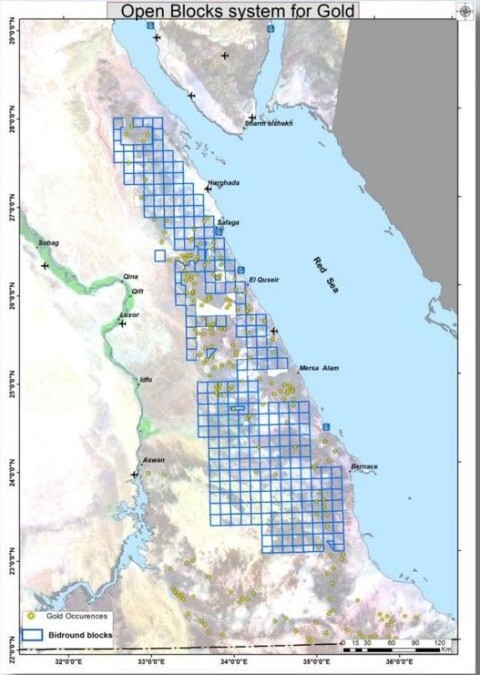
The mechanism behind that effort is a regulatory overhaul that includes a new Open Blocks system, a royalty-and-tax-based exploitation model, an expanded investor-support role for the Mineral Resources and Mining Industries Authority and plans for a digital mining platform giving companies greater access to available acreage and geological data.
Under Open Blocks, investors can pursue available areas throughout the year rather than waiting for periodic bidding rounds.
Petroleum and Mineral Resources Minister Karim Badawi said 119 companies, including 14 foreign firms, submitted 403 offers covering 118 blocks since the system was launched in July. The areas include prospects for gold, phosphate, talc and kaolin.
The response gives Egypt a measurable indicator of investor interest.
It does not yet establish that the reforms have succeeded.
The harder test is conversion: whether applications become licences, licences lead to funded drilling programmes, and exploration ultimately produces commercially viable mines.
Open Blocks Put Reform to the Test
Egypt has long promoted the mineral potential of its Eastern Desert and its position within the Arabian-Nubian Shield, a geological belt extending across northeast Africa and the Arabian Peninsula.
The government says Egypt has about 100,000 square kilometres of exposed Precambrian basement rock across the Eastern Desert and southern Sinai, with potential for gold, copper, base metals, nickel, cobalt, platinum-group elements, rare metals and rare-earth elements.
But geological potential alone does not create a mining industry. Exploration capital tends to follow predictable fiscal terms, accessible geological information, workable licensing procedures and confidence that discoveries can progress through permitting and development.
Egypt’s latest reforms are aimed squarely at those constraints.
Badawi said the government has introduced a new exploitation model based on royalties and taxes, strengthened the Mineral Resources and Mining Industries Authority and moved towards a one-stop-shop model intended to coordinate government approvals more efficiently.
Incentives have also been designed to attract junior and mid-tier exploration companies, which frequently undertake the higher-risk early exploration that precedes major discoveries.
The Open Blocks system changes the timing of access to acreage. Instead of companies having to wait for a government tender cycle, qualifying mineral areas can remain continuously available for assessment and application.
That matters because mining exploration moves differently from oil and gas development: companies frequently need to assemble geological positions, raise risk capital and prioritise drilling programmes across several jurisdictions.
The 403 submissions covering 118 blocks therefore represent an encouraging initial response. But applications themselves carry limited economic value until companies commit money to geological surveys, drilling and project development — a process that can take years and in which many prospects never become mines.
AngloGold Looks Beyond Sukari
The second important signal from the opening day came from AngloGold Ashanti, operator of the Sukari gold mine and already one of the most significant foreign investors in Egypt’s mining industry.
El-Sisi met AngloGold Chief Executive Alberto Calderon on the sidelines of the forum, with discussions covering an expansion of cooperation beyond Sukari into additional exploration, technology and expertise transfer, workforce training, local supply chains and new investment.
According to the Presidency, Calderon described Egypt as a priority investment destination for the company and said AngloGold plans additional investment in promising Egyptian locations, while the two sides discussed expanding gold-exploration programmes.
No investment value, timetable or new concession was announced, meaning the discussions should be regarded as an expansion signal rather than a newly signed investment deal.
Even so, AngloGold’s appetite for further exploration carries particular weight.
Unlike a prospective entrant assessing Egypt from outside, the company already operates the country’s flagship producing gold asset and therefore has first-hand experience of its geology, operating environment, infrastructure and regulatory system.
Sukari provides the benchmark against which Egypt’s wider mining strategy is likely to be judged.
Badawi said the mine had produced about 6.8 million ounces of gold since production began in June 2009. The government now wants the success of one major asset to become evidence for a broader exploration industry rather than remain an exceptional case.
El-Sisi told forum participants that the state would support companies investing in mining and other sectors. He later toured the exhibition, including the Ministry of Petroleum and Mineral Resources, Capital Drilling, Elsewedy Electric and AngloGold Ashanti pavilions.
From Extraction to Processing
Cairo’s strategy extends beyond discovering additional deposits.
The government is also trying to capture more value domestically through mineral processing and downstream industry rather than relying primarily on exports of unprocessed commodities.
Badawi said eight new value-added projects are being developed. Among the largest is the first phase of the Abu Tartour phosphoric-acid complex, planned with production capacity of about 250,000 tonnes a year, investment of up to $650 million, and targeted production from 2028.
The industrial component is important to the government’s broader mining proposition. Successful exploration would increase mineral output, but domestic refining and processing could potentially generate a larger manufacturing footprint, supply-chain activity and export value.
The forum itself reflects that wider approach. Organisers expect more than 6,000 attendees from over 50 countries, alongside more than 100 exhibiting companies, with sessions covering regulation, finance, exploration, technology and project development.
Its stated theme — unlocking the exploration potential of Egypt and the Arabian-Nubian Shield — comes as the government aims ultimately to increase mining’s contribution to 6% of GDP.
That target remains ambitious.
The more immediate question is whether regulatory changes can build a sufficiently deep pipeline of exploration projects from which future mines can emerge.
Interest Must Now Become Capital
The opening day therefore produced something more useful than another statement about Egypt’s mineral wealth: an initial measure of how companies are responding to the new system.
403 offers.
119 companies.
14 foreign participants.
118 exploration blocks.
Those numbers show interest.
They do not yet show investment at scale.
The indicators that matter next will be the number of blocks successfully awarded, the financial and work commitments attached to those awards, the speed with which companies obtain permits, the amount of exploration capital deployed and, ultimately, drilling results.
AngloGold’s willingness to consider investment beyond Sukari adds a potentially important vote of confidence from an operator already exposed to the Egyptian market. But here too, future spending and exploration programmes will matter more than statements of intent.
For Egypt, the fifth Mining Forum therefore marks a transition in the argument for the sector.
The question is no longer simply whether the country has promising geology. The Arabian-Nubian Shield, Sukari and decades of geological work have already made that case.
The question now is whether Egypt has created an investment framework capable of repeatedly converting that geology into commercial projects.
Related news:
Egypt Gold Holds Firm as Eastern Desert Exploration Expands
Egypt Targets 2026 Gold Output from Abu Marawat Mine
Read also:
Qatar’s LNG Wealth Delivered World-Class Living Standards. Now Comes the Productivity Test
Ghana’s Fantasy Coffins Turn Funeral Craft Into a Global Art Business