Telecom Egypt’s 5-Pbps Sharm El-Sheikh–Taba cable is turning Sinai into an eastern gateway linking Gulf and Levant networks to Egypt’s Europe-facing backbone — just as regional rivals race to build routes that could bypass it
Egypt is expanding the geography of its international data business, with a new submarine cable through Sinai set to connect emerging Saudi- and Jordan-facing gateways more directly with the country’s established routes towards Europe.
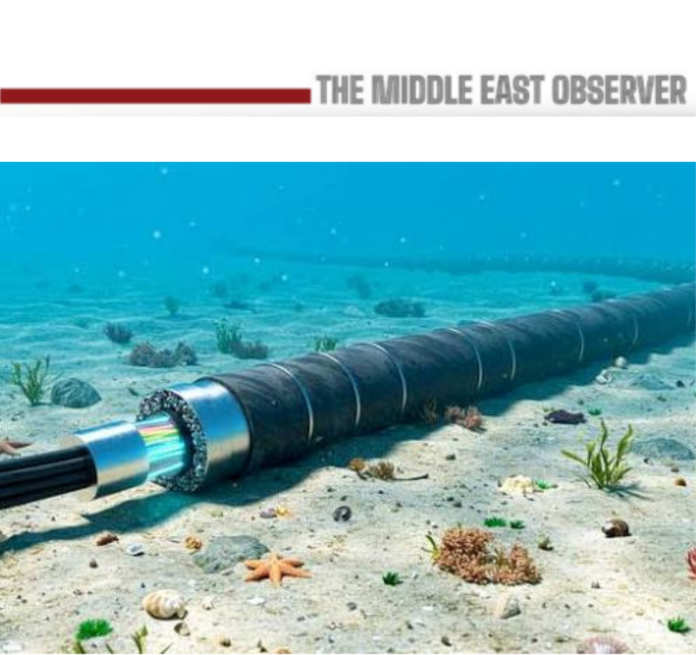
Telecom Egypt has signed an agreement with Greek marine contractor Power Sub Link S.A. (PSL) to build an approximately 200-kilometre submarine cable between Sharm El-Sheikh and Taba, with design capacity of about 5 petabits per second and a targeted service date in the fourth quarter of 2027.
The project’s significance lies less in its length than in its position.
The cable will extend Telecom Egypt’s Red Sea subsea infrastructure towards Taba and provide another link into terrestrial routes running from the Red Sea towards Mediterranean landing points. Telecom Egypt presents the development as part of its Eastern Digital Corridor. In economic terms, it is creating what can increasingly be viewed as a second geographic layer to Egypt’s traditional Suez-centred international data architecture.
That could strengthen Egypt’s role in one of the world’s most consequential digital transit zones — but also comes as competitors across the Middle East accelerate efforts to find alternatives to it.
Sinai becomes a regional junction
Taba is already moving beyond its previous role as a peripheral landing location.
Telecom Egypt and Jordan’s NaiTel established Coral Bridge, a roughly 15-kilometre submarine link between Taba and Aqaba equipped with 48 fibre pairs and more than 1 Pbps of design capacity. Telecom Egypt describes Taba as part of its broader new international infrastructure in Sinai and has positioned the connection as a route serving enterprises, hyperscalers and international data traffic between the Middle East and Europe.
Sharm El-Sheikh is developing in the opposite direction.
Telecom Egypt and Saudi operator Mobily agreed to land a Saudi-owned submarine cable between Duba and Sharm El-Sheikh, with Mobily explicitly saying the system would connect Saudi Arabia, Gulf markets and neighbouring countries into Egyptian infrastructure and provide onward connectivity towards Europe.
The emerging geography is therefore significant:
Saudi Arabia → Sharm El-Sheikh → Taba → Jordan, with connections through Egypt towards Mediterranean networks and Europe.
These are separate infrastructure projects, not a single commercially integrated cable system. But their combination gives Telecom Egypt the ability to build a more interconnected network around Sinai rather than relying predominantly on the conventional north-south flow between the Red Sea, Suez and Mediterranean.
That changes the strategic function of the peninsula. Sinai is moving from the edge of Egypt’s cable map towards becoming an interchange between Egyptian, Gulf and Levantine networks.
Why the world should care
Submarine cables carry more than 99% of international data flows, underpinning cloud computing, financial transactions, government communications and the wider digital economy. Global investment in them rose from about $800 million in 2015 to $9.7 billion in 2025, while international bandwidth demand has continued to accelerate.
That makes Egypt’s geography important well beyond its domestic telecom market.
The Red Sea–Mediterranean axis sits between major European and Asian networks, while repeated cable disruptions and geopolitical tensions have pushed governments, carriers and hyperscalers to place greater value on physical route diversity rather than capacity alone.
Europe is already treating the region as a strategic connectivity issue.
A European Commission expert-group report published this year designated the Trans-Mediterranean, Red Sea and Indian Ocean as a priority region for additional cable capacity. Its proposed architecture includes routes from mainland Europe landing in Egypt before crossing towards the Arabian Sea through Jordan, Saudi Arabia and Oman or the UAE, with the aim of creating greater resilience between Europe and Asia and reducing dependence on vulnerable maritime chokepoints.
The EU has separately allocated €347 million for 2026-27 towards strategic digital backbone projects, submarine cable resilience and repair capacity.
The Sharm–Taba project is not an announced EU-funded component of that programme, but its geography increasingly aligns with the same policy objective: widening the number of viable connections between Europe, Egypt, the Gulf and Asia.
That gives the Sinai build-out a global dimension.
The new cable does not itself bypass the Bab el-Mandeb Strait, nor does it eliminate Red Sea geopolitical risk. End-to-end exposure depends on where an international cable originates and the complete route it follows.
Its immediate value is more precise: it provides more ways to move traffic through Egypt once that traffic reaches the country’s network.
The commercial bet
For Telecom Egypt, this is also a foreign-currency infrastructure business.
The company earns from international connectivity through cable landings, capacity sales, terrestrial crossings and interconnection services — effectively the digital equivalent of transit infrastructure.
Management has explicitly described USD-linked international wholesale revenues as a natural hedge against currency volatility. In the first quarter of 2026, domestic infrastructure-service revenue rose 18% year-on-year, while Telecom Egypt continued to identify its international cables and wholesale operations as strategically important.
The broader company is also generating greater capacity to invest. First-half revenue reached EGP59.2 billion, up 17% year-on-year, while EBITDA rose 20% to EGP26.4 billion and free cash flow reached EGP10 billion.
Yet the financial case for Sharm–Taba cannot currently be quantified.
Telecom Egypt has not disclosed the project’s capex, financing structure, anchor customers, contracted capacity, expected pricing or anticipated return on investment. Cable-project revenues can also be lumpy: Telecom Egypt’s International Cables & Networks revenue fell 28% year-on-year in the first quarter, which the company attributed to the cyclical timing of projects.
That distinction matters. A 5-Pbps design specification demonstrates technological capacity; it does not guarantee utilisation or financial returns.
The commercial test will be how much international traffic Telecom Egypt can attract onto the new routes — and at what margins.
Competition moves both ways
That test is becoming more difficult because Egypt is no longer the region’s uncontested answer to Europe–Asia connectivity.
Saudi Arabia, Oman and other regional players are developing new submarine and terrestrial routes designed partly to reduce dependence on existing Red Sea and Egyptian crossings. The Blue-Raman architecture, for example, demonstrates that Europe–Asia connections can be designed to bypass Egypt, while Saudi-backed projects are exploring terrestrial paths through the Levant towards Europe.
The competitive threat is therefore real.
Unlike ships using the Suez Canal, digital traffic has no obligation to cross Egypt. Carriers and hyperscalers can choose different routes according to price, latency, security, redundancy and regulatory conditions.
This is where the Sinai strategy becomes particularly important.
Rather than simply attempting to preserve Egypt’s historical dominance over Europe–Asia transit, Telecom Egypt appears to be positioning its infrastructure so that new regional corridors can interconnect with Egypt even when they originate elsewhere.
Jordan can enter through Taba. Saudi Arabia can enter through Sharm El-Sheikh. Other systems can connect through Egypt’s Mediterranean and Red Sea landing points.
The objective is therefore shifting from controlling a route to controlling an interchange.
From choke point to network
For decades, Egypt’s digital advantage closely resembled its maritime one: geography placed it on one of the shortest routes between Asia and Europe.
That model is increasingly insufficient.
More cables, terrestrial corridors and regional data centres mean international traffic will have more alternatives. The strategic question is no longer whether competing routes will emerge — several already are.
It is whether Egypt can make itself valuable to those routes.
The Sharm–Taba cable is important because it widens the answer. By connecting Taba more deeply into Egypt’s Red Sea infrastructure while Sharm El-Sheikh develops links towards Saudi Arabia, Telecom Egypt is building a network capable of receiving traffic from more directions.
Egypt’s next digital advantage may therefore come not from remaining a chokepoint that global traffic has to cross, but from becoming the interchange where competing Middle Eastern corridors choose to meet.
If that strategy succeeds, Sinai will represent more than a second route across Egypt’s telecommunications map. It will become a key part of a wider contest to determine how the Gulf, Asia and Europe remain digitally connected — and who earns from carrying the traffic between them.
Related news:
A New $500mn Submarine Cable Plant Planned by Elsewedy West of Damietta
Egypt and Jordan Reconnect After 25 Years with New Submarine Cable
Read also:
The Missing Middle: Why Egypt’s Capital Markets Still Struggle to Fund Its Unicorns
Concentrix’s $1bn investment demonstrates Egypt’s ability to retain & grow outsourcing scale