
EGX30 rises 2.83%, 197 shares advance and the pound strengthens as foreign institutional purchases reach EGP339mn; turnover improves but remains below historical averages.
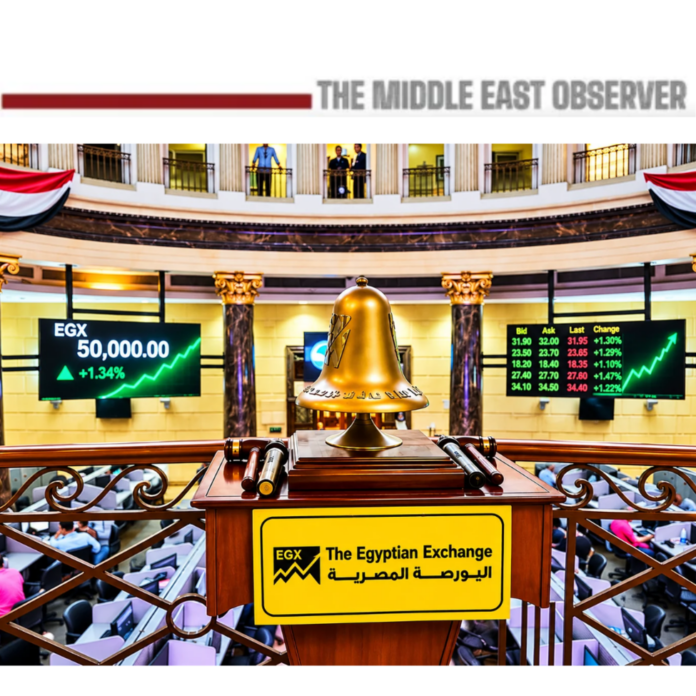
CAIRO, Egyptian stocks extended their recovery for a second consecutive session on Wednesday as foreign institutional net purchases more than doubled to EGP338.7 million, helping lift the benchmark EGX30 by 2.83% to 50,650.18 points. The advance brought 197 shares higher, added EGP99 billion to market capitalisation and coincided with further gains in the pound. Ordinary equity turnover also increased, although it remained below longer-term averages.
Recovery Broadens After October Sell-Off
The EGX70 small- and mid-cap index gained 3.02% to 17,151.55 points, while EGX100 advanced 2.98% to 23,011.03. The Shariah-compliant EGX33 and EGX35-LV each rose 2.49%.
Market breadth strengthened further, with 197 shares advancing against 16 decliners and 10 unchanged, compared with Tuesday’s 180 gainers and 29 losers.
The EGX30 traded between 49,481.62 and 50,650.18 points, closing at its session high. Its two-day recovery reached 4.6%, reversing Monday’s losses and lifting the benchmark above its October 29 closing level.
The advance follows a difficult October, when EGX30 lost 4.43%, EGX70 fell 9.91% and EGX100 declined 8.62%, according to the exchange’s monthly report.
Despite Wednesday’s gains, EGX30 remained approximately 4.2% below its October 21 level of 52,854.95 points.
Market capitalisation increased to EGP3.989 trillion. Comparisons with pre-November valuations require adjustment for Banque du Caire‘s recent listing, which introduced approximately EGP80.8 billion in listed equity value.
Foreign Institutions Lead as Liquidity Improves
Foreign institutional net purchases accelerated to EGP338.7 million from EGP136 million on Tuesday, an increase of approximately 149%.
Arab institutions also bought EGP63.5 million net, while Egyptian institutions sold EGP247.8 million, indicating a shift towards overseas institutional buying.
Across investor nationalities, foreigners purchased EGP336.6 million net and Arab investors EGP50.3 million, against Egyptian net sales of EGP386.9 million, according to closing reports.
Ordinary equity turnover rose 20.7% to EGP9.004 billion from Tuesday’s EGP7.46 billion, demonstrating stronger underlying trading activity.
The exchange separately executed EGP2.205 billion in block transactions across 31 companies, bringing aggregate reported equity trading value to EGP11.21 billion.
Excluding these transactions, Wednesday’s turnover remained 18.5% below its 90-day average, according to EnterpriseAM.
The recovery therefore gained breadth, institutional support and liquidity simultaneously, although trading activity has not yet returned to normal levels.
Pound Strengthens as Foreign Debt Buying Continues
The dollar declined approximately 1.2% against the Egyptian pound on Wednesday to EGP54.63 buying and EGP54.77 selling, according to Central Bank of Egypt quotations.
The currency’s appreciation coincided with a second consecutive session of foreign and Arab net buying in government securities.
Egyptian Exchange data reported by Hapi showed combined net purchases of $112.3 million in the secondary Treasury-bill market, including $109.2 million by non-Arab foreigners and $3.1 million by Arab investors.
The figure was below Tuesday’s $196.4 million, but nevertheless signalled continued demand for Egyptian government debt. These secondary-market purchases do not necessarily represent equivalent immediate foreign-currency inflows.
Higher Interest Rates Remain a Valuation Test
The recovery comes under restrictive monetary conditions following the central bank’s October 29 decision to raise interest rates by 100 basis points.
Overnight deposit and lending rates stand at 20% and 21%, respectively, while recent pound Treasury-bill auctions have delivered accepted yields above 25%.
Monday’s euro-denominated Treasury-bill auction also cleared at 3.25%, compared with 2.25% at the previous comparable issue.
Elevated sovereign yields continue to compete with equities for investment capital, making sustained institutional participation and corporate earnings growth essential to the recovery.
EGX Develops Pipeline of 20 Growth Companies
Separately, the Egyptian Exchange signed a memorandum of understanding with Endeavor Egypt to support potential listings by fast-growing companies.
Exchange Chairman Omar Radwan met representatives of approximately 20 businesses at a World Bank-organised event to discuss capital-market financing, governance and listing requirements.
The initiative supports Egypt’s ambition to develop at least five billion-dollar companies over five years, although no firm IPO commitments or timetables have been announced.
Recovery Strengthens, but Institutional Commitment Remains Critical
Wednesday’s advance marked a significant strengthening of Egypt’s equity recovery. Foreign institutional buying accelerated, market breadth improved and ordinary trading activity increased, while the pound strengthened and foreign demand for Treasury bills continued.
Yet the benchmark remains below its October peak, and elevated government-security yields continue to compete for investment capital.
The immediate test is whether EGX30 can sustain its position above 50,000 points with stronger turnover and continuing institutional purchases.
Related news:
Egypt’s Landmark Bank IPO Exposes Deepening Stock Market Weakness
Egypt Stocks Rebound as Foreign Institutions Return, but Weak Liquidity Tests Recovery
Read Also:
Egypt Stocks Rebound 3.5% as $619mn Debt Selling Tests Recovery
Egypt Stocks Struggle to Recover as High Yields Challenge Equity Demand