
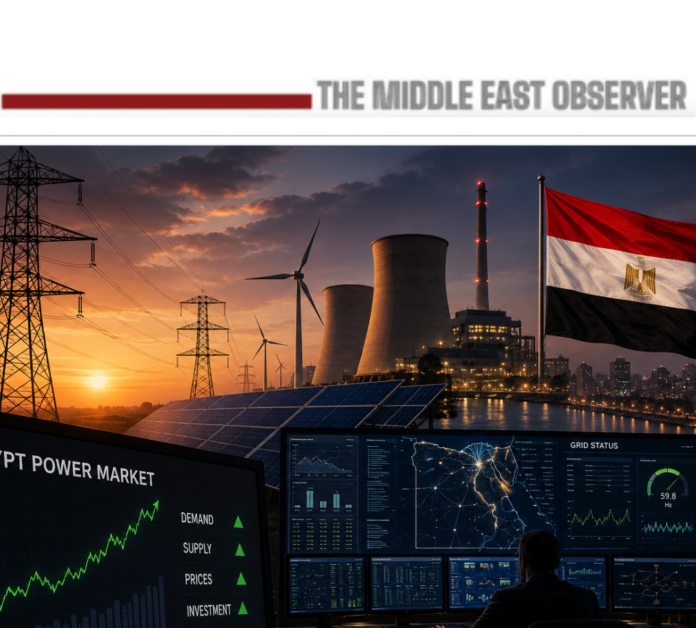
Electricity is becoming harder for Egyptian industry to treat as simply another regulated utility cost.
Peak demand approached 40GW during the summer of 2026, while Egypt accelerated plans to add solar, wind and battery capacity to a system still heavily dependent on natural gas. Private developers, meanwhile, are committing billions of dollars to projects increasingly underpinned by long-term power purchase agreements.
The change is commercial as much as technological.
Egypt needs new generating capacity, but also private capital to finance it, contracts capable of attracting lenders and a transmission system able to carry renewable power to factories and other large consumers.
For the state, the challenge is to attract investment while retaining oversight of a strategic national system. Developers want predictable returns. Lenders want protection against contractual and currency risks. Industrial consumers want reliable electricity at a competitive price.
The question is therefore shifting from how much electricity Egypt can generate to something more consequential: who prices it, who carries the risk and what will it ultimately cost industry?
Opening the Market to Private Capital
Egypt has been laying the institutional foundations for greater private participation.
Electricity and Renewable Energy Minister Mahmoud Esmat has said the government is working to separate generation, transmission and distribution functions as it prepares the sector for increased private-sector involvement. A working group has also been established to inventory electricity-sector assets, alongside efforts to strengthen regulation.
The direction matters because Egypt is gradually moving away from a model dominated by vertically integrated state electricity provision.
Private-to-private arrangements already allow independent generators to supply businesses under regulated conditions. But Egypt is not yet a fully liberalised wholesale electricity market: the state remains central to transmission, regulation and much of electricity purchasing.
For investors, restructuring is therefore only the beginning.
A deeper private power market requires transparent grid-access rules, predictable regulation and contracts that allow developers and lenders to price risk over decades.
PPAs Put a Price on Risk
The investment already entering the sector illustrates why those contracts matter.
In June 2025, Norway’s Scatec reached financial close on its Obelisk project, comprising roughly 1.1GW of solar capacity and a 100MW/200MWh battery system. Estimated capital expenditure was about $590mn, supported by approximately $479mn of non-recourse financing.
The electricity will be sold under a 25-year, US dollar-denominated PPA with the Egyptian Electricity Transmission Company, backed by a sovereign guarantee.
Scatec separately signed a 25-year dollar-denominated PPA for a 900MW wind project at Ras Shokeir, with expected investment of about $1bn.
These arrangements expose the real economics of renewable infrastructure.
A PPA is not merely an agreement to buy electricity. It allocates risk.
Developers need predictable revenues to justify large upfront investments. Banks need confidence that debt can be serviced. Buyers need electricity at a price that remains commercially sustainable.
In Egypt, foreign exchange sits near the centre of that equation.
Renewable projects frequently rely on foreign financing and imported equipment, while much of the domestic economy operates in Egyptian pounds. Dollar-denominated PPAs can protect international investors against currency depreciation, but the risk does not disappear. It moves elsewhere in the system.
Who ultimately carries it — the state, electricity purchaser, taxpayer or industrial consumer — will help determine the true cost of Egypt’s renewable transition.
Storage Changes the Economics
Renewable generation alone cannot provide all the flexibility an industrial power system requires. Solar and wind output fluctuate; factories cannot always adjust production accordingly.
Battery storage can shift electricity towards periods of stronger demand, support grid stability and reduce renewable curtailment.
Egypt is consequently expanding storage alongside generation. By July 2026, the government reported installed renewable capacity of about 9.5GW — roughly 3GW each of hydropower, solar and wind — alongside 500MWh of battery storage. It plans a substantial increase in storage as more intermittent generation enters the system.
The commercial implication is straightforward: electricity produced cheaply is not necessarily electricity delivered cheaply.
For an industrial consumer, the relevant calculation extends beyond generation. Financing, foreign-exchange protection, storage and balancing, transmission and contractual risk can all affect the final price.
A cheap solar tariff therefore does not automatically translate into cheap electricity at the factory gate.
The Grid May Hold the Greatest Power
That distinction makes transmission increasingly important.
Egypt’s strongest renewable resources are often far from its largest industrial loads. Wind projects are concentrated around the Gulf of Suez and Red Sea, while large solar developments are expanding in Upper Egypt and desert locations.
Their electricity must reach Cairo, the Delta, industrial zones, ports and manufacturing clusters.
Transmission capacity is therefore becoming an economic asset in its own right.
A developer may have land, financing and a PPA, but without timely grid connection its generating capacity has limited commercial value. If renewable generation expands faster than the network, the grid rather than investment capital becomes the binding constraint.
The government is expanding substations and high-voltage transmission infrastructure while pursuing grid modernisation, storage, smart distribution and advanced control systems.
Egypt’s transition consequently requires two investment cycles to proceed together: generation and the network capable of carrying it.
From Power Policy to Industrial Strategy
The ultimate test lies with the customer.
Egypt’s electricity strategy targets renewables to account for more than 42 per cent of the country’s generation mix by 2030, requiring a sharp acceleration from current levels.
Closing that gap requires more than building power stations. It requires customers willing to buy their output.
For steel, cement, fertiliser, chemicals and other energy-intensive industries, electricity is both a production cost and increasingly a trade consideration.
The EU’s Carbon Border Adjustment Mechanism reinforces that connection. As carbon exposure becomes embedded in the economics of exporting to Europe, access to lower-carbon electricity can strengthen the competitiveness of Egyptian manufacturers.
But manufacturers cannot sacrifice cost competitiveness for sustainability.
A company deciding whether to sign a long-term renewable PPA will ultimately judge it on three things: reliability, price predictability and delivered cost. Carbon intensity increasingly matters, but not independently of those fundamentals.
That is why Egypt’s electricity transition is becoming part of its broader industrial strategy.
A manufacturer deciding where to build a factory increasingly considers not simply whether electricity is available, but its price, reliability, carbon intensity and contractual certainty.
Egypt possesses strong solar and wind resources, a large domestic market and proximity to European, Middle Eastern and African trade routes. Competitive renewable electricity could turn those advantages into part of the country’s industrial proposition.
But the competitive advantage will not be determined by how cheaply Egypt can generate renewable electricity. It will depend on how cheaply and reliably it can deliver that electricity to industry.
That requires more than additional megawatts. It requires bankable PPAs, credible regulation, manageable currency exposure, sufficient transmission capacity and industrial demand capable of sustaining private investment.
Egypt is therefore doing more than adding power.
It is beginning to determine who prices electricity, who finances it, who carries its risks and who ultimately captures its economic value.
Related news:
EGX Mixed as Overseas Investors Rotate Beyond Large Caps
Egypt announces 28 Industrial opportunities to Anchor Local and Global Leadership
Read also:
Airbnb Expands Beyond Home Rentals With AI, Hotels, and Social Travel Features
Egypt and Syria Deepen Cooperation on Gas and Infrastructure