

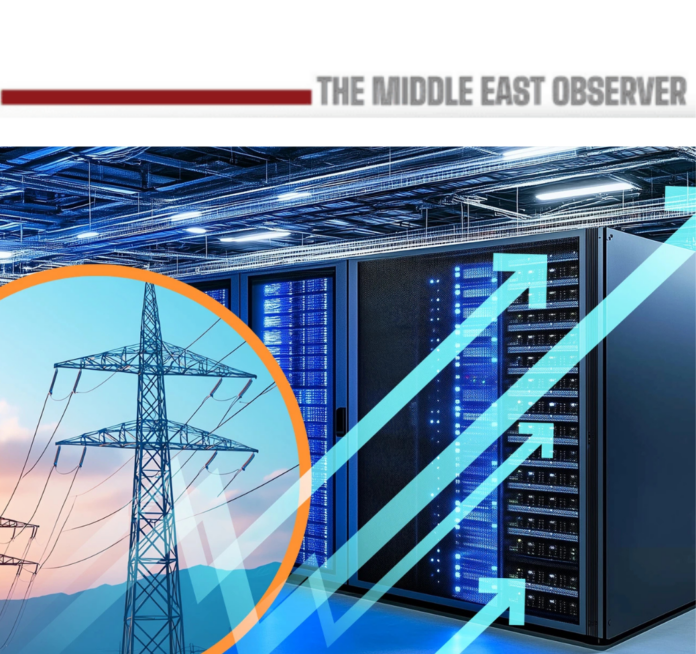
The Middle East’s push to become a global artificial-intelligence hub is creating a parallel race for a more fundamental resource: electricity.
Power demand across the Middle East and North Africa is forecast to more than double from 1,671 TWh in 2025 to 3,670 TWh by 2050, while installed generation capacity is projected to quadruple from 580 GW to 2,328 GW, according to Rystad Energy.
AI is not driving that increase alone. Industrial expansion, population growth, cooling, transport electrification, hydrogen, commercial activity and public services are also raising consumption. But data centres add a particularly demanding new load: they require large volumes of reliable power, often faster than grids can deliver new capacity.
That is turning electricity infrastructure into a competitive asset for the Gulf.
Saudi Arabia and the UAE are investing heavily to build AI, cloud and data-centre industries. Their ability to scale those ambitions will increasingly depend not only on access to capital and advanced chips, but on available megawatts, grid connections, cooling and dependable generation.
The challenge is global. The International Energy Agency expects data-centre electricity consumption to rise from about 485 TWh in 2025 to 950 TWh by 2030, while consumption from AI-focused facilities is projected to triple. Energy infrastructure, however, develops much more slowly than computing capacity.
From GPUs to grids
The Gulf has advantages: abundant gas, strong solar resources, sovereign capital and governments capable of coordinating large infrastructure programmes. Gas, renewables, storage and nuclear can together provide the mix of low-cost and dispatchable power required by increasingly electricity-intensive economies. Rystad expects gas to remain part of the regional mix even as renewables and storage expand.
Yet generation is only part of the problem.
A fourfold increase in capacity will require enormous investment in transmission, substations, transformers, cables, batteries, interconnectors and grid-management systems. Those supply chains are already under pressure: Rystad says transformer lead times can exceed 160 weeks, gas-turbine order books stretch roughly three years and grid-connection queues can run five to seven years in key markets.
That creates an industrial opportunity as large as the infrastructure challenge.
If MENA imports most of this equipment, much of the value generated by its power boom will flow to foreign manufacturers. If governments localise transformers, batteries, cables, inverters and other grid technologies, the electricity build-out could become a second industrialisation programme alongside the region’s AI drive.
The opportunity extends beyond the Gulf. Egypt and Morocco could increasingly combine renewable resources with manufacturing and export-oriented energy industries, while Gulf economies provide some of the region’s largest concentrations of capital and new electricity demand. Rystad says recent disruption has already redirected part of the region’s renewable activity towards Egypt and Morocco, even as MENA remains on course for a much larger long-term power system.
For decades, Middle Eastern energy power was measured principally in barrels and cubic feet. The next phase will increasingly be measured in gigawatts, grid capacity and the speed at which electricity can reach new industries.
The Gulf has spent heavily to secure chips, cloud infrastructure and AI partnerships. Its ability to convert those investments into an AI economy may ultimately depend on something less glamorous: whether its power systems can keep pace.
Related news:
OpenAI Launches GPT-5.6 Globally as Frontier AI Race Enters a New Strategic Phase
AI’s New Arms Race Is Being Funded by Stock, Not Money
Read also:
Gulf Investors Build Sectoral Clusters Across Syria’s Reconstruction
From the Nile to the Yellow River:70 Years, Two Civilizations with a Shared Future