

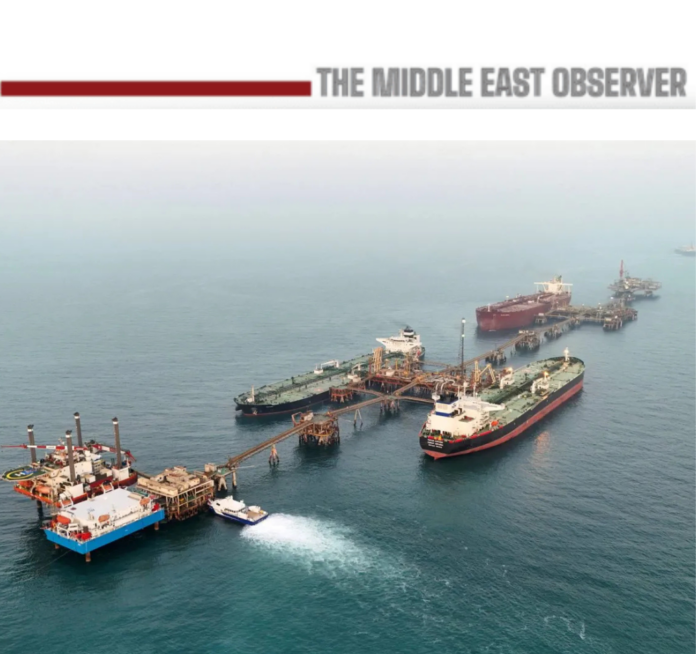
Iraq is rebuilding the capacity to produce and export substantially more oil just as OPEC+ prepares to decide how much of that capacity Baghdad may ultimately use. Beyond the immediate disruption at Hormuz, a larger contest is emerging across the Gulf over quotas, market share and — increasingly — the number of routes through which a producer can guarantee delivery.
OPEC+ paused further production-target increases on September 6, keeping October requirements at September levels after six months of increases and shifting attention towards a potentially more consequential negotiation: how production should be divided from 2027.
Saudi Arabia, Russia, Iraq, Kuwait, Kazakhstan, Algeria and Oman — the seven countries participating in the latest voluntary-adjustment discussions — agreed to maintain September required production levels in October. The group had already completed the phased return of a 1.65mn-barrel-a-day voluntary reduction introduced in 2023, while broader production restraints remain in place through the end of 2026. Crucially, higher authorised production has not always translated into equivalent physical supply as war and disrupted shipping have constrained several producers.
For Iraq, the pause places greater importance on what happens next.
US consultancy DeGolyer and MacNaughton is conducting an independent assessment of maximum sustainable production capacity among participating producers, with findings expected to feed into negotiations over 2027 baselines. Iraq has been pressing for a higher allocation as it invests to lift productive capacity.
In OPEC arithmetic, capacity is increasingly political capital: the larger the independently recognised production base, the stronger a member’s argument for greater future market share.
Baghdad’s frustration is already evident. Reuters reported in June, citing sources familiar with internal discussions, that Iraqi officials had considered leaving OPEC if the country failed to secure a significant quota increase. Iraq’s oil ministry said withdrawal was not official government policy. The episode nevertheless exposed the widening tension between an investment programme designed to increase production and a quota system capable of limiting how much additional crude reaches the market.
That leaves Iraq attempting to raise three different ceilings simultaneously: what it can produce, what it can transport and what OPEC will permit it to produce.
From 2.34mn barrels to a 5mn-barrel export system
The physical recovery is already accelerating.
Iraq exported about 2.34mn barrels a day in August, according to Iraqi officials cited by Reuters, sharply above roughly 1.35mn b/d in July. Vortexa estimated August flows at around 2.3mn b/d and Kpler at approximately 2.17mn b/d. Even after that rebound, exports remained below pre-war levels exceeding 3.3mn b/d.
By early September, Oil Minister Basim Mohammed Khudair said exports had reached approximately 3mn b/d since the beginning of the month, while available export capacity had risen beyond that level. The figure is an Iraqi government-reported early-month run rate rather than an independently verified September monthly average, but it marks another substantial step towards restoring lost volumes.
Baghdad’s target is considerably larger: 5mn b/d of export capacity once strategic pipeline projects towards Fishkhabour in northern Iraq and Baniyas on Syria’s Mediterranean coast are completed alongside upgraded southern outlets.
Export capacity, however, should not be confused with production or an OPEC quota. Iraq could eventually possess infrastructure capable of moving 5mn b/d without producing that volume, while its longer-term production ambitions could themselves exceed the capacity of today’s export network.
That distinction is becoming central to Iraq’s strategy. Building fields without routes leaves barrels stranded. Building routes without securing sufficient production allowances risks leaving pipelines underutilised.
Hormuz has turned redundancy into an economic asset
For decades, Iraq’s most productive oil geography has pointed south. Giant fields around Basra feed terminals in the Gulf, leaving the bulk of exports dependent on passage through the Strait of Hormuz.
The current conflict has exposed the cost of that concentration.
Hormuz traffic deteriorated again in early September. Kpler data cited by Reuters showed the 10-day average falling to about 10 commodity vessels a day, the lowest since May, while no very large crude carrier had exited the strait for several days amid renewed attacks and restrictions.
Iraq’s recovery has partly depended on exceptional arrangements rather than a return to normal navigation. Tehran has permitted some Iraqi tankers to transit the strait, giving Baghdad an unusual degree of access while shipping conditions remained impaired.
That advantage is useful but strategically uncomfortable. A major oil exporter does not achieve genuine energy security if continued market access depends upon another state allowing its vessels through a contested chokepoint.
Iraq is therefore accelerating its search for western exits.
The northern strategy would move southern crude towards Haditha and Fishkhabur, connecting eventually with infrastructure leading to Ceyhan on Türkiye’s Mediterranean coast. A western route would extend from Haditha towards Baniyas in Syria, establishing another Mediterranean outlet. Baghdad’s proposed Syria-linked network remains at feasibility stage; industry sources estimate the project could require at least $15bn and about four years to complete. It should therefore be treated as an estimated investment requirement rather than committed expenditure.
Yet Syria is no longer merely a hypothetical route.
Since April, Iraq has been moving fuel oil by truck through Syria to Baniyas, where the terminal has been expanded to handle large numbers of road tankers. Baghdad has also prepared crude and naphtha exports through the corridor, with plans initially involving around 50,000 b/d of crude. Iraqi-origin fuel oil shipped from Baniyas has subsequently reached markets including the US, Spain and Egypt.
The sequence is important:
emergency trucking today, pipelines tomorrow, strategic Mediterranean redundancy thereafter.
Hormuz has therefore changed the economics of infrastructure. A $15bn alternative route can appear excessive when a maritime chokepoint functions reliably. Once that chokepoint can interrupt the fiscal lifeline of an oil-dependent state, the same project begins to resemble strategic insurance.
The cost of dependence is already visible in Iraq’s crude price
Iraq has not recovered volumes through logistics alone. It has also used price.
SOMO offered some August-loading Basrah crude at discounts of around $25-$30 a barrel FOB, according to Reuters, creating sufficient margin to compensate buyers and traders for unusually high freight, insurance and security costs.
The discounts attracted PetroChina, Zhenhua Oil, TotalEnergies, Vitol, Trafigura and Mercuria, while Chinese and Indian refiners returned to Iraqi cargoes. Reuters reported that some trading economics could still leave margins approaching $10 a barrel after an estimated $17 a barrel in shipping and insurance costs.
That reveals a less visible cost of the Hormuz crisis.
Hormuz risk has not disappeared; part of it has migrated from the tanker route into Iraq’s realised selling price.
Restoring export volume is therefore not equivalent to restoring the economics that prevailed before the war. When a producer must compensate a buyer for accepting transport risk, part of the geopolitical cost is effectively borne through the crude differential.
Alternative pipelines consequently offer more than physical security. They can restore bargaining power.
A barrel that can reach customers through either Hormuz, Türkiye or Syria carries greater commercial optionality than one dependent on a single route. The producer is less vulnerable to distressed pricing precisely because buyers know that transport disruption does not necessarily eliminate the barrel from the market.
The UAE shows where the competition could lead
The emerging Iraqi strategy becomes clearer beside the UAE, which left OPEC earlier in 2026 and is now pursuing production growth without OPEC crude quotas.
The comparison requires care. The International Energy Agency expects total UAE oil output to reach about 5.2mn b/d in 2027, while Reuters puts current UAE crude production capacity at around 4.4mn b/d, supplemented by approximately 1.1mn b/d of condensate and natural gas liquids capacity. Those broader oil volumes are not directly comparable with an OPEC crude-production quota.
The strategic direction, however, is unmistakable.
ADNOC is pursuing a substantial upstream expansion while the UAE already possesses the approximately 1.8mn b/d Habshan-Fujairah pipeline, allowing crude to reach the Arabian Sea without crossing Hormuz. Abu Dhabi is also accelerating additional infrastructure intended to expand exports through Fujairah.
The contrast with Iraq is striking.
Abu Dhabi has sought freedom from the quota constraint; Baghdad is seeking a larger quota while simultaneously trying to escape the route constraint.
Saudi Arabia adds another layer. Riyadh remains the central political and spare-capacity power inside OPEC+, while also strengthening its ability to move crude west towards Yanbu on the Red Sea. Across the Gulf, the Hormuz crisis has accelerated investment in pipelines, ports, storage and inland links, while Kuwait has examined greater access to alternative regional infrastructure.
This creates an unusual relationship among Gulf producers: they can remain competitors for oil customers while becoming potential partners in transport resilience.
The implications extend well beyond the Gulf.
If Iraq succeeds in lifting productive and export capacity, the UAE expands supply outside OPEC discipline and Saudi Arabia preserves substantial flexibility, Middle Eastern producers could eventually compete more aggressively for market share once the immediate supply disruption eases.
The infrastructure being constructed to protect producers from scarcity could then help create a different problem: greater competition among producers themselves.
Asian refiners, particularly in China and India, would be among the immediate beneficiaries. More competing barrels increase procurement options and strengthen negotiating power over differentials. China’s seaborne crude imports remained around 40% below pre-conflict levels in August, illustrating how strongly Asian buyers have been affected by restricted Middle Eastern supply.
Trading houses benefit differently. Dislocated markets create arbitrage between distressed loading prices and higher-value destination markets for companies capable of arranging ships, insurance, storage and transfers.
Transit states acquire another form of value. Türkiye and Syria can monetise geography through transit fees, infrastructure investment and greater strategic relevance.
The benefits are therefore distributed across the chain: refiners gain purchasing leverage, traders capture dislocation premiums and transit countries turn geography into income.
For producers, the calculation is more demanding.
Iraq’s immediate constraint remains the ability to move oil safely through Hormuz. Its emerging constraint is whether OPEC+ grants sufficient room for higher production. Beyond both lies a potentially more competitive market in which several regional producers possess more capacity than before and increasingly sophisticated ways of reaching the same customers.
The conventional hierarchy of oil power has long been measured through reserves, production capacity and spare capacity. The Hormuz crisis is adding another metric: route capacity.
A country capable of producing 5mn barrels a day but dependent on one vulnerable maritime exit does not possess the same strategic position as a producer able to redirect the same barrel towards the Indian Ocean, Red Sea or Mediterranean.
The next phase of Middle Eastern oil competition will therefore not be determined solely by who secures the largest quota or pumps the greatest volume. It will increasingly depend on who can preserve delivery — and pricing power — when a particular route fails.
In an era of contested chokepoints, the value of a barrel increasingly depends on how many ways it can reach the sea.
Related news:
Iraq Denies OPEC Exit Speculation, Reaffirms Commitment to Higher Production Quota
Iraq Begins Trucked Oil Exports via Syria as Hormuz Disruptions Reshape Flows
Read also: