

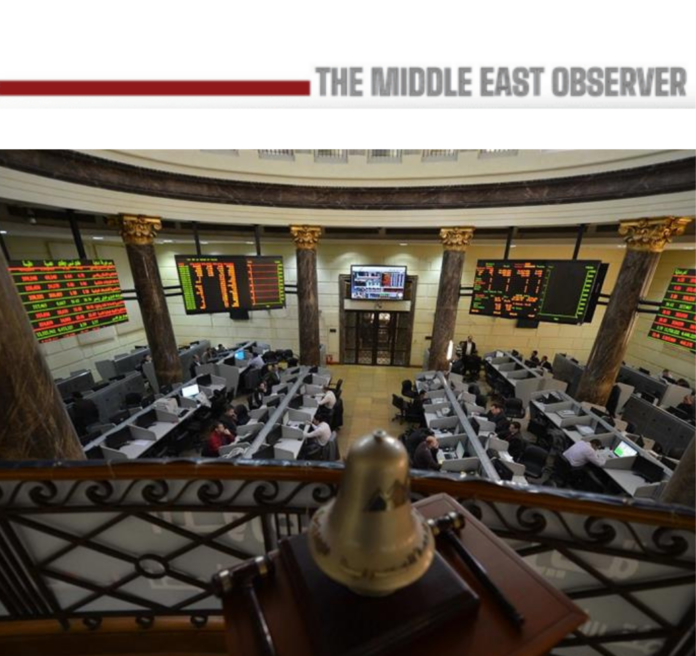
Egyptian equities opened the week at another record on Sunday, with smaller stocks outperforming the blue-chip benchmark and domestic investors absorbing foreign selling. At the same time, the heavy sovereign-debt outflows seen late last week largely disappeared and the pound strengthened modestly — a more balanced cross-market picture that strengthens, but does not yet prove, the case for greater resilience in Egyptian financial assets.
The EGX30 rose 0.72% on September 6 to a record 56,676.16 points, extending its winning streak to four sessions and taking its 2026 gain to about 35%. The index reached an intraday high of 56,788.85.
More importantly, the rally broadened.
EGX70 climbed 1.48% to 21,618.27 and EGX100 gained 1.13% to 28,213.87, both comfortably outperforming the large-cap index. EGX35-LV rose 1.65%. Market capitalisation increased by about EGP34bn to roughly EGP4.453tn, with equity trading around EGP15bn-EGP15.5bn depending on the reported transaction measure.
That matters because last week’s record was increasingly led by larger companies.
Sunday showed the broader market rejoining the advance.
Breadth Returns After a Record Week
The recent sequence has been unusually strong.
After closing at 54,866.04 on August 31, EGX30 rose 1.03% on Tuesday, 0.45% on Wednesday, 1.06% on Thursday and another 0.72% on Sunday — a cumulative gain of about 3.3% across four consecutive rising sessions.
Measured conventionally from the previous Thursday’s close, EGX30 gained about 2.1% last week, finishing September 3 at 56,270.32.
But smaller stocks had barely participated in that weekly advance. Sunday partly resolved that weakness as EGX70 rose more than twice as fast as EGX30.
The distinction is important.
A record benchmark accompanied by improving breadth is a stronger market signal than one driven primarily by heavyweight stocks.
One session cannot establish that breadth has durably returned. But continued participation from smaller and mid-cap companies is now a more important test of the rally than the next round-number milestone for EGX30.
Domestic Capital Is Becoming a More Important Buffer
Sunday also reinforced the increasingly domestic character of Egyptian equity trading.
EGX-derived closing reports differ slightly in their treatment of transactions, but point in the same direction: Egyptians were net buyers of roughly EGP290mn-EGP293mn, while foreigners sold around EGP255mn-EGP256mn and Arab investors sold approximately EGP33mn-EGP38mn.
Those are millions, not billions, correcting erroneous units appearing in some secondary summaries.
The market nevertheless advanced across all major indices.
That supports a structural development identified by EGX chairman Omar Radwan. He said around 450,000 new investors entered the exchange during the first eight months of 2026, compared with 300,000 in the same period of 2025 and only 25,000 during all of 2020.
Average liquidity has risen to about EGP9bn in 2026 from EGP3.5bn last year, with recent daily liquidity reaching EGP15bn-EGP18bn.
This larger domestic investor base appears to be reducing the immediate sensitivity of equity prices to relatively modest foreign selling.
But domestic dominance is not the same as institutional depth.
A deeper market requires not simply more trading accounts, but more institutional capital, stronger market-making capacity, broader free floats and a larger supply of high-quality listed companies.
That distinction is increasingly important as liquidity grows.
More Investors Need More Investable Assets
The emerging IPO pipeline therefore belongs at the centre of the EGX outlook.
Al Borsa reported on Sunday, citing a government official close to the process, that the State-Owned Companies Unit is preparing a possible 30% offering of Alamal Alsharif Plastics, potentially by December, with a provisional listing file expected to be submitted shortly.
The report said the government aims to begin trading in three companies before year-end: Alamal Alsharif Plastics, Misr Life Insurance and Banque du Caire.
The stage classification matters.
The Alamal transaction is reported as being prepared; it is not yet a formally launched IPO and its timetable remains subject to listing, regulatory and market conditions.
But the broader economic logic is clear:
more investors now need more assets.
If rapidly expanding domestic liquidity continues chasing largely the same stock universe, share prices can rise without the capital market becoming proportionately deeper.
New listings can change that equation by increasing free float, expanding sector representation and directing savings towards companies rather than merely increasing secondary-market turnover.
For Egypt, that would turn today’s liquidity boom into a more meaningful source of capital-market development.
Heavy Debt Selling Pauses — but Foreign Demand Has Not Returned
The sovereign-debt market provided a second, more tentative improvement.
Foreign and Arab government-debt flows had been volatile through the previous week, with large inflows early on followed by several sessions of substantial selling.
On Sunday, however, combined foreign and Arab net selling in the secondary Treasury market fell to only about $83,300.
Gross activity was extremely limited: investors bought approximately $2.74mn of Treasury bills and sold $2.82mn, while there were no reported Treasury-bond transactions. Foreign investors themselves were marginal net buyers of bills, while Arab investors were modest net sellers.
That should not be described as a return of foreign debt demand.
Volumes were too small.
The defensible conclusion is narrower: the intense selling pressure evident late last week was absent on Sunday.
Several more sessions would be needed to establish whether this represents genuine stabilisation or merely a pause in positioning.
The Pound Provides a Second Stabilisation Signal
The currency also moved modestly in the opposite direction to last week’s weakness.
The Central Bank of Egypt’s average market rate put the dollar at EGP50.8166 for buying and EGP50.9166 for selling on Sunday, compared with EGP50.8871/50.9871 on Thursday.
The appreciation was small and does not establish a new FX trend.
But the combination is noteworthy:
equities reached another record, small caps outperformed, government-debt selling almost disappeared and the pound strengthened modestly.
That represents a healthier cross-market configuration than during parts of last week, when stocks were rising alongside significant foreign debt withdrawals and currency pressure.
For equity investors, the currency remains a stock-selection variable as well as a macroeconomic risk. Exporters and foreign-currency earners can respond very differently to exchange-rate movements than import-dependent or externally indebted businesses.
High Yields Raise the Fundamental Hurdle
Egypt’s interest-rate environment remains the strongest competing asset-allocation argument against equities.
The CBE’s overnight deposit rate is 19%, while the lending rate stands at 20%.
With EGX30 already up around 35% this year, the next stage of the rally increasingly requires companies to deliver earnings capable of compensating investors for equity risk against high domestic fixed-income returns.
That should increase differentiation between companies.
Earnings growth, pricing power, leverage, cash generation and currency exposure become progressively more important as an index moves further from the valuations at which the rally began.
This is the point at which a liquidity-driven market must increasingly become an earnings-driven one.
From Resilience to Market Depth
Sunday therefore delivered more than another index record.
The EGX30 extended its winning streak. Smaller companies rejoined the rally. Domestic investors absorbed foreign equity selling. Heavy government-debt outflows paused, while the pound strengthened modestly.
Together, those signals reinforce the argument that Egyptian equities are becoming better able to absorb shifts in external portfolio sentiment.
But that is only the first test.
The more consequential challenge is whether Egypt can convert greater participation and liquidity into institutional depth.
That requires sustained breadth, earnings capable of supporting higher index levels, successful new listings and ultimately greater participation from long-term international investors.
Egypt’s market is increasingly demonstrating that it can reach records without foreign capital leading the move.
That is resilience.
The larger achievement will be turning domestic liquidity into a deeper capital market capable of attracting global capital for the long term — rather than merely proving that it can withstand its movements.
Related news:
EGX Hits Record as Domestic Liquidity Deepens Amid Foreign Portfolio Volatility
EGX30 Holds Near Records as Broader Market Loses Momentum
Read also:
Shein Heads for Hong Kong IPO at a Quarter of Its Peak Valuation
US-Venezuela Oil Pact Links 65bn Barrels to $100bn Investment Push