
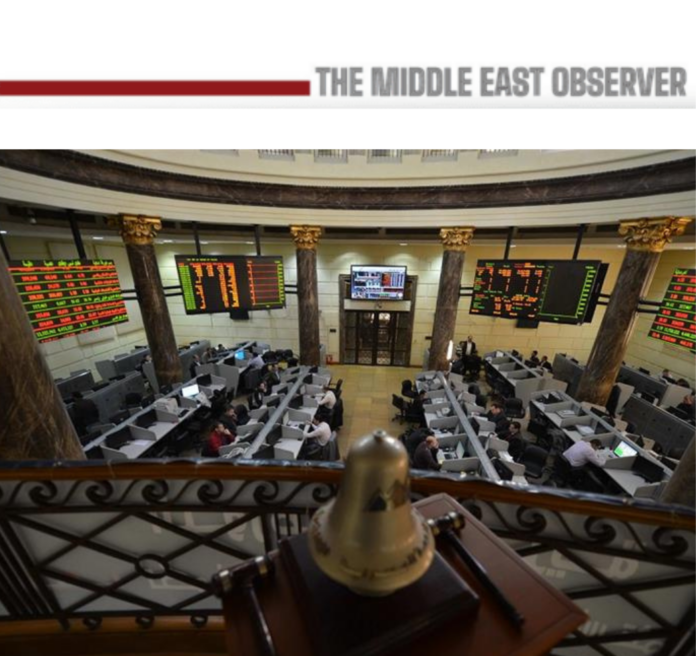
Egyptian stocks ended the week at a record high, with the EGX30 breaking through 56,000 even as foreign portfolio positioning turned more cautious in government debt and the pound weakened. The divergence points to an important shift in Egypt’s capital market: a rapidly expanding domestic investor base is giving equities greater capacity to absorb external volatility, although foreign participation and market breadth remain important tests of the rally’s durability.
The EGX30 rose 1.06% on Thursday to a record 56,270.32 points, extending its late-week rebound. EGX70 gained 0.37% to 21,302.67 and EGX100 advanced 0.55% to 27,898.74, while market capitalization increased by about EGP38bn to EGP 4.418 tn.
Listed-equity turnover was about EGP 14.25 bn, with 129 stocks advancing against 96 decliners. Egyptians were net buyers of EGP131.7mn, while foreigners sold EGP 111.1mn and Arab investors sold EGP20.6mn. Egyptians accounted for almost 90% of trading.
Reuters said gains in Commercial International Bank and Talaat Moustafa Group helped support the benchmark. Regional markets also recovered on Thursday after the previous day’s US-Iran-driven sell-off, with Egypt’s 1.1% gain exceeding advances in Saudi Arabia, Dubai, Abu Dhabi and Qatar.
A Weak Start Became a Record Week
The week’s progression says more about market resilience than Thursday’s record alone.
EGX30 fell 0.31% on Sunday and 0.13% on Monday, before rising 1.03% on Tuesday, 0.45% on Wednesday and 1.06% on Thursday.
The benchmark consequently gained 2.11% for the week, from 55,106.54 to 56,270.32. Market capitalization increased by approximately EGP137bn.
But the advance was increasingly concentrated in larger companies.
EGX100 gained 1.16% for the week while EGX70 rose only 0.16%, a marked change from August, when smaller companies had substantially outperformed the blue-chip benchmark.
That does not invalidate the record. It changes the test.
Another EGX30 high matters less if smaller companies and broader market participation fail to confirm it.
The week’s political backdrop also adds significance. On Wednesday, Egypt’s market rose while Saudi Arabia, Abu Dhabi, Dubai and Qatar fell after renewed US-Iran strikes. By Thursday, Gulf equities had recovered, but the EGX accelerated further.
One week does not establish that Egypt has decoupled from regional risk. It does suggest the market is becoming better able to absorb it without an immediate broad equity sell-off.
Domestic Liquidity Is Becoming the Buffer
The strongest evidence for that change lies not in the index but in who is trading it.
EGX chairman Omar Radwan said about 450,000 new investors joined the market during the first eight months of 2026, up from 300,000 during the same period last year.
Average daily liquidity has increased to about EGP9bn this year from EGP3.5bn in 2025, while Radwan said liquidity reached roughly EGP18bn a day during the last two weeks. The EGX itself highlighted the figures following his interview with Asharq Bloomberg.
The weekly trading mix reinforces the point.
Egyptians accounted for 88.5% of listed-share transactions, excluding deals, while foreigners represented 8.6% and Arabs 2.9%. Foreign investors recorded only EGP20.4mn of net equity selling for the week, compared with EGP811mn from Arab investors.
That helps explain why sizable movements by international investors elsewhere in Egyptian financial markets did not translate into equivalent equity-market disruption.
But domestic dominance should not be confused with institutional depth.
A larger local investor base can provide liquidity and absorb selling, but a mature capital market also requires institutional investors, effective market makers, diverse securities and a larger pipeline of investable companies.
That makes Radwan’s expectation of new private-sector offerings — particularly in fintech and non-bank financial services — strategically important. Banque du Caire and Misr Life Insurance are also among the state-related offerings being prepared.
The logic is straightforward: more investors now need more assets.
Without new listings, rapidly expanding liquidity can simply chase the existing stock universe. Successful IPOs would instead convert higher participation into genuine market depth and fresh financing for companies.
Government Debt Sent a Different Signal
Foreign portfolio behaviour looked considerably less stable in the sovereign-debt market.
Arab and foreign investors recorded about $227mn of net selling in the secondary government-debt market on Thursday, following approximately $270mn on Wednesday and $287.6mn on Tuesday. Monday had begun with roughly $422mn of net buying.
Taken together, those published daily figures imply net selling of roughly $363mn over the four sessions.
But the maturity profile matters.
Earlier in the week, investors remained willing to buy short-term Treasury bills while selling longer-duration government bonds. That is more consistent with reduced duration appetite than with a wholesale rejection of Egyptian sovereign risk.
The distinction is important because Egypt’s high short-term yields remain attractive. What appears less secure is investors’ willingness to extend that exposure further along the maturity curve when currency, interest-rate and geopolitical risks rise.
The equity and debt markets are therefore telling different stories.
Domestic investors increasingly dominate equities, while international portfolio capital remains much more responsive to changes in yield, currency and duration risk.
The Pound Shows Where Pressure Remains
The foreign-debt repositioning coincided with greater activity in Egypt’s currency market.
The CBE’s average market rate ended Thursday at EGP50.8871 per dollar for buying and EGP50.9871 for selling, compared with EGP50.1649 and EGP50.2649 on August 26. That represents depreciation of about 1.4% over the period.
Banking-sector sources separately reported that interbank dollar transactions increased to around $1.5bn during the week from $1.25bn previously, compared with a usual weekly range of roughly $750mn-$1.2bn.
The higher interbank activity coincided with foreign portfolio selling and stronger demand for dollars. It should not, however, be treated as proof that portfolio exits alone caused the currency movement.
For equity investors, the interaction still matters.
A 2.1% weekly rise in the EGX30 does not translate into the same hard-currency return when the pound is weakening. At company level, depreciation can favour exporters and foreign-currency earners while raising costs for import-dependent businesses and borrowers with foreign-currency liabilities.
The currency is therefore increasingly a stock-selection variable, not merely a macroeconomic backdrop.
High Yields Raise the Bar for the Next Rally
Egypt’s interest-rate structure reinforces that selectivity.
The CBE’s overnight deposit rate remains 19%, with its lending rate at 20% and main-operation rate at 19.5%.
Those rates help explain continued international interest in short-term government securities. They also create a demanding benchmark for equities.
With the EGX30 up roughly 35% this year, the next leg of the rally should depend increasingly on companies delivering earnings capable of compensating investors for equity risk against high domestic fixed-income returns. Radwan similarly put the benchmark’s year-to-date advance at around 35%.
The strongest companies should therefore increasingly differentiate themselves through real earnings growth, pricing power, manageable leverage and favourable foreign-currency exposure, rather than momentum alone.
That transition from liquidity-driven appreciation towards fundamental stock selection would itself be a sign of a maturing rally.
The Record Is Not the Hardest Test
The week leaves Egyptian equities in a stronger position.
EGX30 gained 2.11%, closed above 56,000 for the first time and added about EGP137bn in market value. The market recovered rapidly from early-week weakness and absorbed renewed regional geopolitical tension without a broad sell-off.
More importantly, the investor base is expanding rapidly and liquidity has increased substantially.
That strengthens the case that Egypt’s equity market is becoming more domestically resilient before it becomes internationally deeper.
But the qualifications matter.
Small caps barely advanced during the week. Foreign equity participation remains modest. Arab and foreign investors were net sellers of government debt after Monday’s inflow. And the pound weakened by about 1.4%.
The next phase therefore rests on three tests: whether earnings validate higher index levels, whether new IPOs convert liquidity into genuine market depth, and whether international investors begin extending their Egypt exposure beyond short-term sovereign yield into equities and longer-duration assets.
Egypt’s market has increasingly demonstrated that it can rise without foreign capital leading the move.
That is a significant source of resilience.
The greater achievement would be to use its expanding domestic investor base to build a deeper market that ultimately brings long-term foreign capital back in — rather than merely proving that the EGX can reach records without it.
Related news:
EGX Defies Regional Pressure as Market Resilience Faces a New Test
EGX Rebounds Above 55,000 as Foreign Flows Reveal a Two-Speed Market
Read also:
Greece Signs €3bn ‘Achilles Shield’ Deal as Israel Deepens European Defence Footprint
Egypt and China Build a New Economic Architecture for the Next Decade