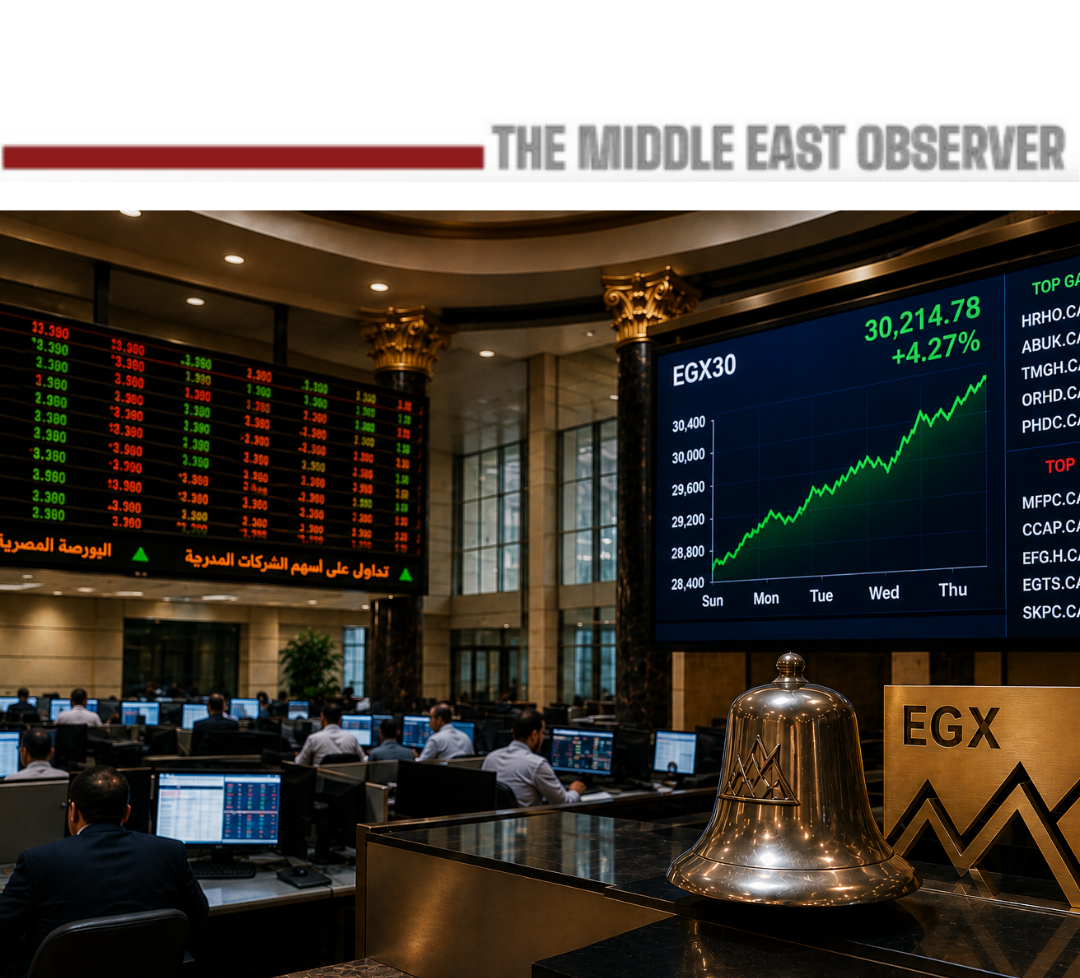

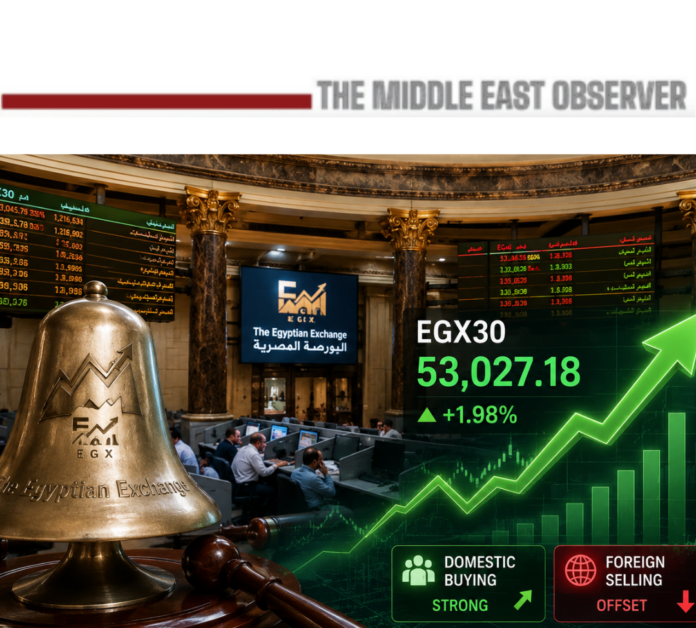
Egyptian equities extended their gains on Monday as strong buying by Egyptian and Arab investors lifted all major indices, pushing the benchmark EGX30 back above the 53,000-point level despite sizable foreign selling. The session highlighted resilient domestic investor participation while international investors remained net sellers of Egyptian equities.
The EGX30 gained 1.08% to close at 53,126.01 points. The rally broadened across the market, with the EGX70 Equal Weight Index rising 1.72% to 17,560.69 points, the EGX100 Equal Weight Index advancing 1.37% to 23,397.83 points, the EGX35-LV adding 0.75% to 6,315.54 points, and the EGX33 Shariah Index increasing 0.80% to 5,957.71 points. Market capitalisation rose to approximately EGP3.91 trillion, adding around EGP24 billion during the session.
The gains came despite continued regional uncertainty and renewed foreign selling in both equities and Egyptian government debt, underscoring the important role played by domestic liquidity in supporting market performance.
Broad-Based Rally Extends Market Momentum
Monday’s session confirmed that buying interest remained broadly distributed across the Egyptian market rather than concentrated in a limited number of heavyweight stocks.
While the benchmark index posted a solid gain, the stronger performance of the EGX70 highlighted sustained investor appetite for small- and mid-cap companies. The equal-weight indices continued to outperform the benchmark, suggesting investors remained focused on company-specific opportunities alongside the recovery in blue-chip shares.
Market breadth also reflected healthy participation. According to Egyptian Exchange statistics, 135 stocks advanced, compared with 103 decliners, while 24 securities closed unchanged. Equity turnover exceeded EGP12 billion, making it one of the strongest trading sessions of recent weeks and indicating continued investor engagement across the market.
Domestic Investors Drive Buying
Official Egyptian Exchange statistics showed Egyptian investors as net buyers worth approximately EGP1.78 billion, while Arab investors added EGP573.3 million in net purchases.
In contrast, foreign investors recorded net sales of approximately EGP2.36 billion, illustrating a divergence between domestic and international investor positioning.
Monday’s trading showed that domestic investors were the principal source of buying, offsetting foreign selling and supporting gains across the broader market. The session also demonstrated that overseas selling does not necessarily dictate overall market direction when supported by strong local liquidity.
Selective Stock Positioning Continues
The day’s largest declines were recorded by Cairo Educational Services, which fell 9.70%, Pioneers Properties for Urban Development (PRE), down 7.39%, and Middle & West Delta Flour Mills, which declined 7.15%.
The session reflected selective stock-specific positioning rather than broad sector leadership. Financial services, real estate and industrial companies were among the most actively traded sectors by value, while individual price movements continued to be driven primarily by company-specific developments.
Debt Market Highlights Diverging Foreign Positioning
Foreign investor behaviour continued to differ between Egypt’s equity and fixed-income markets.
According to Egyptian Exchange data, Arab and foreign investors recorded approximately US$893 million in net sales in the secondary market for Egyptian government securities during Monday’s session.
The continued caution in local-currency government debt contrasts with stronger participation across parts of the equity market and illustrates the different factors influencing each asset class. Government securities remain closely tied to interest-rate expectations, exchange-rate dynamics and global risk appetite, whereas equity investors can selectively target companies with stronger earnings visibility, pricing power and resilient balance sheets.
Tax Reform Aims to Strengthen Capital Markets
Alongside market activity, regulators continued advancing reforms designed to improve Egypt’s investment environment and deepen capital markets.
The Financial Regulatory Authority (FRA), the Egyptian Tax Authority (ETA) and the Egyptian Exchange (EGX) have established a permanent joint committee to unify the tax treatment of capital-market transactions and strengthen coordination between the three institutions.
The committee will prepare unified tax guidance covering listed and unlisted securities, investment funds and capital-market transactions, while improving digital integration between the EGX and the Tax Authority. It will also review existing tax instructions to ensure they remain aligned with current legislation and evolving market practices.
Greater consistency in the interpretation and administration of capital-market taxation is expected to reduce compliance uncertainty, improve transparency and strengthen investor confidence, supporting a more efficient and predictable regulatory environment for both domestic and international market participants.
The reforms form part of Egypt’s broader strategy to deepen capital markets, encourage private-sector financing and improve the investment climate. The FRA estimates that financing provided by regulated non-banking financial institutions reached approximately EGP1.4 trillion by the end of 2025, accounting for around 54% of Egypt’s financial sector.
Separately, the FRA is launching a specialised training programme for executives of state-owned companies preparing for future public offerings, strengthening governance, disclosure standards and investor-relations practices ahead of the government’s IPO programme. The initiative complements earlier reforms, including incentives to expand derivatives trading and legislative amendments allowing the future corporatisation of the Egyptian Exchange.
Market Themes
With two trading sessions completed this week, several themes are emerging across the Egyptian market.
First, market leadership remains broad-based. While the EGX30 has resumed its upward trend, the continued outperformance of the EGX70 and EGX100 suggests investors continue allocating capital beyond traditional blue-chip stocks.
Second, domestic investors continue to provide the principal source of market liquidity. Monday’s strong net purchases by Egyptian and Arab investors more than offset foreign selling, highlighting the depth of local participation in supporting market performance.
Third, policymakers are accelerating structural reforms through initiatives covering taxation, derivatives, IPO readiness and market governance, reinforcing efforts to build a more transparent, diversified and internationally competitive capital market.
Outlook
Attention is now turning to second-quarter corporate earnings, particularly from banks, real estate developers, industrial companies and consumer businesses, which are expected to determine whether the recent outperformance of small- and mid-cap shares can be sustained.
The pace of the government’s state-owned enterprise IPO programme will also remain an important indicator for investors, as additional listings are expected to broaden sector representation, improve market liquidity and expand opportunities for institutional capital.
Investors will also monitor inflation, monetary policy expectations, corporate guidance and the implementation of ongoing capital-market reforms. While foreign investors remain cautious towards Egyptian fixed-income assets, resilient domestic liquidity and improvements to the regulatory framework could continue supporting equity-market activity.
Monday’s session reinforced a market in which earnings quality, corporate fundamentals and selective investment opportunities are becoming increasingly influential in shaping returns. As the reporting season gathers pace, company-specific performance is likely to play a larger role than benchmark composition in determining investor allocations.
Related news:
Egypt’s Inflation Eases to 13.9% in July
Egypt’s Fund Boom Signals Deeper Shift in Capital Markets Architecture
Read also:
How Digital Money Can Strengthen Monetary Policy Across the MENA Region
Profit-Taking Erases $2.6bn from Nigerian Exchange as Rally Faces Valuation Test