Small-cap losses outpace the benchmark as high interest rates raise the hurdle for equities; S&P decision removes a potential obstacle to foreign institutional participation
CAIRO — Egyptian equities ended the week lower despite a modest rebound in blue chips on Thursday, as steeper losses among smaller stocks pointed to a more selective market after months of broad gains.
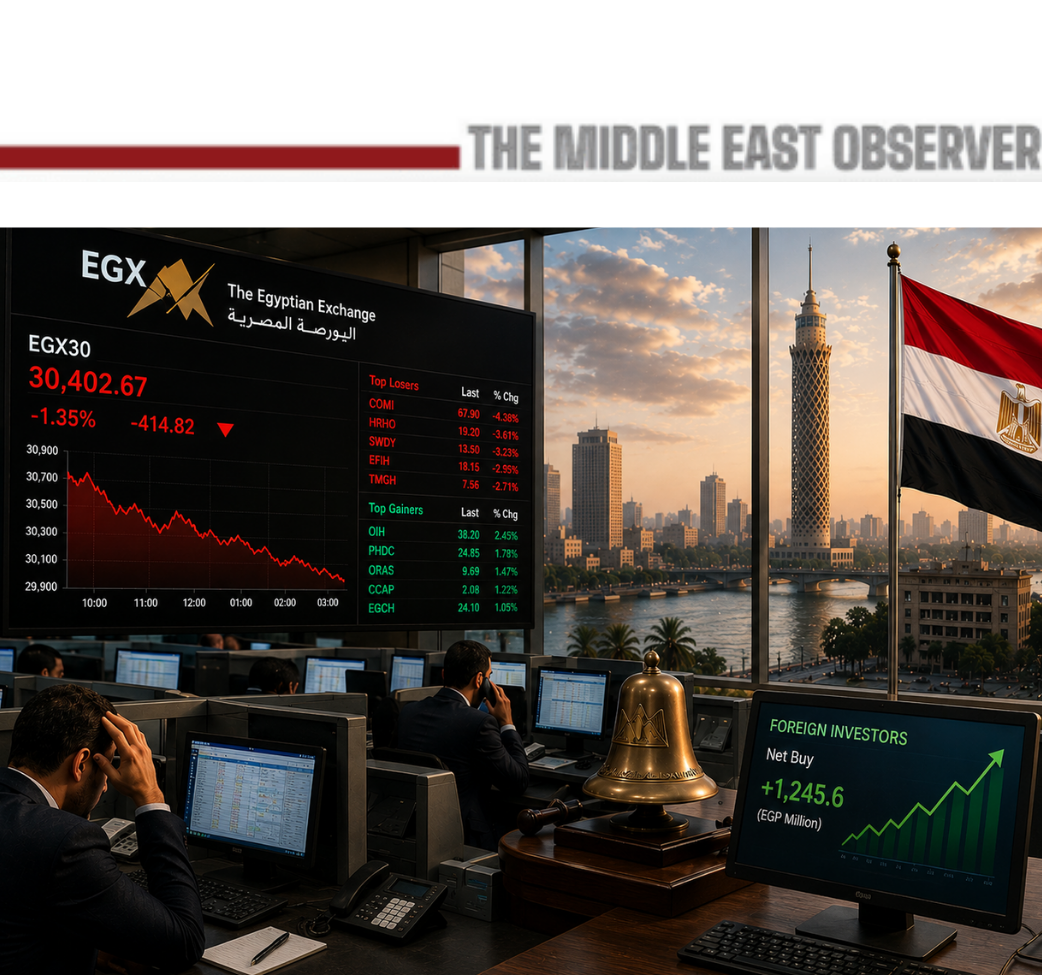
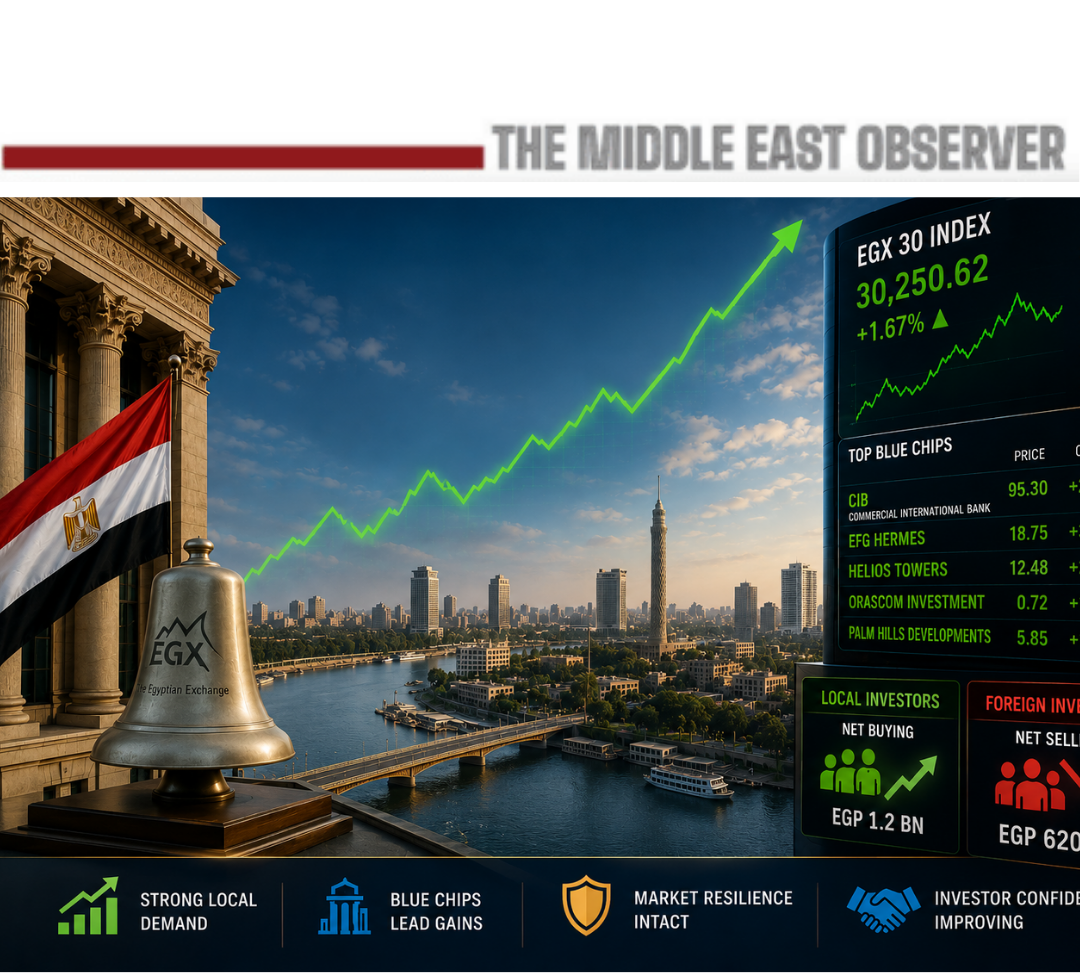
The benchmark EGX30 rose 0.41% on Thursday, August 20, to 54,737.07 points, breaking a three-session losing streak. But the recovery did not extend across the market: the EGX70 Equal Weight Index fell 0.70% to 20,816.03 and the broader EGX100 declined 0.49% to 27,052.41.
Over the week, the EGX30 lost about 0.9%, while the EGX70 fell roughly 3.6%. The disparity suggests that the correction was considerably deeper below the blue-chip benchmark, where smaller companies had generated some of the strongest gains during the earlier rally.
The pattern is consistent with a market becoming more selective after a period of broad re-rating, although a single week is insufficient to establish a lasting rotation.
That distinction matters for investors assessing an exchange that remains close to record levels in Egyptian-pound terms. Nominal index gains do not translate directly into equivalent real or dollar returns after several years of elevated inflation and currency depreciation.
A Broader Pullback Beneath the EGX30
The week began with the EGX30 rising 1.09% to 55,854.74 before three consecutive declines culminated in a 1.38% fall on Wednesday to 54,512.65. The EGX70 dropped a much sharper 3.25% on Wednesday, while the EGX100 fell 2.75%.
Thursday’s recovery therefore repaired only part of the benchmark’s losses and failed to produce an equivalent rebound among smaller stocks.
Rather than signalling a market-wide retreat, the week’s performance points to increasing differentiation between companies by liquidity, earnings prospects and balance-sheet strength.
That is likely to become more important after the substantial rise already recorded by Egyptian equities. The EGX30 remained up about 31% year-to-date and more than 50% over 12 months at Thursday’s close, according to market data.
The question is increasingly whether earnings can support those gains.
Foreign Flows Need Careful Interpretation
Thursday’s investor-flow data appeared dramatic.
Egyptian investors were reported as heavy net buyers, while non-Arab foreign investors recorded approximately EGP11.69bn of net selling.
The figure should be treated cautiously. Large block and negotiated transactions can distort daily nationality flows, meaning the headline number does not by itself establish a broad withdrawal of foreign portfolio capital.
This distinction is particularly important in a market where individual transactions can be large relative to normal daily institutional turnover.
The data therefore provide insufficient evidence, on their own, to conclude that international investors are making a broad exit from Egyptian equities.
Foreign positioning should instead be assessed alongside activity in Egypt’s government-debt market, currency conditions and changes in international benchmark eligibility — all of which influence the relative attractiveness of Egyptian assets.
High Rates Raise the Equity Hurdle
The most immediate constraint remains monetary policy.
The Central Bank of Egypt kept its overnight deposit rate at 19% and lending rate at 20% on August 20, with the main-operation and discount rates unchanged at 19.5%.
Headline inflation increased to 14.9% in July from 14.3% in June, while core inflation reached 14.7%. The CBE nevertheless reported flat monthly headline and core inflation in July and maintained a restrictive stance intended to keep the disinflation process on track.
For equities, the implication is straightforward.
High yields on government securities and other local fixed-income instruments raise the return investors require from stocks. As the market becomes more expensive, companies need stronger earnings growth to justify valuations relative to lower-risk alternatives.
This makes another broad valuation re-rating harder to sustain without corresponding improvements in corporate profits.
Companies capable of protecting margins, generating cash and managing financing costs should therefore become more important to index performance than businesses dependent on cheap leverage or abundant speculative liquidity.
The week’s widening gap between blue chips and smaller stocks is consistent with that more discriminating environment, even if it is too early to call it a durable change in market leadership.
A Stronger External Buffer
The domestic rate constraint is being offset partly by an improved external position.
Egypt’s net international reserves reached a record $56.29bn at the end of July, according to the CBE. Headline and core inflation stood at 14.9% and 14.7%, respectively, according to the bank’s latest published indicators.
Higher reserves matter to equity investors because they reduce concerns over foreign-currency availability and strengthen the buffer against external shocks — issues that became central to international investors’ assessment of Egypt during the country’s earlier foreign-exchange shortages.
But greater macroeconomic stability does not automatically translate into deeper equity-market liquidity.
That distinction was underlined by the most consequential institutional development of the week.
S&P Removes a Classification Risk
On Friday, August 21, after the EGX had closed for the week, S&P Dow Jones Indices confirmed that Egypt would remain classified as an emerging market.
The timing is important: the announcement cannot be used to explain Thursday’s 0.41% EGX30 rebound. It instead changes the institutional backdrop facing investors as the market enters the new week.
S&P DJI had consulted investors on potentially moving Egypt to frontier-market status, but concluded the review without making the proposed reclassification. Poland, the other country considered in the 2026 classification review, was upgraded from emerging to developed-market status.
For Egypt, the decision removes a potential obstacle to international participation.
Country classifications matter beyond funds that mechanically track an index. They can influence benchmark eligibility, investment mandates, liquidity requirements and internal risk limits used by institutional asset managers.
A frontier reclassification could therefore have narrowed the pool of investors able or willing to allocate capital to Egyptian equities even where it did not trigger automatic selling.
Retaining emerging-market status avoids that risk. It does not mean that the structural questions that prompted the consultation have disappeared.
The Deeper Test Is Investability
For Egypt, the longer-term challenge is less about classification itself than the characteristics that make an emerging market investable.
International institutions typically require sufficient free float, liquidity, market capitalisation, transparent price formation and confidence that capital can enter and leave efficiently.
There has been progress.
The Egyptian Exchange said earlier this year that it had satisfied FTSE Russell’s requirements to maintain its emerging-market classification.
More recently, Telecom Egypt was upgraded from the small-cap to mid-cap segment of FTSE Russell’s Global Equity Index Series as part of its September 2026 review.
The reclassification provides an example of an Egyptian company reaching greater investable scale. It says less, by itself, about market-wide depth.
That requires a larger pool of companies with sufficient free float and liquidity, alongside credible new listings capable of attracting institutional capital.
Regulatory plans to develop derivatives, short selling and other market infrastructure could help broaden the exchange’s toolkit. But additional products are not substitutes for underlying liquidity.
Brokerage Growth Reflects a Larger — but Also More Expensive — Market
The expansion of Egypt’s brokerage industry offers another measure of increased activity, though nominal figures can exaggerate the scale of underlying growth.
Industry revenues reportedly increased from about EGP1.7bn in 2020 to EGP7.7bn in 2025.
Part of that increase reflects higher trading activity and a larger market. But inflation, currency depreciation and rising nominal asset values also magnify revenue measured in Egyptian pounds.
Converting the figures into dollars can help isolate the currency effect, but such a calculation represents FX-adjusted nominal growth, not real growth. Establishing real expansion would require adjusting for inflation and examining changes in trading volumes, commissions and the number and composition of investors.
The more useful test of the industry’s development is therefore whether higher revenues are accompanied by deeper liquidity and broader institutional participation.
From Re-Rating to Earnings
The EGX enters the new week with two competing forces.
The macroeconomic backdrop has improved and S&P’s decision has removed a potential institutional risk. But domestic interest rates remain high enough to make fixed income a formidable competitor for capital.
That combination makes corporate earnings increasingly important.
The EGX30’s roughly 0.9% weekly decline was modest. The EGX70’s approximately 3.6% fall was more revealing, suggesting that investors are becoming less willing to treat the market as a single momentum trade.
S&P’s decision removes a potential obstacle to foreign participation, but it does not resolve the market’s deeper constraints.
With local interest rates still at 19-20%, further gains are likely to depend increasingly on earnings growth, liquidity and a broader pool of investable companies rather than another broad rise in valuations.
Related news:
Egypt Races to Arrest Gas Decline as Five New Wells Target October Start-Up
Egypt plans to issue the first tax certificates in its history during FY 2026/27
Read also:
Oil Shock Redraws Emerging Market Currency Landscape
Egyptian Banks Raise Deposit Rates as Loan Demand Strengthens