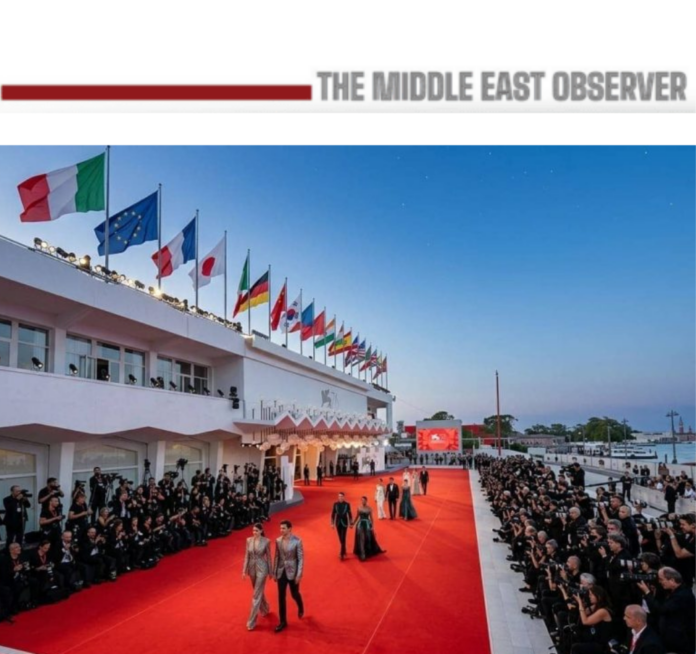
The Venice Film Festival is increasingly becoming more than an awards-season launchpad. Its parallel industry market connects unfinished films, intellectual property, financiers, streamers and production locations — with Saudi Arabia and Egypt gaining a small but strategically important position inside that ecosystem.
The economic story behind the 2026 Venice Film Festival will unfold largely away from the premieres.
From September 3 to 9, the Venice Production Bridge will bring together producers, financiers, banks, distributors, sales agents, broadcasters, streaming platforms, film commissions and post-production companies. Its purpose is straightforward: move projects from ideas and unfinished productions towards financing, completion and commercial distribution.
That makes Venice part festival and part capital marketplace for intellectual property.
The clearest example is the Venice Gap-Financing Market. This year, organisers selected 65 projects from more than 370 applications. Their teams will hold one-to-one meetings with potential investors and commercial partners including private financiers, banks, distributors, sales agents, television commissioners and streaming platforms.
The model addresses one of independent cinema’s biggest structural problems: projects can secure development money and still fail because they cannot close their final financing package or find distribution.
Venice is positioning itself in that gap.
Its Book Adaptation Rights Market, meanwhile, brings 30 international publishers and literary agencies into meetings with producers seeking books, biographies, comics and other intellectual property that can be converted into screen productions.
Another programme connects producers directly with streamers, while the new VPB Locations Market brings film commissions and studios into the same ecosystem, competing partly through production infrastructure, locations and financial incentives. Venice also operates a dedicated immersive market covering virtual, augmented and mixed-reality projects.
In economic terms, Venice is bringing more of the film value chain under one roof: IP acquisition → development → financing → production location → post-production → distribution → streaming.
Where the Middle East enters
For MENA, the particularly relevant mechanism is Final Cut in Venice, which has supported unfinished films from Africa and from Iraq, Jordan, Lebanon, Palestine, Syria and Yemen since 2013.
Six work-in-progress films have been selected for the 2026 programme, which will place their producers in front of buyers, distributors, post-production companies, festival programmers and potential partners between September 6 and 8.
Saudi Arabia and Egypt have established direct positions within this system.
The Saudi Red Sea Fund, part of the Red Sea Film Foundation, is offering €5,000 to a Final Cut project. The Foundation is supporting Final Cut for a fifth consecutive year and describes its broader mandate as developing film activity in Saudi Arabia while backing filmmakers across the Arab world, Africa and Asia.
Egypt’s El Gouna Film Festival is offering a separate $5,000 award to an Arab project, together with participation in its CineGouna industry platform.
The amounts themselves should not be overstated. A €5,000 or $5,000 award will rarely determine whether a feature film gets made.
The strategic value lies elsewhere.
A Venice-backed award provides validation at precisely the stage when filmmakers are trying to persuade sales agents, festivals, distributors and other investors to commit money or market access. El Gouna and Red Sea are therefore buying something more valuable than a small financial interest: a place inside an international project-discovery network.
That gives Gulf and Egyptian film institutions earlier visibility into emerging directors, stories and intellectual property rather than waiting to acquire films after they become successful.
Saudi Arabia’s wider calculation
For Saudi Arabia, the Venice connection complements a much larger strategy.
The Red Sea Film Foundation operates funding, laboratories and a film market alongside its Jeddah festival, while the Kingdom is simultaneously attempting to attract physical film production, build studios and develop domestic talent.
Its Venice participation therefore serves both cultural and industrial objectives: discovering projects, building international relationships and increasing Saudi Arabia’s credibility as a source of film capital.
The strategic competition is not simply over which country hosts the biggest festival. It is increasingly about who enters promising film projects earliest and controls the financing, production services, distribution relationships and intellectual property around them.
Egypt’s opportunity — and the gap
Egypt approaches the same market from a different position.
It possesses the Arab world’s deepest historic film-production base and a large domestic talent pool. CineGouna gives it an established bridge into independent Arab filmmaking, and its Venice Final Cut award reinforces that connection.
But Egypt faces a larger economic question: whether it can translate its cinematic heritage into a modern film-services and financing industry.
That means competing not just through festivals, but through production incentives, predictable permitting, studio capacity, skilled crews, post-production, international co-production structures and private investment.
This is where the Venice model matters.
The festival demonstrates that the modern cinema economy is no longer divided neatly between filmmakers, festivals and distributors. Financing, technology, intellectual property, tourism, production incentives and streaming now intersect much earlier in a project’s life.
For MENA governments seeking to build creative industries, the lesson is therefore bigger than cinema.
Film festivals are becoming investment infrastructure.
Venice has recognised that the value of a successful festival is not simply measured by celebrities arriving on boats or the films winning prizes. It is increasingly measured by how much intellectual property, financing and commercial activity passes through the ecosystem surrounding it.
Saudi Arabia is positioning itself aggressively inside that network. Egypt already has an entry point through El Gouna and its historic production base.
The next competition will be over who turns those connections into a sustainable regional film economy.
Related news:
How Hollywood and Luxury Brands Created a Win-Win Business Model
Oscars, A Stage for Cinema — and a Voice for Peace
Read also:
Norway Moves to Tighten Rules on AI-Powered Smart Glasses
Europe Under Fire: Wildfires Scorch an Area the Size of Luxembourg