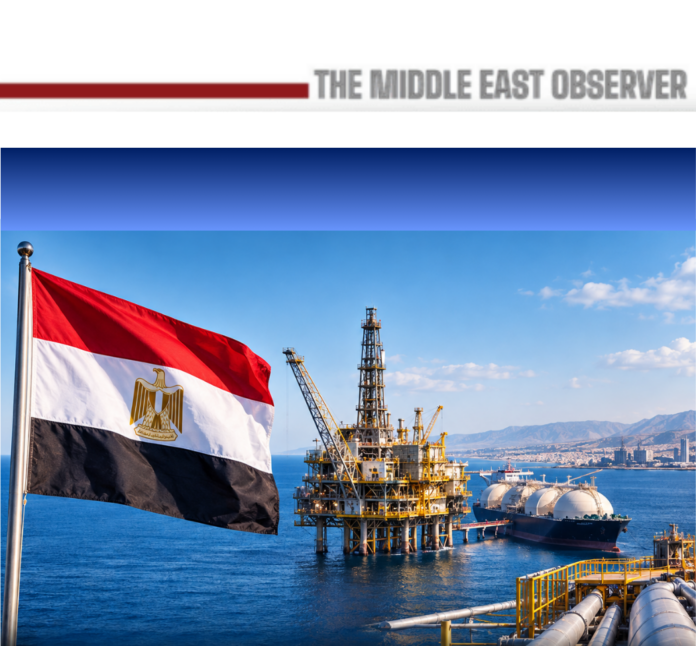
Gas agreements with Cyprus, new upstream investments, renewable electricity contracts and cross-border power links are expanding Egypt’s regional energy role. The economic test is whether these projects can reduce import dependence while generating sustainable returns.
CAIRO, Egypt is accelerating its transformation into an Eastern Mediterranean energy hub through a growing portfolio of natural gas developments, renewable power contracts and cross-border electricity projects, seeking to turn its established infrastructure into a regional platform for energy production, processing and trade.
The expansion comes as the country faces a substantial domestic energy bill. Petroleum imports rose 27.6% to $24.9bn in the fiscal year ending June 2026, pushing the petroleum trade deficit up 31.5% to $18.3bn, according to Central Bank of Egypt figures released on 12 October.
Natural gas accounted for $4.7bn of the $5.4bn increase in petroleum imports, while crude oil purchases added another $1.9bn, partly offset by a decline in refined-product imports.
The figures explain the urgency behind Cairo’s emerging two-track strategy: reducing costly domestic supply shortages while expanding the commercial use of Egyptian infrastructure to handle energy produced elsewhere in the region.
Recent agreements with Chevron, Eni, TotalEnergies and Gulf partners are moving that strategy forward. At the same time, completed solar projects, new wind and battery-storage contracts, and electricity connections with Saudi Arabia and Europe are broadening the country’s energy ambitions beyond natural gas.
Cypriot Gas Moves From Agreements Towards Production
The most advanced regional development came on 28 July, when Italy’s Eni and France’s TotalEnergies approved the development of Cyprus’s offshore Cronos gas field.
The final investment decision covers a project expected to begin production in 2028, reaching approximately 500mn cubic feet daily, equivalent to about 2.8mn tonnes of LNG annually.
Under the development plan, Cypriot gas will reach Egypt through a subsea pipeline, be processed using existing facilities associated with the Zohr field, and move to the Damietta LNG terminal for export, principally to European markets.
Eni operates Cronos with a 50% interest, while TotalEnergies holds the remaining 50%. TotalEnergies expects to market half the resulting LNG.
The agreement marks an important commercial advance. Cyprus will supply the gas, Egypt will provide processing and export infrastructure, and international buyers will provide demand.
Chevron’s Aphrodite project could establish a second major Cypriot supply route, although it remains at an earlier investment stage.
On 8 October, Petroleum Minister Karim Badawi met Chevron executives in Athens to complete the remaining technical, legal and commercial arrangements for connecting Aphrodite to Egypt.
The estimated $4bn-plus development includes a floating production facility and a subsea pipeline designed to carry up to approximately 800mn cubic feet of gas daily into Egypt’s network.
The partners are working towards decisions on long-lead equipment procurement and the project’s final investment approval. NewMed Energy, which owns 30% of Aphrodite, anticipates a final investment decision in 2028 and first production in 2031.
A memorandum covering the proposed sale of Aphrodite’s recoverable gas to Egyptian Natural Gas Holding Company EGAS provides a foundation for the project’s commercial structure, although definitive contractual arrangements remain necessary.
Ownership is also changing. On 31 July, Shell agreed to sell its subsidiary holding a 35% interest in Aphrodite to Hungary’s MOL Group for up to $720mn, with completion expected in 2027 subject to regulatory and other conditions. Chevron retains a 35% operating interest.
Egypt’s regional portfolio extends beyond these two fields. An agreement signed with ExxonMobil and QatarEnergy in May is examining whether further Cypriot discoveries can be developed and commercialised through Egyptian infrastructure. The Petroleum Ministry reported progress on technical and commercial studies in August, but no final investment decision has been announced.
Meanwhile, the Chevron-operated Leviathan consortium approved a $2.36bn expansion of the Israeli gas field in January, with additional production expected from 2029. The development supports expanded regional supply arrangements, including deliveries to Egypt, although cross-border pipeline dependence remains an important supply-security consideration.
Together, the projects create a staggered development pipeline rather than a single immediate source of new gas.
Cronos has secured investment approval. Aphrodite is advancing towards that stage. The ExxonMobil–QatarEnergy projects remain under study. Their financial contributions must therefore be assessed against different investment commitments, execution risks and production schedules.
For Egypt, greater throughput could improve utilisation of infrastructure built around its own Mediterranean gas discoveries. The commercial return, however, will depend on gas-purchase terms, liquefaction and transportation charges, operating expenses and the share of export proceeds retained by Egyptian entities.
The gross value of LNG exports cannot be treated automatically as Egyptian foreign-exchange earnings.
Domestic Gas Recovery Becomes the Immediate Priority
While regional developments promise longer-term returns, Egypt’s more urgent challenge is rebuilding domestic production.
Reuters reported in July that Egyptian gas output averaged below 4.4bn cubic feet daily during fiscal 2025/26, with official planning documents projecting approximately 4.2bn cubic feet daily in the current fiscal year.
Imports from pipeline suppliers and LNG cargoes totalled around 985bn cubic feet during 2025/26, equivalent to approximately 2.7bn cubic feet daily. Official projections reviewed by Reuters put imports at 1.081tn cubic feet for 2026/27.
The figures underline the scale of the task. Egypt needs to replace declining output from mature fields before new discoveries can produce a sustained net increase in national supply.
The government has responded by accelerating drilling, connecting additional wells and revising investment arrangements with international petroleum companies.
BP brought its Fayoum-4 well in the West Nile Delta into production in August, adding approximately 80mn cubic feet daily, two years ahead of its original schedule, according to the Petroleum Ministry.
The well forms part of a four-well drilling programme valued at around $700mn, demonstrating the potential to obtain earlier production by using existing offshore facilities.
Further additions are planned.
On 14 October, Asharq Bloomberg reported, citing an unnamed government official, that BP aims to add 65mn cubic feet of gas and 1,625 barrels of condensates daily from the Raven field beginning in March 2027, through investment estimated at $100mn.
At EGAS’s September general assembly, the government outlined targets for approximately 330mn cubic feet of additional daily gas production, including 250mn from Zohr and West Mina and another 80mn from Meleiha in the Western Desert.
These are project-level targets, not verified increases in October’s national output. They also cannot be added indiscriminately to existing production figures or other drilling forecasts because of possible overlap and natural field decline.
Investment commitments are expanding alongside the drilling programme.
On 5 October, Chevron signed a new offshore exploration agreement for Egypt’s Lotus block, committing a minimum investment of $88mn, including two exploratory wells and seismic-data processing.
Arcius Energy, the BP–XRG joint venture, is pursuing further development opportunities, including the Harmattan field.
The government’s June announcement that accumulated arrears to foreign petroleum partners had been cleared addressed a longstanding obstacle to upstream investment. Arrears had reached approximately $6.1bn in mid-2024.
Regular payment of subsequent obligations, commercially viable producer incentives and dependable recovery of investment costs will remain essential if accelerated drilling is to translate into sustained production.
In the meantime, Egypt has expanded LNG import and regasification capacity to protect electricity generation and industrial supply.
Reuters reported in July that Cairo was negotiating contracts with major international suppliers for 15–18 LNG cargoes monthly over at least three years, potentially costing $8bn–$11bn annually. The full proposed package had not been confirmed as finalised.
Such agreements could reduce emergency procurement risks, but their financial value will depend on pricing formulas, delivery obligations and international gas prices.
The strongest reduction in import exposure would come from sustained domestic production growth, supported by lower gas consumption in electricity generation.
Renewable Contracts Add a Second Route to Energy Resilience
That second route is gathering momentum as Egypt expands solar, wind and battery-storage capacity.
The New and Renewable Energy Authority reported installed renewable capacity of approximately 9.1 gigawatts in February 2026, including the first contribution from Scatec’s Obelisk solar project.
On 12 August, Norway’s Scatec confirmed commercial operation of Obelisk’s second phase, completing approximately 1.1 gigawatts of solar generation and a 100-megawatt battery system with 200 megawatt-hours of storage.
The completed facility is expected to produce more than 3 terawatt-hours of electricity annually under a 25-year, dollar-denominated power purchase agreement.
That is already operating capacity, unlike several larger projects still in development. Obelisk’s first phase was included in the earlier national renewable-capacity figure and should not be counted twice.
The economic implications are measurable.
If Obelisk’s forecast annual generation entirely displaced gas-fired electricity, it could replace an indicative 60mn–75mn cubic feet of gas consumption daily, depending on the efficiency of the power stations displaced.
This is an illustrative calculation, not a reported national fuel saving. The actual benefit depends on grid dispatch, demand, storage losses and the sources of electricity replaced.
Nevertheless, it demonstrates how renewable electricity can contribute to gas-import substitution.
Egypt’s contracted renewable portfolio is expanding considerably.
In January, Scatec signed another 25-year power purchase agreement covering 1.95 gigawatts of solar capacity and 3.9 gigawatt-hours of battery storage, with forecast annual generation of approximately 6 terawatt-hours once completed.
In March, the government signed further renewable agreements involving Kemet Group, including a proposed 2,000-megawatt solar project, two additional solar projects totalling 720 megawatts and large-scale battery storage.
The March package also included land-use arrangements for a separate 900-megawatt Ras Shokeir wind project being developed by a consortium involving Orascom Construction, France’s ENGIE and Japanese interests associated with Toyota Tsusho.
In September, Infinity Power and Hassan Allam Utilities Energy signed a power purchase agreement for another 1-gigawatt Ras Shokeir wind development.
The distinction between these arrangements matters. A signed power purchase agreement provides a contractual basis for electricity sales; a land-use agreement secures a development right. Neither necessarily means financial close, construction completion or commercial generation has occurred.
Grid infrastructure is therefore becoming as important as generating capacity.
On 15 June, the European Investment Bank and European Union announced financing of up to €690mn for Egypt’s electricity network, comprising a €600mn loan and up to €90mn in grants.
The programme is designed to strengthen transmission infrastructure and support the integration of additional solar and wind generation, with the EIB-backed implementation phase scheduled for 2027–2030.
This investment addresses a central constraint: new renewable capacity cannot deliver its intended economic benefit without sufficient transmission, storage and reliable grid operation.
Egypt is targeting a 45% renewable contribution to its electricity mix by 2028. Achieving that ambition will depend on installed capacity becoming operational, the completion of network upgrades and the electricity actually generated.
Long-term renewable contracts also carry financial obligations. Dollar-denominated power purchase agreements can improve investment certainty but create foreign-currency exposure for electricity buyers.
Their economic merit must therefore be measured against the full cost of electricity supplied, including financing and network expenses, and the value of imported gas displaced.
Regional Electricity Trading Broadens the Hub Strategy
Egypt’s energy ambitions are also extending across national electricity networks.
On 13 October, Egypt and Saudi Arabia reviewed final testing arrangements for their $1.8bn electricity interconnection, which has a planned exchange capacity of 3,000 megawatts.
Officials expect the project to enter its next operational stage in the coming weeks following completion of trials.
The connection can improve system flexibility by allowing electricity exchanges between markets with different demand patterns and generating resources.
Further west, the proposed 3,000-megawatt GREGY interconnector between Egypt and Greece could eventually provide a route for Egyptian renewable electricity into European markets.
The project remains subject to technical studies, environmental approvals, financing and final investment decisions.
These developments represent a wider commercial proposition: Egypt could increasingly participate in both regional natural gas trade and cross-border electricity markets.
Such connections can improve grid resilience and create new trading opportunities, but export capacity must be balanced against domestic electricity needs.
Global Supply Disruptions Reinforce Egypt’s Strategy
The international energy crisis has made supply diversification more urgent.
Reuters reported on 12 October that Qatar’s LNG exports remained severely constrained following damage to infrastructure and disruption to shipping through the Strait of Hormuz. September shipments were approximately one-quarter of pre-war levels.
European gas inventories are also below normal seasonal levels, intensifying competition for available LNG cargoes and putting pressure on international prices.
For Egypt, the consequences are immediate.
At an illustrative import volume of 1bn cubic feet daily, a sustained $1 increase in the price per million British thermal units would add approximately $365mn to annual procurement costs, before differences in gas quality and contractual terms.
The calculation illustrates the sensitivity of an import-dependent energy system to international prices.
Higher global gas prices could improve the future commercial attraction of Cypriot LNG exports through Egypt. Yet the same prices increase the cost of gas imported to supply Egyptian power stations and industry.
The July fire affecting a floating LNG import and regasification unit and a storage vessel at Damietta Port also highlighted the importance of operational security and contingency planning. The incident involved import infrastructure and should be distinguished from the Damietta LNG export plant.
The government is responding through a combination of domestic production incentives, diversified procurement, expanded regasification capacity, renewable generation and regional infrastructure partnerships.
Its latest agreement with Saudi Arabia, signed on 11 October, adds cooperation in petroleum and gas trading, transportation, storage, distribution and petrochemicals. The memorandum broadens the institutional framework for commercial cooperation, although it does not itself establish new contracted gas supplies.
The principal challenge is implementation. Energy markets may also change substantially before the Cypriot projects expected in 2028–2031 enter production.
Future LNG earnings cannot be valued simply against October 2026 prices. They will depend on European demand, competing international LNG supply, security conditions and long-term commercial agreements.
The Economic Test of Egypt’s Energy-Hub Ambitions
Egypt’s transformation is taking shape through developments at different stages of maturity.
BP’s Fayoum-4 well and Scatec’s completed Obelisk project are contributing to the domestic energy system. Additional gas wells and contracted renewable developments offer potential medium-term improvements.
Cronos has secured investment approval for production targeted in 2028, while Aphrodite and other Cypriot discoveries represent subsequent opportunities to expand regional gas processing and trading.
The Saudi electricity connection is approaching operation, while the proposed Greece interconnector could eventually establish a renewable electricity export route to Europe.
Together, these developments could diversify Egypt’s energy business across gas production, processing, storage, renewable generation and electricity trade.
But their economic benefits must be measured separately.
Additional domestic gas can reduce imports only after allowing for declining output elsewhere. Renewable power can lower fuel requirements only when it is generated, transmitted and used in place of gas-fired electricity. Regional gas exports can produce lasting benefits only when processing and trading revenues exceed the associated costs.
Egypt’s strongest long-term position would combine reliable domestic energy supplies with commercially competitive infrastructure services for neighbouring producers and consumers.
The country already possesses much of the physical infrastructure needed to pursue that role. New regional agreements and electricity investments are expanding its potential utilisation.
The decisive measure of success will be whether this growing network of contracts delivers lower net energy-import costs, stronger industrial competitiveness and sustained foreign-exchange earnings — turning Egypt’s Mediterranean location into lasting economic resilience.
Related News:
Egypt’s Crude Oil and Petroleum-Product Import Bill Projected to Double
Examines Egypt’s rising energy-import exposure, refinery strategy and pressure from international fuel prices.
EGAS Targets 330mn cf/d New Gas Output Before End-2026
Details Egypt’s drilling programme, field-development priorities and efforts to reverse declining domestic gas output.
Read Also:
Egypt, South Korea Forge Strategic Partnership Centred on Industry and Investment
Covers new cooperation in clean energy, electricity transmission, grid modernisation and industrial investment.
Middle East Crude Nears Pre-War Levels, but Energy Crisis Shifts Downstream
Explains why continued LNG and refined-product disruptions pose risks even as regional crude exports recover.