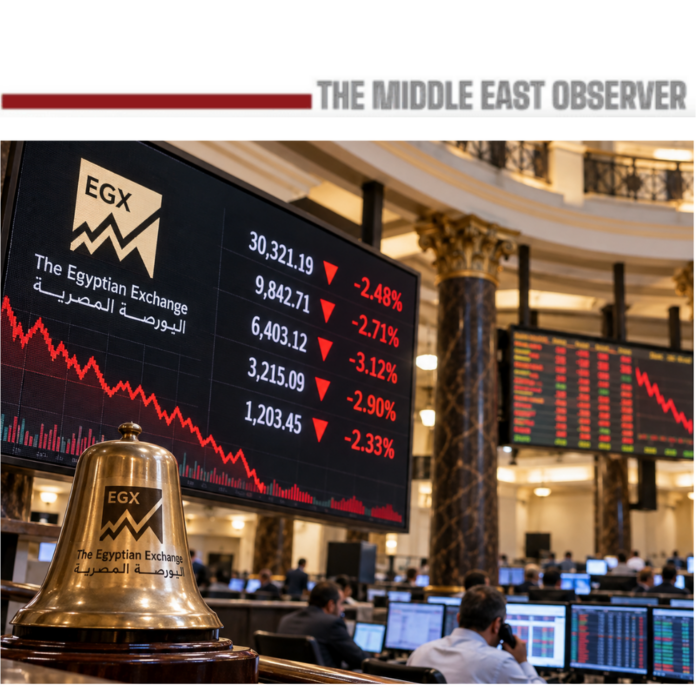
CAIRO — The Egyptian Exchange ended the week lower on Thursday, but the anatomy of the correction changed: losses intensified across smaller stocks even as pressure on the EGX30 eased, while foreign institutions maintained substantially stronger demand for Egyptian sovereign debt than for listed equities.
The EGX30 fell 0.83% to 53,776.69 points, completing five consecutive declining sessions and taking its weekly loss to 3.1%. The benchmark remains 28.6% higher in 2026, leaving the retreat a correction within a still-strong year rather than, so far, a reversal of the broader advance.
The more important deterioration occurred beneath the benchmark. The EGX70 EWI fell 1.92% Thursday and 5.82% over the week, while the EGX100 EWI lost 1.70% on the day and 5.23% weekly. Small- and mid-cap losses were therefore substantially deeper than the EGX30’s, signalling that weakness has migrated from benchmark de-risking into a broader repricing of equity risk.
Yet Thursday also contained an early stabilisation signal. The EGX30 fell as low as 52,793.23 before recovering to 53,776.69 — almost 1,000 points above its intraday trough. That contrasts with Wednesday, when the benchmark closed at its session low, suggesting selective demand returned to larger stocks even as broader-market pressure intensified.
Turnover also increased to approximately EGP 10.2bn from EGP 9.1bn Wednesday, although it remained about 12.8% below its 90-day average. Participation therefore increased as the sell-off broadened without yet reaching the expanding-volume profile normally associated with broad liquidation.
Foreign Institutions Draw a Clearer Line
The most important distinction is no longer simply between Egyptian and foreign investors, but between the assets foreign institutions are willing to own.
Across the week, foreign investors sold a net EGP 984.8mn of listed equities, almost entirely driven by institutions, which recorded net equity sales of EGP 993.2mn. Arab investors also sold a net EGP 484.5mn. Egyptians accounted for 89.4% of equity trading and remained the principal domestic counterweight to offshore selling.
Government debt told a very different story.
Foreign institutions bought EGP 80.79bn of Treasury bills and bonds and sold EGP 25.81bn, producing net purchases of EGP 54.98bn. Arab institutions added another EGP 19.92bn of net purchases.
The data do not establish that the same portfolios sold equities and bought Treasury instruments. They do, however, establish where foreign institutional demand was materially stronger.
Egyptian risk is still attracting foreign capital; listed equities are receiving far less of that conviction than sovereign debt.
High Sovereign Yields Raise the Equity Hurdle
The allocation preference has a straightforward economic logic.
The latest Treasury auctions before Thursday cleared at weighted-average accepted yields ranging from 24.63% on 91-day bills to 25.81% on 273-day instruments, with six- and 12-month bills also above 25%.
At those yields, equities face a formidable competing return. Listed companies must offer more than nominal upside: earnings growth, valuation re-rating and corporate catalysts must compensate investors for materially greater business, execution and market risk.
That hurdle remains in place after the Central Bank of Egypt kept its overnight deposit rate at 19%, lending rate at 20% and main-operation rate at 19.5% after Thursday’s market close. Because the decision came after trading ended, Thursday’s session did not price the outcome; the unchanged rates nevertheless preserve the high-carry environment confronting equities when trading resumes.
FX conditions, meanwhile, remained orderly. The CBE’s official dollar rate ended Thursday at EGP 51.7144 for buying and EGP 51.8520 for selling, limiting evidence of broader cross-asset stress despite the equity correction.
Breadth Is Now the Test
The EGX30 has declined in every session of the week, but the benchmark alone now understates the extent of the correction. The near-6% weekly fall in the EGX70 shows that risk reduction has spread substantially further through the market.
The next test is therefore breadth, not simply whether the EGX30 rebounds.
A large-cap recovery alone would provide limited evidence of stabilisation. A rebound accompanied by stronger small- and mid-cap participation, moderating foreign equity sales and increased institutional buying would provide a more convincing signal that the correction is beginning to mature.
For now, foreign institutions are not rejecting Egyptian risk. They are pricing it selectively — and high-yielding government debt is commanding considerably greater conviction than equities.
Related news:
EGX30 Holds Near Records as Broader Market Loses Momentum
Foreign Buying Gives Way to Domestic Buying as (EGX) Ends Week Higher
Read also:
How Digital Money Can Strengthen Monetary Policy Across the MENA Region
Saudi Arabia Seeks Private Capital for Major Makkah Development