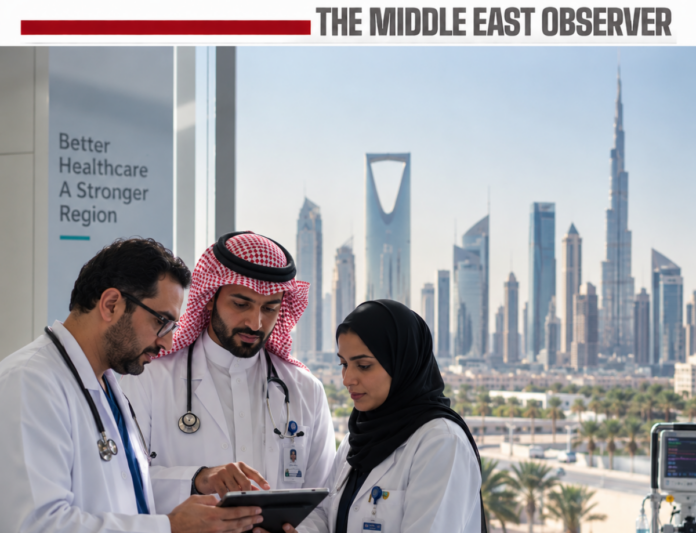
Egypt, Saudi Arabia and the UAE account for 41 of the 50 positions in Forbes Middle East’s 2026 ranking of healthcare founders and shareholders, concentrating 82% of the list in three markets whose healthcare industries are developing along markedly different lines.
The UAE leads with 18 entries, or 36%, followed by Saudi Arabia with 13, or 26%, and Egypt with 10, or 20%.
The more significant development, however, is increasingly cross-border.
Egyptian pharmaceutical manufacturers are investing in Saudi production. Saudi healthcare groups are deploying capital into Egypt. UAE-based operators are expanding across both markets and further abroad. What was once primarily a collection of national healthcare industries is becoming a more interconnected regional market for capital, manufacturing, hospitals, technology and specialist care.
Forbes bases its ranking on a combination of company size, ownership, industry impact, achievements during 2025 and 2026, experience, operational diversity, transparency and sustainability. It is therefore not a ranking of national healthcare systems or companies by revenue alone, but an editorial measure of corporate influence and entrepreneurial weight.
Seen through that lens, the ranking provides a useful map of where healthcare ownership, investment and expansion are concentrating across the Middle East.
Egypt: Pharmaceutical Depth Moves Beyond the Domestic Market
Egypt accounts for one-fifth of the Top 50 and has the clearest pharmaceutical concentration of the three leading markets. Six of its 10 entries, or 60%, are classified in pharmaceuticals, alongside diagnostics, hospitals and outpatient care.
Sherine Helmy of Pharco Pharmaceuticals ranks No. 10, making her Egypt’s highest-ranked entry. Pharco combines a large domestic manufacturing base with a growing regional strategy, including planned pharmaceutical production in Saudi Arabia.
At No. 16, Riad Armanious of EVA Group reflects a similar shift towards higher-value manufacturing and internationalisation. EVA has expanded into oncology and research-intensive medicines while developing new manufacturing capacity outside Egypt.
Mahmoud Abdel Gawad and Omar Abdel Gawad of Ibnsina Pharma rank No. 19. Their position highlights another important part of Egypt’s healthcare infrastructure: pharmaceutical distribution and logistics. Ibnsina connects producers with pharmacies and medical providers through one of the country’s largest distribution networks.
Egypt’s representation broadens beyond pharmaceuticals with Hend El Sherbini of Integrated Diagnostics Holdings at No. 21. IDH has developed a regional diagnostics platform around laboratory scale, automation and specialist testing, positioning diagnostics as one of Egypt’s most exportable healthcare-service capabilities.
At No. 27, Fahad Khater of Alameda Healthcare Group represents the institutional hospital market. Alameda’s ability to attract large-scale private investment for expansion in Egypt and the Gulf points to growing investor interest in hospital assets capable of becoming regional platforms.
The lower half of Egypt’s representation shows the same diversification. Magda Habib and Mairose Doss of Dawi Clinics rank No. 33, bringing a scalable outpatient model built around multidisciplinary clinics and technology. Heba El Sewedy of Ahl Masr Foundation and Burn Hospital is No. 37, representing specialist nonprofit healthcare focused on burns treatment and research.
Pharmaceutical manufacturing then returns strongly. Magdy Elba of APEX Pharma ranks No. 38, with APEX expanding production in Egypt while establishing manufacturing in Saudi Arabia. Mahmoud Farrag of Parkville is No. 41, reflecting growing private-equity interest in pharmaceutical and consumer-health businesses. Mazen ElMenshawy of Manapharma completes Egypt’s representation at No. 45, with a business centred on pharmaceutical production, distribution and technology transfer.
Egypt’s Impact: Industrial Strength Becomes Regional
The central message from Egypt’s representation is its industrial depth.
Pharco, EVA, Ibnsina, APEX, Parkville and Manapharma span manufacturing, distribution, exports, specialist therapies and technology transfer. This gives Egypt a healthcare base that is more industrial than hospital-led.
The next phase is already under way.
Pharco, EVA and APEX are among the Egyptian groups expanding into Saudi Arabia, demonstrating that domestic manufacturing scale is increasingly being converted into regional capacity. At the same time, Alameda and Dawi show that hospital and outpatient models are attracting capital and becoming more scalable.
Egypt’s opportunity is therefore to move further up the healthcare value chain—from volume manufacturing towards complex therapies, contract production, diagnostics, research-intensive products, specialist care and export-oriented healthcare services.
The ranking portrays Egypt as a healthcare manufacturing and entrepreneurial base that is beginning to operate regionally rather than solely domestically.
Saudi Arabia: Healthcare Capacity Becomes a Major Investment Market
Saudi Arabia accounts for 13 positions, with hospitals dominating the country’s representation.
Nine of the 13 Saudi-based entries—about 69%—are hospital or hospital-led groups under Forbes’ classifications, reflecting the scale of capacity expansion under way across the Kingdom.
At No. 2, Sulaiman Al Habib of Dr. Sulaiman Al Habib Medical Services Group is the highest-ranked Saudi entry. HMG has developed one of the region’s largest private healthcare systems, combining hospitals, clinics, physicians and pharmacies with substantial financial scale.
Mazen Fakeeh of Fakeeh Care Group ranks No. 6, illustrating how acquisitions are becoming an important route to expansion alongside new hospital development.
At No. 8, Ayman Tamer of Tamer Group represents the pharmaceutical, medical-supply and healthcare-technology side of the market, while Nassir Sultan Alsubaie of Mouwasat Medical Services ranks No. 9, reflecting the continued expansion of large listed hospital networks.
Specialist care also features prominently. Mutasim Alireza of Magrabi Health ranks No. 12, built around ophthalmology and dentistry, while Mohammed Al Hammadi of Al Hammadi Holding is No. 13, combining hospital capacity with specialist services and new healthcare partnerships.
Malek Almoosa of Almoosa Health ranks No. 17, representing another family-controlled hospital platform using long-term financing to expand. At No. 18, Hazem Zagzoug of Andalusia Health Group illustrates the growing cross-border flow of Saudi healthcare capital, including investment into Egypt.
Expansion accelerates further with Fouziyah Aljarallah of Hayat National Hospitals Group at No. 24, whose strategy centres on adding hospitals, beds and geographic coverage.
Saudi Arabia’s industrial healthcare ambition is represented by Mohamed Mazen Batterjee of Batterjee Pharma at No. 25, where localisation and contract manufacturing are central to growth. Khalid Yassin of United Pharmaceutical Company ranks No. 29, reflecting consolidation in pharmacy retail and distribution.
Further down the ranking, Mohammed Alungal of Abeer Medical Group is No. 40, expanding across hospitals, clinics and day surgery, while Hussain Alnezir of Dar Afia Hospital at No. 46 represents the evolution of specialist facilities into broader multispecialty platforms.
Saudi Arabia’s Impact: Capacity, Consolidation and Localisation
Saudi Arabia’s ranking captures a healthcare sector in the middle of a major capacity-building cycle.
Large hospital groups are adding beds, acquiring competitors and extending specialist services. Financing and consolidation are allowing operators to grow faster than organic hospital construction alone would permit.
At the same time, the Kingdom is trying to deepen the industrial base that supports those hospitals.
Batterjee Pharma and Tamer Group point towards greater localisation of pharmaceuticals, medical technology and healthcare supplies. The objective is increasingly not simply to expand care delivery, but to produce more of what the expanding healthcare system consumes domestically.
Saudi Arabia therefore emerges as the region’s clearest example of healthcare capacity becoming a large-scale investment industry, supported by hospital consolidation, specialist medicine and localisation.
UAE: Integration Creates the Region’s Broadest Healthcare Platform
The UAE leads with 18 entries, but its real strength lies in the breadth of its healthcare ecosystem.
Unlike Egypt’s pharmaceutical concentration or Saudi Arabia’s hospital dominance, the UAE spans integrated healthcare systems, hospitals, diagnostics, insurance, pharmacies, fertility, research, technology, pharmaceuticals and healthcare investment.
At No. 1, Shaista Asif of PureHealth tops the regional ranking. PureHealth has assembled one of the Middle East’s most integrated healthcare platforms, combining hospitals, clinics, diagnostics, insurance, pharmacies and technology while investing internationally.
Azad Moopen of Aster DM Healthcare ranks No. 3, representing another large cross-border platform operating across multiple healthcare segments and markets.
At No. 4, Shamsheer Vayalil of Burjeel Holdings adds another major hospital and healthcare-asset group, reinforcing the UAE’s position as a headquarters for regional operators.
The ecosystem extends beyond hospital ownership. Zaid S. Al Khayyat of Al Khayyat Investments ranks No. 11, with activities spanning pharmaceuticals, diagnostics, medical technology and logistics. Majid Al Qassimi of Gulf Medical Projects Company is No. 14, combining hospitals with pharmaceuticals, home care and digital services.
Thumbay Moideen of Thumbay Group ranks No. 15, integrating hospitals with medical education and research. Marwan Ibrahim Nasser of Al Tadawi Healthcare Group is No. 20, combining specialist hospital care with community and workplace clinics.
Specialist medicine provides another growth layer. Michael Fakih of Blue Ocean Health and Fakih IVF Group ranks No. 23, while Majd Abu Zant of Global Fertility is No. 28, showing how fertility care is becoming a regional business capable of expanding through acquisitions, technology and specialist networks.
Established hospital operators remain important. Zanubia Shams and Taher Shams of Zulekha Healthcare Group rank No. 30, while Jamil Ahmed of PRIME Health Holdings is No. 32, reflecting the progression from outpatient medicine towards broader hospital and pharmacy networks.
The UAE’s differentiation becomes clearer further down the ranking. Ali Hashemi and Ihsan Almarzooqi of Metabolic rank No. 36, bringing clinical research, digital medicine and data-driven chronic-disease management into the mix. Mohamed Mostafa of PDC ranks No. 39, adding clinical research and regulatory services.
Sunny Kurian of Dr. Sunny Healthcare Group is No. 43, while Sukhdeep Sachdev of Leader Healthcare ranks No. 44, extending the market into home care, medical technology, biotechnology and specialist infrastructure.
At No. 47, Ruchi Dana of DANA Group represents the growing overlap between healthcare, artificial intelligence, robotics and venture investment. Ghazi Koudsi of New Country Healthcare is No. 48, covering pharmaceuticals and regional distribution, while Sundeep Sahni and Nadin Karadag of Valeo Health rank No. 50, representing technology-enabled diagnostics.
UAE’s Impact: A Healthcare Headquarters Economy
The UAE’s 18 entries show an ecosystem that has moved beyond hospital ownership into integration.
PureHealth, Aster and Burjeel provide scale. Al Khayyat Investments and Leader Healthcare extend the value chain into technology, pharmaceuticals and infrastructure. Metabolic, PDC and Valeo add clinical research, data and diagnostics.
The result is a market capable of connecting capital, insurance, hospitals, laboratories, pharmaceutical supply, technology and research within increasingly integrated corporate structures.
The UAE also functions as a headquarters economy. Many operators based there derive growth from markets outside the country, giving the UAE influence disproportionate to the size of its domestic population.
Its competitive trajectory is increasingly tied to international acquisitions, AI, precision diagnostics, clinical research and deeper integration between healthcare providers, insurers and technology platforms.
The UAE therefore stands out as the region’s most diversified and internationally connected private healthcare hub.
Jordan: Pharmaceuticals and Specialist Care Retain Regional Weight
Outside the three dominant markets, Jordan contributes three entries and has the strongest representation among the remaining countries.
At No. 5, Said Darwazah of Hikma Pharmaceuticals is the highest-ranked figure outside Egypt, Saudi Arabia and the UAE. Hikma’s international manufacturing and commercial footprint makes it one of the region’s few genuinely global pharmaceutical businesses.
Manufacturing Anchors Healthcare Influenceof The Specialty Hospital ranks No. 26, while Abdullah Bashir of Jordan Hospital is No. 34. Together, they reinforce Jordan’s longstanding strengths in tertiary care, complex surgery and medical expertise.
Jordan’s prospects are therefore tied less to the large-scale infrastructure build-out seen in the Gulf and more to pharmaceutical exports, specialist medicine, teaching hospitals and medical tourism.
Morocco: Manufacturing Anchors Healthcare Influence
Morocco contributes two entries, both from pharmaceuticals.
Lamia Tazi of SOTHEMA ranks No. 22, while Ayman Cheikh-Lahlou of Cooper Pharma is No. 31.
Both companies have developed significant manufacturing and international distribution capabilities, giving Morocco a clear position as a North African pharmaceutical production base.
The opportunity is similar to Egypt’s, although at a smaller scale: export manufacturing, African expansion, contract production and international pharmaceutical partnerships.
Qatar: Healthcare Growth Through Capital
Qatar contributes two entries, both associated with diversified investment platforms.
Ramez Al-Khayyat of Estithmar Holding ranks No. 7, with healthcare investments extending across several regional markets. Mohammed Miandad VP of 33 Holdings is No. 42, combining conventional healthcare services with technology and AI.
Qatar’s position therefore rests less on domestic scale than on capital deployment and portfolio expansion, allowing healthcare influence to extend beyond the country’s population base.
Tunisia: A Specialist Pharmaceutical Niche
Tunisia contributes one entry.
Olfa Gam of Cytopharma ranks No. 49, representing specialised pharmaceutical manufacturing, particularly in technically demanding cytotoxic medicines.
Its inclusion shows how smaller markets can compete through technical expertise and higher-value niches rather than volume alone.
Axios International: Healthcare Beyond Physical Assets
One entry does not fit neatly into a single national market.
Joseph Saba of Axios International ranks No. 35, with Forbes listing his base across the UAE, Ireland and France.
Axios operates in patient access and healthcare solutions rather than conventional hospital ownership or manufacturing. Its business sits between pharmaceutical companies, health systems and patients, increasingly using data and analytics to structure treatment-access programmes.
Its presence underlines the widening definition of healthcare investment, which increasingly includes data, clinical services, access platforms and healthcare infrastructure alongside hospitals and factories.
Three Markets Are Reshaping the Regional Healthcare Economy
The concentration of 82% of the ranking in Egypt, Saudi Arabia and the UAE reflects more than numerical dominance.
It reveals three distinct but increasingly connected healthcare models.
Egypt’s advantage is industrial: pharmaceuticals, manufacturing, distribution and a growing capacity to export healthcare businesses.
Saudi Arabia’s advantage is scale: hospitals, specialist care, consolidation and localisation supported by rising private and institutional investment.
The UAE’s advantage is integration: healthcare delivery, insurance, diagnostics, technology, research and capital assembled into increasingly international platforms.
The boundaries between those models are already narrowing.
Egyptian pharmaceutical manufacturers are establishing capacity in Saudi Arabia. Saudi healthcare groups are expanding into Egypt. UAE-based companies are deploying capital and operating platforms across both markets and beyond the region.
The ranking therefore captures a healthcare economy that is becoming less national and more regional.
Egypt is exporting industrial capability. Saudi Arabia is absorbing capital into healthcare capacity and localisation. The UAE is providing increasingly integrated corporate platforms with international reach.
Together, the three markets are becoming the principal centres through which much of the Middle East’s private healthcare investment, consolidation and cross-border expansion is being organised.
Related news:How Digital Health Is Reshaping Healthcare Delivery in Egypt
MENA Market Snapshot: How Healthcare, Biotechnology and Food Security Are Reshaping Regional Growth
Read also:Why Global Pharmaceutical Companies Continue Expanding Manufacturing Across MENA
MENA Market Snapshot: How Healthcare, Biotechnology and Food Security Are Reshaping Regional Growth