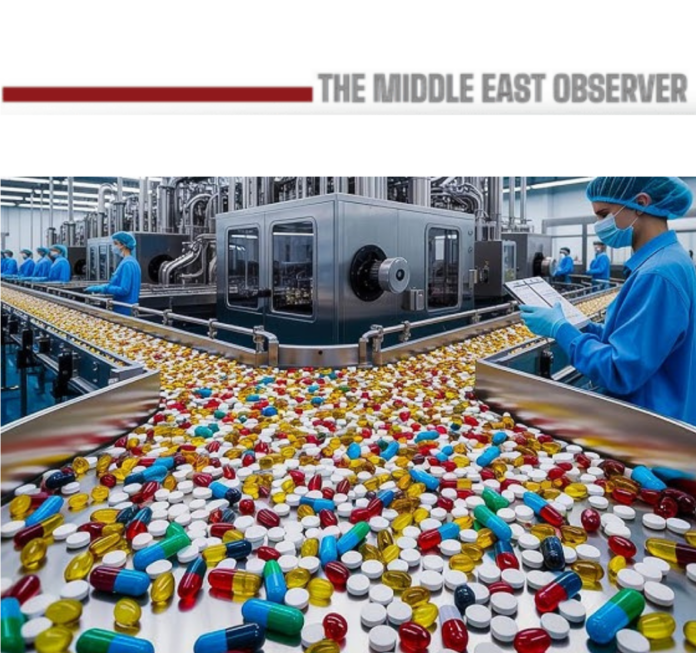
Local production has risen from an estimated 80-85% of medicines a decade ago to about 91% today, but continued dependence on imported active ingredients is pushing Egypt towards the next—and more difficult—stage of pharmaceutical industrialisation.
Egypt’s pharmaceutical industry has substantially expanded domestic production over the past decade, leaving policymakers with a more complex challenge: moving beyond finished medicines towards producing more of the ingredients on which those factories depend.
Industry estimates in 2016 put locally manufactured medicines at roughly 80-85% of consumption. The EDA now says domestic production covers about 91% of pharmaceutical products, although the historical and current figures are not necessarily calculated on an identical basis.
The industrial base has also deepened. The EDA has reported more than 179 pharmaceutical factories and 986 production lines, but only five factories specialising in pharmaceutical raw materials—a disparity that highlights how much thinner the industry’s upstream manufacturing base remains.
Egypt has meanwhile moved beyond conventional generics into more complex products including insulin, oncology medicines and plasma-derived therapies. But that progress has exposed the industry’s next deficiency: Egypt increasingly makes the finished medicine while importing much of what goes into it.
From finished drugs to imported inputs
Insulin demonstrates the shift. Health Minister Khaled Abdel-Ghaffar said in August that locally manufactured insulin now exceeds Egyptian demand, creating a surplus, although producers continue to rely on internationally sourced raw materials. Egypt began producing long-acting insulin glargine locally in December 2024 through a partnership between EVA Pharma and Eli Lilly.
Plasma-derived medicines show a similar divide between security of supply and a fully domestic manufacturing chain.
Egypt achieved clinical self-sufficiency in human albumin, immunoglobulins and coagulation factors in 2025 through Grifols Egypt for Plasma Derivatives. But Egyptian plasma-derived medicines have been manufactured through Grifols’ Spanish operations while the company develops the infrastructure intended to bring the manufacturing value chain onshore.
Grifols said in June that it had already invested €280mn in Egypt and would add €180mn under its 2026-29 expansion plan. The first phase of its industrial complex is due to open in October with plasma-processing, testing and logistics facilities. The company is targeting a collection capacity of as much as 3mn litres annually by 2029, although it has not identified that date as a deadline for completing the entire domestic manufacturing chain.
Oncology provides another measure of the imports being targeted. The EDA says a Sandoz-SEDICO technology-transfer agreement aims to localise five essential cancer medicines with an Egyptian market value exceeding EGP371mn and a combined import bill of about $10.7mn.
Such projects show how domestic production is moving into higher-value medicines. They also reinforce the larger industrial challenge: expanding finished-product capacity does not eliminate dependence on imported pharmaceutical inputs.
Active ingredients become the next industrial priority
The EDA is consequently targeting domestic production of the 50 most heavily imported active pharmaceutical ingredients, which account for nearly 78% of Egypt’s human-medicine API imports.
What matters is not the number 50, but the concentration of import dependence behind it.
Unlike industrial projects that must develop a market alongside new capacity, prospective API manufacturers would be supplying an established downstream pharmaceutical industry. A locally manufactured ingredient could also feed several formulations and competing manufacturers rather than replace a single imported finished drug.
The opportunity extends beyond the initial priority group. The EDA has said its broader strategy envisages localising about 400 APIs across 30 therapeutic categories, associated with roughly $1.57bn in imports. That figure relates to the wider programme, not specifically to the first 50 ingredients.
The authority has not publicly disclosed a complete list of the priority 50 alongside their individual import values and volumes. Those data will ultimately be important for investors assessing which ingredients can support commercially viable plants.
For investors, the opportunity therefore lies less in treating the priority ingredients as 50 separate projects than in the emergence of an upstream pharmaceutical-supply industry serving an existing domestic manufacturing base. Potential investment extends beyond APIs to pharmaceutical intermediates, specialty chemicals, technology-transfer ventures, analytical laboratories and the specialised utilities, purification and waste-treatment infrastructure required by upstream manufacturing.
The strongest projects are likely to combine high recurring import expenditure, several domestic buyers and sufficient regional export demand to support competitive scale.
The investment test
Scale and cost will determine how much of that opportunity Egypt can capture.
Egypt will be competing against Chinese and Indian suppliers that benefit from integrated chemical supply chains, specialised expertise and much greater production scale. Producing an API domestically at substantially higher cost could improve security of supply and reduce direct foreign-currency exposure while raising costs for Egyptian drugmakers and the healthcare system.
The test is therefore whether Egypt can produce priority inputs reliably and at internationally competitive cost.
Regional markets could improve those economics. The EDA says Egyptian pharmaceutical exports reached about $1.3bn in 2025 and is targeting $3bn by 2030, including $1.34bn to African markets. Its strategy also envisages pharmaceutical manufacturing hubs elsewhere on the continent, supported by technology transfer and greater regional production.
Larger export volumes could improve plant utilisation and help domestic API producers approach the scale needed to compete internationally. That favours ingredients with substantial Egyptian consumption, multiple local customers, strategic importance and credible export demand rather than localisation for its own sake.
For investors, the opportunity lies less in a list of 50 APIs than in the emergence of an upstream pharmaceutical-supply industry serving Egypt’s 179-plus drug factories and potentially wider African and Middle Eastern markets. Its success will depend on whether the country can combine technology transfer, sufficient scale and competitive costs.
Related news:
Egypt’s State Drug Group Targets EGP3.6bn Profit After Multiyear Overhaul
Can Egypt Turn Pharmaceutical Self-Sufficiency into Regional Leadership?
Read also:
Egypt’s North Coast Gold Rush: Tourism Booms as Al-Jafira Joins the Investment Map
The Maintenance Economy: The Industry Egypt’s Infrastructure Boom Is Creating