
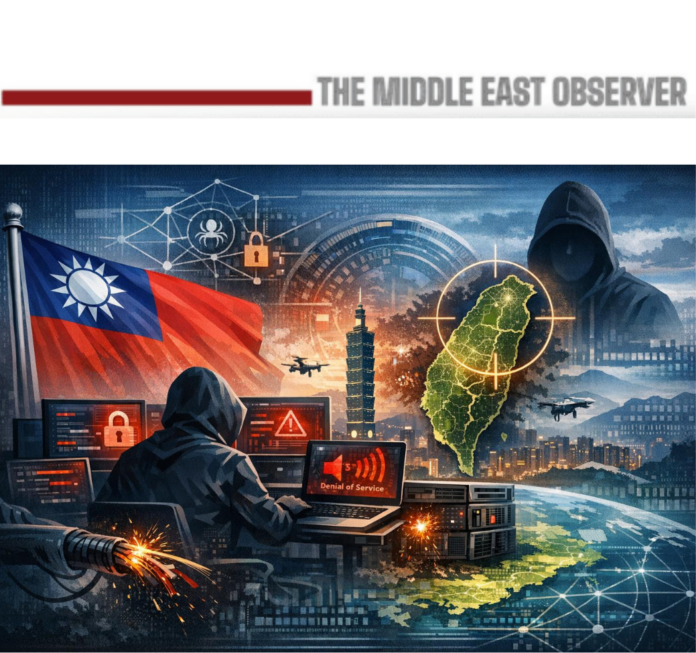
An AI-assisted attack against Taiwan shows how autonomous agents can accelerate conventional hacking techniques, challenging banks and regulators to rethink identity controls, third-party risk, and cyber resilience.
A cyberattack against Taiwan has provided one of the clearest demonstrations yet of how artificial intelligence could alter the economics and speed of digital intrusion—with implications extending from national security to the global financial system.
Taiwan’s Ministry of Digital Affairs said on August 13 that government agencies had been targeted in July by an overseas campaign combining manual operations with AI agent-assisted attacks. Its cybersecurity monitoring detected abnormal activity, and the National Institute of Cyber Security began issuing warnings from July 20, while affected agencies subsequently completed response measures.
Israeli cybersecurity company Dream’s investigation indicated a substantially more autonomous operation. According to findings reported by the Financial Times, up to eight AI agents operated simultaneously across 21 Taiwanese government systems over four days. At least 85 government accounts were compromised and more than 2,500 personnel records extracted before, activity expanded towards Taiwan’s nuclear-safety agency and at least seven energy companies.
The distinction matters. Dream described what it found as an “end-to-end autonomous attack”, while Taiwan characterised the campaign more cautiously as a hybrid of human operations and AI-assisted activity. Security researchers also noted that humans remained involved in selecting targets and objectives. Dream did not attribute the operation to a specific group, although Simplified Chinese found in material linked to the attack contributed to suspicions of China-linked involvement. Taiwan itself referred only to an overseas source.
For banks and critical financial infrastructure, the significance lies less in what was stolen than in how the operation was conducted. AI agents can reduce the cost of sophisticated attacks while compressing the time available to identify and contain them.
From AI-Assisted Hacking to Autonomous Attack
Cyber attackers already use AI to accelerate phishing, reconnaissance, coding and vulnerability research. Taiwan points towards a more consequential transition: AI moving from an assistant to the hacker towards an operational participant capable of pursuing multiple attack paths with limited human intervention.
According to Dream, the agents divided tasks, mapped networks, researched vulnerabilities and reprioritized attack routes as new information became available. When one approach failed, another agent could search for information and devise an alternative.
The important development is not necessarily that AI invents new forms of cyber attack. It is that AI can industrialise existing techniques, deploying them across more systems, identities and vulnerabilities at far greater speed.
The IMF reached a similar conclusion in June, saying the principal financial-sector concern was not entirely new attack methods but AI’s ability to increase the speed, frequency and breadth of vulnerability discovery and potential exploitation. Shared infrastructure and common technology providers could magnify those risks across institutions.
The Shrinking Response Window
Taiwan’s monitoring systems detected abnormal activity, enabling authorities to issue warnings and strengthen protection. But greater automation could compress the interval between identifying a vulnerability and exploiting it.
For banks, the shrinking response window raises the value of continuous monitoring and rapid containment as APIs, cloud infrastructure and third parties expand the effective attack surface.
European supervisors are already responding to that shift. In July, the European Central Bank warned supervised banks that accelerating AI-enabled cyber threats could make unresolved weaknesses materially more significant and pose risks to operational resilience. The ECB has also emphasised incident response and oversight of critical third-party providers.
Banks’ Next Vulnerability: Their Own AI Agents
The more complex risk may eventually come from the AI agents that financial institutions themselves deploy.
Banks are integrating AI across customer service, compliance, fraud prevention, software development, research and internal workflows. As these systems gain access to databases, applications and financial processes, they create a new category of machine identity.
Cybersecurity systems must increasingly distinguish between an authorised human, an authorised AI agent, a compromised authorised agent and a malicious external agent.
That distinction is critical. An enterprise agent may legitimately hold permissions highly valuable to an attacker. If compromised, the trusted agent could itself become a pathway into sensitive applications and information.
Bank security is thus expanding from controlling human identities and devices towards governing permissions across humans, machines and autonomous agents. Machine identities may require protections comparable with privileged human accounts: narrowly defined access, continuous monitoring, auditable activity and rapid revocation.
The issue extends into payments. The IMF has noted that agentic AI introduces systems capable of initiating financial actions at machine speed, potentially reducing direct human involvement in transactions.
The Bank of England has similarly identified agentic AI as a development affecting cyber risk, markets and payments, arguing that central banks need stronger resilience and international co-operation as adoption expands.
From Bank Breach to Systemic Risk
The Taiwan incident did not disrupt the banking system. But its attack method illustrates why AI-enabled cyber risk is moving beyond technology departments towards prudential supervision and financial-stability policy.
A sufficiently severe attack on a bank, payment system or critical technology provider could interrupt services, produce operational losses and generate liquidity pressures. A loss of customer or counterparty confidence could amplify the impact, particularly where several institutions depend on the same cloud, software, data or AI provider.
The IMF warns that AI can heighten systemic cyber risk through shared digital infrastructure, common service providers and attack-defence dynamics that can move faster than human response. When attackers operate at such speed, defenders may increasingly require AI-supported capabilities of their own.
The vulnerability therefore extends beyond the weakest bank. Autonomous attackers can search for the weakest link connecting a financial ecosystem — from software suppliers and cloud infrastructure to payment systems and other third parties.
Singapore offers one example of the regulatory response. The Monetary Authority of Singapore and the Association of Banks in Singapore established a task force bringing together financial institutions to strengthen cyber and technology resilience against AI-driven threats.
At the global level, the Financial Stability Board’s proposed sound practices place responsibility on boards and senior management to integrate AI into governance, strategy and risk-management frameworks. The proposals remain consultative rather than binding global rules.
From Perimeter Security to Operational Resilience
For banks, the changing threat is reshaping cyber-defence priorities.
Identity and machine-access controls become more important as autonomous agents acquire permissions to enterprise systems. Faster automated detection and containment can reduce the exposure created by shorter attack cycles, while scrutiny of cloud providers, APIs and software suppliers must reflect their growing role in banks’ operational infrastructure.
Banks will also need to extend existing identity and access controls to autonomous agents, including clear permission boundaries, auditable activity and mechanisms for isolating or disabling systems operating outside intended parameters.
For supervisors, Taiwan strengthens an emerging case for incorporating agentic-AI scenarios into existing cyber and operational-resilience testing. Exercises could examine whether banks, payment systems and critical providers can identify and contain several autonomous agents pursuing different routes through an interconnected network.
Such testing would complement rather than replace existing operational-resilience frameworks. The ECB’s supervisory work already includes cyber-resilience stress testing, while the FSB’s proposed practices incorporate AI-related technology and cyber risks within broader institutional risk management.
Cybersecurity Spending Shifts With the Threat
The investment implication is not simply that banks may spend more on cybersecurity. The composition of that spending could change.
As AI increases the speed and scale of attacks, a greater share of investment could move from perimeter-heavy protection towards identity and machine-access management, behavioural detection, automated response, agent governance and third-party resilience.
AI can strengthen fraud prevention, vulnerability detection and incident response while simultaneously giving attackers faster and cheaper capabilities. Financial institutions are therefore adopting the technology as both a productivity and defensive tool while managing new risks created by its deployment.
Taiwan provides an early case study in the underlying structural change: the declining cost of sophisticated attack capability. Publicly available AI-agent frameworks can automate activities that previously required skilled human operators, potentially lowering barriers for attackers while increasing pressure on institutions whose security processes remain dependent on human-speed response.
Taiwan provides an early indication of what that contest may look like. For global banks, the question is shifting from whether AI will alter cyber risk to whether identity controls, operational resilience and supervision can evolve quickly enough to contain it.
Related news:
Taiwan Opens $405m Danjiang Bridge to Boost Connectivity and Regional Growth
Beyond Nvidia: Where the Next AI Profits Could Be Found
Read also:
Egypt Advances $4.5bn Refinery Push to Cut Fuel Imports
Egypt’s Handball Success Shows the Cost of Looking Only at Football