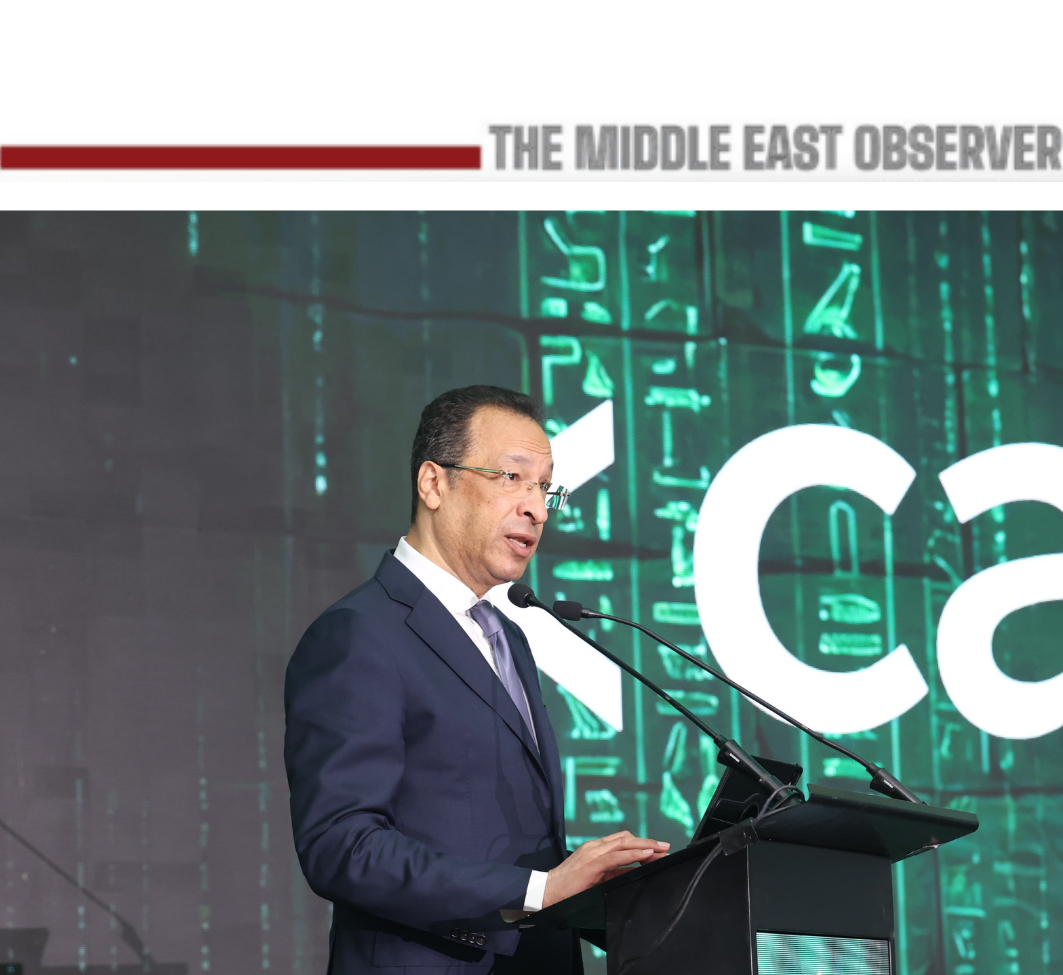

As Egypt moves banking, government services, telecommunications and urban infrastructure onto interconnected digital systems, cybersecurity is becoming an economic-infrastructure question. Stronger connectivity brings productivity and inclusion — but also concentration risk, higher resilience costs and new channels through which a technology failure could become an economic one.
Egypt’s latest push towards branchless banking captures both sides of its digital transformation.
On August 23, the Central Bank of Egypt approved regulations governing its Digital Financial Identity platform and electronic Know Your Customer, or eKYC, services. The framework will enable customers to establish and verify their identities electronically and ultimately obtain banking services without visiting a branch.
The significance lies as much in the safeguards as the convenience.
The framework establishes governance, technical, operational, data-protection and cybersecurity requirements around the new identity infrastructure. Banks seeking to participate must satisfy the CBE’s security and technology requirements before deployment.
That reflects a larger challenge confronting Egypt’s digital economy.
The question is no longer simply how many services can move online. It is whether an economy increasingly dependent on digital identity, electronic payments, telecom networks, government databases, cloud infrastructure and connected cities can continue functioning when parts of that infrastructure are disrupted or compromised.
Cybersecurity is becoming economic infrastructure.
Identity Becomes Infrastructure
eKYC promises a straightforward economic gain.
Remote verification reduces paperwork and branch dependence, lowers friction in acquiring customers and can broaden access to financial services.
But efficiency can create concentration.
Traditional verification is relatively distributed across branches, documents and institutions. As banks increasingly depend on shared digital identity, communications, software and authentication infrastructure, weaknesses in a common layer can potentially affect more than one institution.
The trade-off is therefore not simply convenience versus security. It is also efficiency versus concentration risk.
That concern extends well beyond Egypt.
The IMF warned in July that financial institutions’ dependence on shared software, cloud services and other common digital infrastructure can allow operational weaknesses to acquire systemic consequences. It identified concentration in major technology and cloud providers as one of the structural vulnerabilities created by increasingly interconnected financial systems.
For Egypt, the implication is important.
A compromised customer credential can expose an account. A vulnerability in widely used authentication or technology infrastructure could have a much larger blast radius.
The relevant question becomes not merely who can steal an identity, but how much economic activity depends upon trusting it.
Egypt’s Attack Surface Is Expanding
Banking is only one layer.
Egypt is simultaneously expanding digital government, 5G, cloud computing, data centres, fintech and smart infrastructure.
Each investment has an economic rationale. Collectively, they create more interdependence.
Telecom networks increasingly carry bank authentication, mobile wallets, government services, corporate applications and cloud traffic. As 5G and connected devices expand, those networks will support a wider range of sensors, machines and infrastructure.
Telecommunications consequently begins to function as a systemic digital utility.
Cloud computing creates a similar trade-off. Concentrating processing and storage can reduce costs and improve performance, but reliance on common providers also creates common dependencies.
The IMF has identified this problem explicitly. Financial firms increasingly rely on overlapping third-party IT providers, meaning an incident at one widely used supplier can disrupt critical services across multiple institutions.
The economic risk is therefore not measured simply by the number of cyberattacks.
It depends on what sits behind the system being attacked, how many institutions depend upon it and how easily a substitute can be found.
The Cost Is More Than Cybersecurity Software
This changes the economics of digitisation.
The cost of securing a digital economy is not simply the price of cybersecurity software.
Banks, telecom operators, government agencies and infrastructure providers need redundancy, independent backups, disaster recovery, network segmentation, penetration testing, incident-response capabilities, specialist personnel, supplier oversight and business-continuity systems.
Those are recurring costs, not one-off technology purchases.
And they raise an important economic question:
Who pays for resilience?
Large banks and telecom operators can spread fixed security expenditure across large customer bases. Smaller fintech and technology companies may find the burden proportionately heavier.
Tighter cybersecurity requirements can therefore have two effects simultaneously: strengthening the system while raising the cost of entry.
For public infrastructure, responsibility can be even more complicated. A connected urban system might involve government agencies, developers, software companies, telecom operators and maintenance contractors.
A cyber failure can consequently become a question not merely of technology but of procurement, contractual responsibility, insurance, liability and capital allocation.
The lowest-cost technology contract is not necessarily the lowest-cost infrastructure once recovery capability and the potential cost of failure are included.
When Digital Risk Enters the Physical Economy
The stakes rise when digital systems control physical infrastructure.
Smart transport, buildings, electricity networks, meters, security systems and municipal platforms can improve efficiency and resource management. But connecting operational technology also creates potential pathways between cyber disruption and physical services.
The distinction is fundamental.
A compromised website can interrupt access to information. A serious incident affecting operational technology can potentially interfere with electricity, water, transport or buildings.
That does not mean Egypt has suffered such a systemic smart-city cyber event, nor does current evidence justify predicting one.
It means the economic consequence of a cyber incident depends increasingly on what the compromised technology controls.
For critical infrastructure, perfect defence is unrealistic. The more useful measure is operational resilience: whether essential services can continue through disruption and how rapidly normal operations can be restored.
That principle increasingly shapes international financial regulation. IMF guidance published this year calls for systematic testing, stronger third-party oversight and sector-wide operational-resilience strategies as financial systems become more dependent on digital technology.
Strong Institutions, Rising Stakes
Egypt is not starting from zero.
The country has built cybersecurity institutions, incident-response capabilities and a national cybersecurity framework. Its financial system has also developed dedicated cyber-defence capacity.
That matters because the appropriate story is not that Egypt is digitally expanding without protection.
It is that the value and interconnectedness of what must be protected are increasing.
Strong cyber institutions and rising cyber exposure can exist simultaneously.
Indeed, successful digitisation creates precisely that paradox. The better online services become, the more citizens, companies and government agencies depend upon them — increasing the economic consequences when they are unavailable.
The CBE’s latest intervention should be understood in that context.
Its eKYC framework does more than regulate how customers prove their identity. It places security requirements around infrastructure that is expected to become increasingly important to the functioning of the banking system.
The Third-Party Weak Link
There is another complication: few digital institutions control their entire technology chain.
A bank can depend on telecom operators, cloud providers, payment processors, software developers, identity infrastructure and data centres. Connected cities can combine systems supplied and maintained by numerous contractors.
An institution can therefore secure its own network and remain exposed through vulnerable software or a supplier with privileged access.
The IMF’s 2026 supervisory guidance treats oversight of third-party providers as a core element of cyber-risk management.
For Egypt, that makes technology procurement increasingly strategic.
As investment flows into cloud computing, fintech, data centres and smart infrastructure, contracts need to be judged on more than upfront price and functionality.
Who patches the system? Who can access it? How quickly must vulnerabilities be addressed? Where are backups held? Can operations continue if a supplier fails? Can data and workloads be moved to another provider?
These are cybersecurity questions.
They are also investment questions.
From Cyber Incident to Economic Risk
The crucial distinction is scale.
An attack against one company is normally an operational event.
A disruption affecting payments, communications, government services or critical infrastructure — particularly where multiple institutions share common technology — can have wider consequences.
The IMF identifies three principal channels through which cyber incidents can threaten macrofinancial stability: loss of confidence, lack of substitutes for critical services and interconnectedness. It also cautions that cyber incidents have not, to date, become systemic financial events, an important qualification when assessing future risks.
That distinction is essential for Egypt.
There is no verified evidence that the country currently faces a systemic cyber crisis.
What is changing is the potential transmission mechanism:
Digital identity → banks and payments → telecommunications → cloud and data infrastructure → government and critical services.
At sufficient scale, a cyber incident can therefore migrate from operational disruption into financial-stability and fiscal concerns — and, in an extreme case, acquire sovereign-risk implications.
That does not make every data breach a sovereign event.
It means cybersecurity increasingly influences the resilience of infrastructure on which economic activity depends.
The Cost of Success
Egypt has compelling reasons to accelerate digitisation.
Remote banking can widen financial inclusion. Digital government can reduce administrative friction. Cloud infrastructure can improve productivity. Advanced telecommunications can support new industries. Smart infrastructure can make cities more efficient.
The answer to cyber risk is therefore not slower digitisation.
It is resilience designed into digitisation itself.
The CBE’s eKYC rules capture the challenge. Egypt is making it easier for citizens to establish their identities and enter the financial system digitally while simultaneously imposing security requirements around the infrastructure enabling that convenience.
Trust must now travel through the technology replacing the bank branch.
The same principle increasingly applies across the economy.
Egypt’s digital transformation should ultimately be measured not only by how many services move online, how fast networks become or how much technology investment the country attracts.
The harder test is whether critical services remain available and trusted when something goes wrong.
For investors and policymakers, that changes the calculation. Digital infrastructure cannot be valued solely by the efficiency it creates. Concentration, redundancy, recoverability and the economic cost of failure must enter the equation.
The real cost of going digital is therefore not cybersecurity software.
It is the investment required to prevent failure in one digital layer from cascading through the economy.
For Egypt, cybersecurity is no longer merely a technology feature.
It is economic infrastructure — and increasingly, part of sovereign resilience.
Related news:
Egypt’s AI Ambition Has a Compute Problem
Egypt Joins Global Cybersecurity Elite with Top Score in 2024 Index
Read also:
Syria’s Tourism Rebound Is Outpacing Its Infrastructure
Egypt Leads Arab World, Ranks Second Globally in CAF Charitable Giving Index