
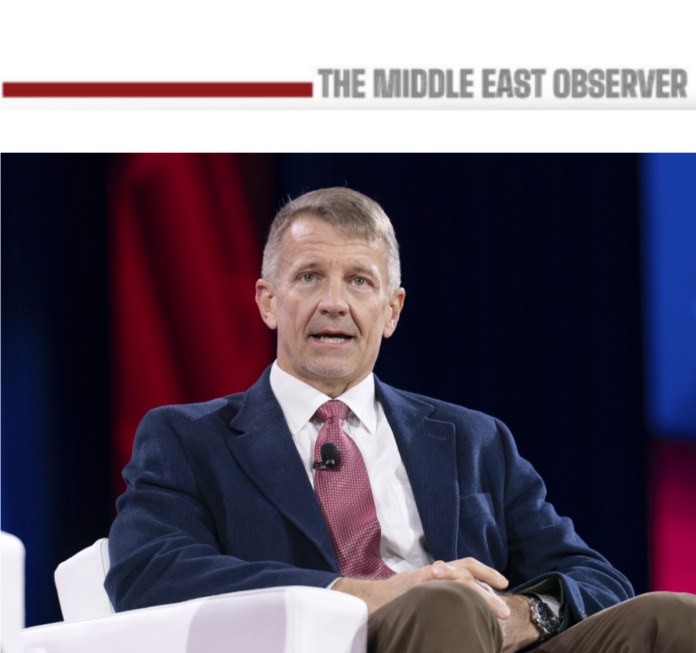
Erik Prince, founder of private military contractor Blackwater, has launched Vectus Air Defense Systems, a US venture seeking to turn air defence from a weapons purchase into a managed service — with the Middle East among its priority markets.
Vectus plans to design, integrate, operate and maintain layered defensive networks under multi year contracts for governments and operators of critical infrastructure. Ukrainian drone-autonomy company Swarmer is a founding partner with a 20% stake.
The commercial proposition addresses a growing problem: relatively cheap drones can threaten refineries, power plants, ports, military installations and data centres worth billions of dollars, while conventional missile interceptors can cost many times more than the weapons they destroy.
Vectus wants to narrow that gap by combining detection and tracking, electronic warfare, guns and lower-cost interceptor drones, reserving expensive missiles for more sophisticated threats. Rather than manufacturing every component, it intends to integrate technologies from specialist suppliers and continuously upgrade the network as threats evolve.
The result is what Prince is effectively pitching as “air defence as a service”: customers pay for continuous protection rather than assembling, operating and maintaining the entire system themselves.
Ukraine Technology Meets Gulf Demand
Swarmer provides the venture with technology developed in one of the world’s most intensive drone conflicts. The company develops software allowing unmanned systems to coordinate with greater autonomy and says its technology has supported more than 100,000 combat missions in Ukraine since April 2024.
Vectus plans to apply that experience to counter-UAS systems, including coordinated interceptor drones.
The Middle East presents a natural market. Prince has spent the past year meeting prospective customers and technology suppliers across the region as well as Ukraine, Africa and Latin America.
Gulf economies have concentrated enormous capital in oil and gas facilities, power infrastructure, desalination plants, ports and airports. They are now adding hyperscale data centres, cloud infrastructure and AI computing facilities.
That makes air defence increasingly an economic-infrastructure issue, not only a military one.
A relatively small attack that interrupts electricity, cooling, communications or logistics can disrupt a much larger asset. For data centres in particular, physical vulnerability can quickly become digital disruption.
As Saudi Arabia, the UAE and other Gulf economies expand investment in AI and cloud infrastructure, protecting the digital economy increasingly means protecting the physical infrastructure beneath it.
Commercial Demand Is Already Emerging
Evidence of that market is beginning to appear.
US-based Powerus, which has been identified as a potential technology supplier to Vectus, recently announced an approximately $22.3mn contract to provide counter-drone capabilities protecting Middle Eastern oil and gas infrastructure.
The 24-month agreement includes hardware, software, installation and maintenance. The customer and deployment locations have not been disclosed.
It is not a Vectus contract, but it provides evidence that regional infrastructure operators are already prepared to pay directly for integrated counter-drone protection.
That is important to Prince’s business case. If air defence becomes a recurring expense for energy companies, data centres, ports and utilities, the potential market extends well beyond traditional military procurement.
A Different Kind of Defence Contractor
Vectus will face established defence groups with far greater scale, existing government relationships and proven air-defence systems.
Its attempted differentiation is therefore not primarily manufacturing. It is integration and operation.
Vectus wants to combine technologies from different suppliers into a defensive architecture tailored to each customer, then operate, maintain and upgrade it under recurring contracts.
That could position the company between traditional weapons manufacturers and the infrastructure requiring protection — effectively making it an air-defence systems integrator and managed-service operator.
But the model faces an important constraint: air defence cannot be outsourced as easily as cybersecurity or cloud computing.
Governments must determine who can authorise electronic interference or kinetic interception, who bears liability for an incorrect engagement and how private operators fit within national military command. Export controls could further complicate networks combining American, Ukrainian, Israeli and other technologies.
In practice, governments may outsource sensors, software, integration and maintenance while retaining sovereign authority over the decision to engage a target.
The First Contracts Will Be the Test
Vectus has established its partnership with Swarmer and outlined its service model, but its commercial position should not be overstated.
No named Middle Eastern Vectus customer, Gulf government contract, deployment location or contract value has been publicly disclosed. Nor has the company revealed what a typical installation would cost.
Its first contracts will therefore determine whether “air defence as a service” can move from an attractive concept into a scalable business.
The underlying market dynamics are nevertheless clear. Drones have reduced the cost of threatening expensive infrastructure; Ukraine has accelerated autonomous defence technology; and Gulf economies are placing ever greater amounts of capital into energy, logistics and digital assets.
Vectus is betting that the resulting security gap creates a new commercial market — one in which customers increasingly pay for continuous protection rather than simply buying weapons.
For the Middle East, the question is no longer only how much strategic infrastructure it can build, but how economically it can defend it.
Related news:
Military Settlement Between Israeli Autonomy and American Interventions
The Asymmetry Paradigm : Redefining Military Power in the Iran Conflict
Read also:
Rebuilding Khartoum’s industrial base takes first step
Tabby Becomes Licensed Consumer and SME Lender in Saudi Arabia