

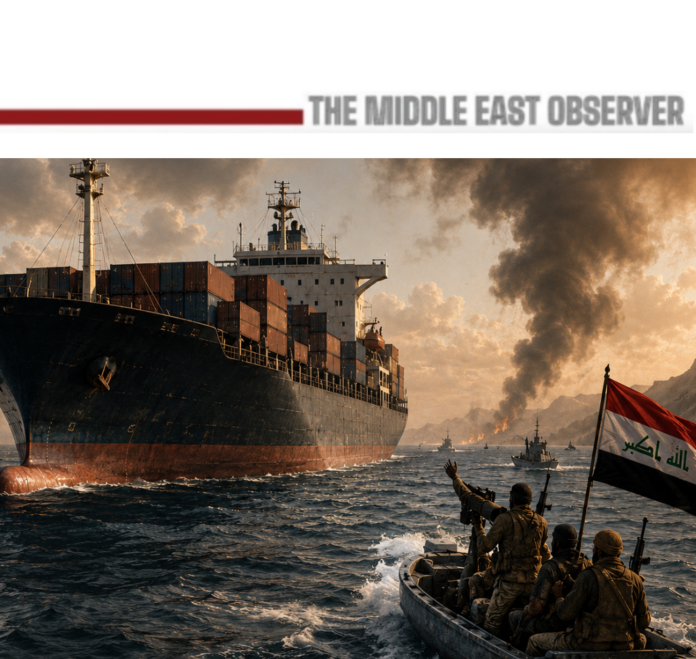
Tanker diversions from Bab el-Mandeb expose the Red Sea route used to bypass disruption in Hormuz, raising oil, freight and insurance risks
Commercial tankers have begun changing course away from the Bab el-Mandeb Strait, Brent crude has risen above $94 a barrel and Asian refiners are examining journeys that could add as much as four weeks to deliveries after Yemen’s Houthi movement threatened ships using Saudi Arabian ports.
Four tankers changed course in the Red Sea on Wednesday, following three diversions the previous day, while a Chinese vehicle carrier abandoned a route towards Jeddah, according to shipping data reviewed by Reuters. Some vessels turned north towards the Suez Canal; others paused while operators assessed the threat.
The disruption has transformed a confrontation centred on the Strait of Hormuz into a potential two-chokepoint crisis. Brent crude rose 3.6 per cent to $94.31 a barrel, Reuters reported, as traders assessed whether pressure on Bab el-Mandeb could restrict the Red Sea route increasingly used to bypass disruption in the Gulf.
Saudi Arabia has shipped an average of more than 4.5mn barrels a day of crude and refined products from its Red Sea terminal at Yanbu since April, with about 70 per cent destined for Asia, according to Reuters and shipping data providers. Energy Aspects estimates that more than 3mn barrels a day of Saudi crude could be forced on to longer routes if Bab el-Mandeb became inaccessible.
The immediate trigger for renewed Houthi-Saudi hostilities was a July 13 strike on Sana’a International Airport claimed by Yemen’s internationally recognised government. The wider maritime escalation unfolded as the US-Iran ceasefire collapsed and Tehran sought additional leverage against renewed American military operations.
Available evidence does not indicate that Saudi forces directly conducted the airport strike. Nor does it support treating the Houthis solely as instruments of Iran. The movement has its own domestic objectives and long standing confrontation with Riyadh, although the timing and scope of its maritime threat also appear to advance Tehran’s interest in placing pressure on two of the world’s most important energy routes.
Sana’a strike breaks four years of relative calm
Yemen’s internationally recognised government said it struck the runway at Sana’a airport to prevent an Iranian aircraft from landing without authorisation, describing the flight as a violation of Yemeni sovereignty.
The aircraft subsequently landed at Hodeidah, another airport controlled by the Houthis. The nature of its cargo and full passenger manifest were not independently established. The Houthis said it was carrying a delegation returning from Iran.
The Aden-based government supplied a stated security justification for the operation. But no independently verified evidence has shown that the aircraft carried weapons or posed an immediate military threat requiring the runway of a civilian airport to be attacked.
The Houthis blamed Saudi Arabia for backing the internationally recognised government, although no evidence has emerged that Saudi forces directly conducted the runway strike.
Within hours, the movement launched missiles towards Abha International Airport in southern Saudi Arabia. The Saudi-led coalition said they were intercepted. It was the first claimed Houthi attack on Saudi territory since an informal truce began in 2022.
Houthi leader Abdul-Malik al-Houthi subsequently warned that Saudi airports, ports, oil installations and other strategic facilities could be targeted if Riyadh escalated further.
The movement then widened its declared target set. In a notice sent to shipping companies on July 20, its maritime coordination centre warned vessels against loading or discharging cargo at Saudi ports and described the measure as a naval blockade.
The declaration does not amount to an internationally recognised blockade, and the Houthis have not physically closed Bab el-Mandeb. But commercial diversions demonstrate that shipowners, charterers and refiners regard the threat as operationally credible.
“Changing behaviour by tankers tells us that they are taking the threats seriously,” said Matt Smith, commodity research director at Kpler. Saudi crude and product movements through Bab el-Mandeb exceeded 4mn barrels a day last month, according to Kpler data.
US-Iran truce collapsed under disputed obligations
The escalation followed the breakdown of a ceasefire memorandum reported by Reuters as having been negotiated in Islamabad between Washington and Tehran in June.
The agreement suspended hostilities, reopened Hormuz to commercial traffic for 60 days and envisaged temporary waivers for Iranian oil exports and procedures for releasing frozen Iranian funds.
Its key provisions were imprecise.
Iran interpreted the maritime clause as recognition of its right to manage traffic through the entire strait. The United States and Gulf governments understood it as an obligation for Tehran to guarantee unrestricted passage without tolls or coercive controls.
Washington accused Iran of attacking vessels using routes Tehran had not approved. Iran accused the US of failing to deliver sanctions relief and unrestricted access to frozen assets.
On July 7, Washington revoked the licence permitting Iranian oil sales, saying Iranian actions in Hormuz were unacceptable. Tehran described the decision as a breach of the memorandum. President Donald Trump subsequently declared the agreement over and US forces resumed sustained attacks.
It is therefore inaccurate to describe the collapse as a single, undisputed American decision to break functioning peace talks.
The memorandum had already entered crisis because of contested maritime incidents, incompatible interpretations and disagreement over economic concessions. Washington nevertheless took the decisive formal steps that ended its practical implementation: revoking the oil waiver, resuming broad military operations and declaring the ceasefire over.
Mohanad Hage Ali of the Carnegie Middle East Center said the original agreement’s vagueness reflected both the difficulty of the issues and the fragility of the arrangement.
“You now need a secondary deal to restore it, if it is to be a basis for restoring calm,” he said.
Iran sought a Red Sea pressure point
The Sana’a strike explains the immediate Houthi retaliation but not fully the decision to threaten international shipping.
Iran asked the Houthis to stand ready to close the Red Sea oil route if the United States attacked Iranian power infrastructure, according to three sources cited by Reuters. One source close to the movement said missiles and drones had been deployed near Bab el-Mandeb. Tehran and the Houthis did not publicly respond to the report.
That reporting does not establish that Tehran ordered the Houthis’ specific July 20 warning to shipping companies. It indicates Iranian preparations and strategic consultation, rather than proving direct command of the decision ultimately announced by the movement.
The evidence therefore points to overlapping motives rather than a simple proxy operation.
The Sana’a airport strike supplied the Houthis with an immediate Yemeni grievance and an opportunity to retaliate against Saudi Arabia. Iran’s confrontation with Washington supplied a broader incentive to extend that response into the maritime domain.
Torbjorn Solvedt, principal Middle East analyst at Verisk Maplecroft, said the timing was particularly dangerous because the Red Sea had become the principal alternative route for Gulf oil exports.
“If fighting intensifies and spills over into Red Sea export infrastructure and shipping, it will threaten the only major alternative route for oil exports from the region,” he said.
The Houthis govern most of northern Yemen, maintain their own military hierarchy and pursue domestic political and economic aims. Iran has nevertheless supplied the movement with weapons, technical assistance and strategic support.
A reasonable assessment is that the campaign serves several objectives: deterring further attacks on Houthi-controlled territory, pressuring Saudi Arabia and raising the economic cost of US operations against Iran.
Saudi Red Sea outlet becomes vulnerable
Saudi Arabia has increasingly used its East-West pipeline to transfer oil from eastern production centres to Yanbu, allowing exports to avoid Hormuz. The pipeline can carry about 5mn barrels a day, although part of that capacity was already in use before the latest crisis.
That alternative now creates a different exposure. Oil shipped eastwards from Yanbu towards India, China and other Asian markets normally passes south through Bab el-Mandeb.
A vessel avoiding the strait must instead travel north through the Suez Canal and then around the Cape of Good Hope, or use a combination of the canal and Egypt’s SUMED pipeline.
Fully laden very large crude carriers cannot pass through the Suez Canal at maximum draft. They generally have to discharge part of their cargo into SUMED on the Red Sea side and recover it in the Mediterranean before continuing around Africa.
Industry specialists estimate that the deviation could add as much as four weeks compared with the normal eastward voyage from Yanbu.
One tanker carrying Saudi crude for India reversed course and signalled a Suez Canal transit, while South Korea’s Hyundai Oilbank sought a vessel with the option of using both Suez and SUMED.
Longer voyages increase fuel consumption, freight charges, war-risk costs and the amount of capital tied up in cargoes. They also reduce the effective availability of the tanker fleet by keeping vessels occupied for additional weeks.
Richard Bronze of Energy Aspects said an effective closure of Bab el-Mandeb would provide the catalyst for a further oil-price rally after renewed US-Iran hostilities had already slowed traffic through Hormuz.
“The Houthis resuming maritime attacks and effectively shutting the Bab el-Mandeb would certainly qualify,” he said.
Market impact becomes measurable
The widening crisis is already visible across energy and shipping markets.
Only three commodity vessels crossed the Strait of Hormuz on Tuesday, down from four on Monday, according to Kpler. No very large crude carriers or LNG tankers were observed.
In the Red Sea, at least seven tankers changed direction or interrupted voyages over two days after the Houthi warning, Reuters reported. Some operators reduced electronic transmissions following security guidance from the EU’s Aspides mission.
Brent’s rise above $94 reflects a renewed geopolitical premium, but markets are not yet pricing a complete and prolonged closure of both waterways.
Analysts estimate that a successful and sustained blockade could push crude above $115–$120 a barrel, while disruption to diesel and jet-fuel flows could prove particularly severe. These are risk scenarios, not central forecasts.
The International Energy Agency has said emergency inventories, alternative infrastructure and higher production outside the Gulf are cushioning crude markets. Refined products remain more exposed because diesel, petrol and aviation fuel are harder to replace when refineries and transport routes are disrupted simultaneously.
Kpler estimates that Asian customers could face delivery delays of about a month if Saudi cargoes were forced around the Cape, with the sharpest impact likely to be felt during the first weeks of disruption.
Egypt broadens its regional response
Egypt’s response developed as the confrontation spread to Gulf states and commercial shipping.
During a July 14 visit to Bahrain, President Abdel Fattah El-Sisi reaffirmed Egypt’s support for the kingdom’s security and condemned attacks affecting its territory, according to the Egyptian presidency.
In successive statements issued between July 15 and 21, Egypt’s Foreign Ministry condemned attacks affecting Bahrain, Kuwait, Saudi Arabia and commercial shipping, including the targeting of civilian and strategic infrastructure and the Kuwaiti tanker Kifan in the Strait of Hormuz.
The statements distinguished between attacks directed at Gulf countries themselves and operations aimed at US facilities located on their territory, while maintaining that both endangered sovereignty, civilians and regional stability.
Egypt’s position rests on four linked principles: defence of Arab sovereignty, protection of civilian and economic infrastructure, freedom of navigation and support for a negotiated settlement.
Cairo has aligned clearly with Saudi Arabia, Kuwait, Bahrain and other Arab governments against Iranian and Houthi attacks, while continuing to argue that military deterrence must lead back to political negotiations.
The stance reflects Egypt’s direct economic exposure. Disruption in Bab el-Mandeb affects access to the Red Sea and Suez Canal, while instability in Hormuz raises energy costs and threatens Gulf economies closely connected to Egypt through investment, trade, remittances and labour markets.
Diplomacy must address both waterways
Pakistan and other intermediaries continue efforts to restore negotiations, but any replacement accord will need more precise provisions than the memorandum reported as having been agreed in Islamabad.
It would have to guarantee commercial passage through Hormuz, establish a mechanism for investigating maritime attacks and define the sanctions relief and financial access Iran would receive. It would also require assurances against attacks on Gulf states and their civilian infrastructure.
The Yemen dimension needs a separate but connected process covering Sana’a airport, northern ports, weapons inspections, humanitarian access and the Saudi-Houthi truce. Freedom of navigation through Bab el-Mandeb would need to form an explicit part of any broader settlement.
The events of the past week show how rapidly separate conflicts can merge.
The Sana’a airport strike triggered renewed Houthi-Saudi hostilities. Iran’s confrontation with the United States created an incentive to extend the retaliation into the maritime domain, while the collapse of the US-Iran truce exposed the Red Sea route increasingly used to bypass Hormuz.
Emergency inventories, pipelines, Suez and longer voyages around Africa can contain part of the disruption. They cannot eliminate the cost of simultaneously insecure waterways.
Restoring secure commercial navigation through Hormuz and Bab el-Mandeb has become essential not only for regional stability but also for containing global energy, freight and inflationary pressures.
Related news:
Saudi Arabia’s Price Cut Signals a Tighter, More Competitive Oil Market
Refining, Not Crude, Becomes the New Fault Line in Global Energy Markets
Read also:
Egypt and Eritrea Sign Maritime Cooperation
How Digital Money Can Strengthen Monetary Policy Across the MENA Region