The president reviews strategic commodity reserves, grain storage expansion, subsidy reform and food safety while reaffirming support for Egypt’s most vulnerable households.
President Abdel Fattah El-Sisi has directed the government to strengthen Egypt’s long-term food security strategy by expanding strategic commodity reserves, enhancing grain storage infrastructure and safeguarding targeted social protection, as senior officials reviewed subsidy reform, agricultural production and food safety policies amid continuing regional uncertainty.
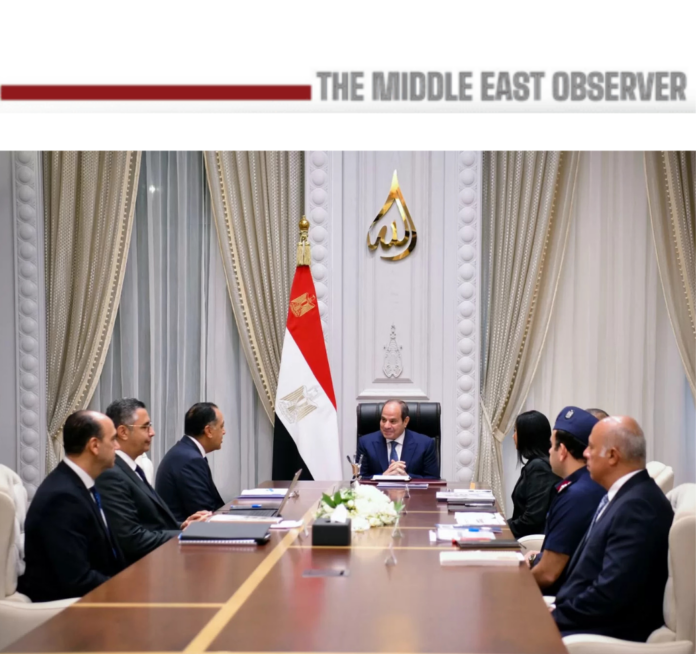
During a meeting in New Alamein City, attended by Prime Minister Mostafa Madbouly, Minister of Supply and Internal Trade Sherif Farouk, Minister of Agriculture and Land Reclamation Alaa El-Din Farouk, Minister of Social Solidarity Maya Morsy, Head of the Administrative Control Authority Major General Amr Adel and Executive Director of the Future of Egypt Authority for Sustainable Development Bahaa El-Ghannam, the President reviewed the state’s preparedness to secure essential commodities, improve subsidy efficiency and reinforce Egypt’s resilience against external supply shocks.
The meeting comes as governments worldwide continue to strengthen food security policies following years of disruptions caused by the COVID-19 pandemic, the Russia-Ukraine war, climate-related pressures and heightened geopolitical tensions across the Middle East, all of which have exposed vulnerabilities in global food supply chains and increased the strategic importance of domestic production and long-term reserves.
Strategic reserves remain at reassuring levels
Officials told the President that Egypt’s reserves of strategic commodities remain at “very reassuring” levels, with stocks of several key commodities sufficient to meet domestic demand for extended periods, while some reserves are adequate for nearly one year.
El-Sisi directed the government to preserve these reserve levels, continue securing supply chains and strengthen procurement mechanisms to ensure market stability and protect consumers from potential disruptions in global commodity markets.
Expanding grain storage infrastructure
A key focus of the meeting was the Future of Egypt grain silo complex, one of the country’s flagship food security projects.
Officials reviewed progress in expanding modern grain storage capacity and logistics infrastructure, with the project expected to improve storage efficiency, reduce post-harvest losses, strengthen emergency preparedness and reinforce Egypt’s long-term strategic reserves.
The Presidency said the development forms part of a broader strategy to modernise the country’s food logistics network while improving the resilience of strategic commodity supply chains.
Increasing domestic production
The meeting also reviewed efforts to expand domestic agricultural production and increase self-sufficiency in strategic crops.
President El-Sisi instructed officials to continue raising local production, improve agricultural productivity and strengthen integration between production, storage and distribution systems to reduce dependence on imports where economically feasible.
He also stressed the importance of encouraging greater private-sector participation in food production, logistics, storage and distribution, describing public-private cooperation as an essential component of Egypt’s long-term food security strategy.
Subsidy reform under review
The government presented a proposed cash-commodity subsidy programme, intended to modernise Egypt’s subsidy system while improving the efficiency and targeting of state support.
Officials said the proposal would provide eligible households with greater flexibility in purchasing essential goods while directing government assistance more effectively toward those most in need.
No decision to implement the proposed system was announced. Instead, the meeting formed part of the government’s ongoing review of options to modernise the subsidy framework while preserving social protection for eligible beneficiaries.
Protecting vulnerable households
Alongside food security, the President reviewed developments in Egypt’s social protection programmes, including the Takaful and Karama initiative and broader support mechanisms targeting low-income families.
El-Sisi reaffirmed that subsidy reforms should continue to prioritise Egypt’s poorest and most vulnerable households, directing officials to preserve beneficiaries’ rights while improving the efficiency, transparency and targeting of state assistance.
Bread subsidies, ration cards and food safety
The meeting also examined the subsidised bread programme, developments in the ration-card system and plans to establish 300 strategic bakeries during the first phase of implementation to strengthen bread security across the country.
Officials additionally reviewed the performance of the National Food Safety Authority, with discussions focusing on enhancing inspection systems, strengthening food quality controls and ensuring that products available in Egyptian markets meet national safety standards.
A broader food security strategy
While the meeting produced no immediate policy changes, it highlighted Egypt’s increasingly integrated approach to food security, combining larger strategic reserves, expanded storage capacity, stronger domestic agricultural production, targeted social protection and gradual subsidy reform within a broader economic resilience strategy.
By linking food security with logistics infrastructure, agricultural development, private-sector participation and social welfare, the government is seeking to reduce the country’s exposure to future global supply disruptions while safeguarding affordable access to essential commodities for vulnerable households.
Related news:
Egypt’s New Delta Megaproject Signals Strategic Shift in Food Security and National Development
Egypt Pushes Africa’s Food Security Agenda at G20’s Historic Meeting
Read also:
HSBC Agrees Egypt Retail Sale to Emirates NBD
UN Warns Global Defense Spending Could Reach $6.6 Trillion by 2035 as Security Costs Surge