

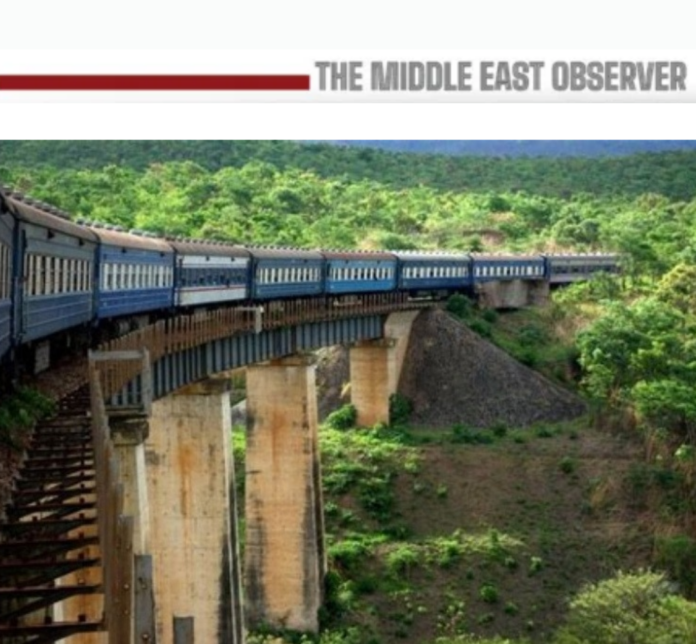
Tanzania and Angola have agreed to pursue a transcontinental railway linking Africa’s Atlantic and Indian Ocean coasts, Tanzanian President Samia Suluhu Hassan announced on October 29 following talks with Angolan President João Lourenço during his state visit to Tanzania.
The initiative would connect Angola’s Atlantic port of Lobito with Tanzania’s Indian Ocean port of Dar es Salaam through Zambia, while serving the Democratic Republic of Congo’s mineral-producing regions. No completion date was announced for the wider connection.
The engineering challenge centres on an 830-kilometre missing link. A new railway between Luacano in Angola and Chingola in Zambia would connect Angola’s existing Benguela Railway to Zambia’s rail network, which links to the 1,860-kilometre Tanzania–Zambia Railway (TAZARA) at Kapiri Mposhi.
Two major developments have advanced the project. China signed a $1.4 billion agreement in September 2025 to rehabilitate TAZARA. On October 27, Africa Finance Corporation (AFC) selected international construction consortia, including Italy’s Webuild and Portugal’s Mota-Engil, as preferred bidders for the new Zambia–Angola railway. Final construction contracts remain under negotiation.
Financing remains the immediate obstacle. The new railway could cost $3 billion–$5 billion, according to preliminary estimates, with the required financing not yet secured. AFC is seeking debt and equity investment, targeting financial close in late 2027 and completion of the new line around 2030.
But the larger question is whether the railway can generate sufficient revenue to justify its investment.
The first commercial test is already measurable. AFC senior director Amadou Wadda said in April that preliminary freight agreements covered approximately one million tonnes annually—only half the two million tonnes identified as the minimum required for commercial viability.
The economic opportunity is considerable. Zambia and the DRC are major copper and cobalt producers serving global energy, technology and manufacturing industries. Connecting Atlantic and Indian Ocean gateways could reduce logistics costs, diversify export routes and strengthen access to European, American and Asian markets.
Webuild estimates that the new Lobito connection could reduce certain Copperbelt freight journeys from as long as 16 days to seven, although those savings remain projections.
Mineral exports alone, however, will not guarantee profitability. The corridor must attract sustained freight contracts, offer competitive tariffs and reliable services, simplify cross-border procedures and generate cargo in both directions. Agricultural exports, processed minerals, industrial equipment and regional manufacturing could provide the additional traffic needed to support long-term returns.
The initiative also carries geopolitical significance, potentially connecting China’s TAZARA investment with the US- and EU-backed Lobito Corridor. For African exporters, the economic advantage would be greater choice between competing maritime gateways.
Ultimately, building an east–west railway is an engineering and financing undertaking; establishing a profitable east–west trade system is the economic transformation needed to justify it.
The railway may connect two oceans, but its future will depend on connecting African production to profitable markets.
Related news:
- Egypt Eyes Industrial Expansion Across Africa as Regional Trade Hits $214bn
- Egypt’s Africa Opportunity Is Bigger Than Exports
