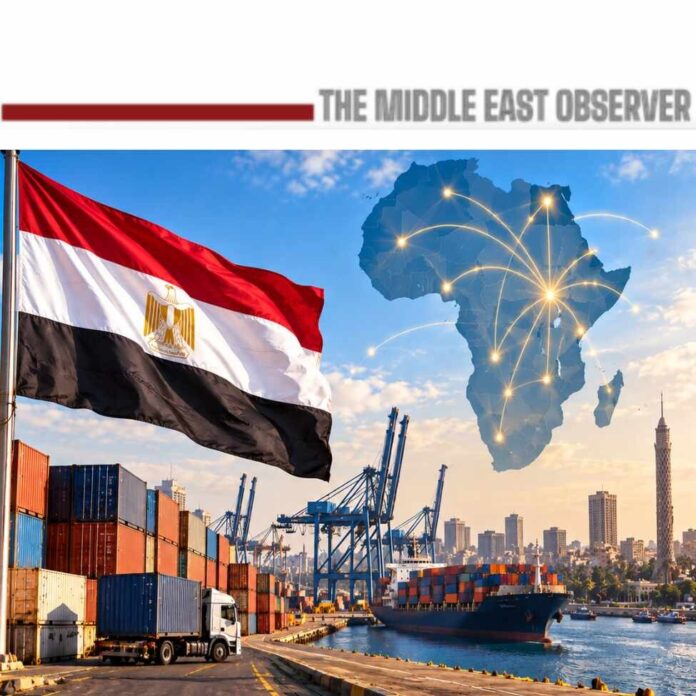
CAIRO — Egypt has built a sizable trade surplus with Africa and demonstrated that its companies can execute some of the continent’s largest infrastructure projects. What it has not yet built is an equally deep system of African production, sourcing, finance and distribution.
That is the central tension emerging from the Egyptian Center for Economic Studies’ latest Economic Lens assessment of Egypt’s economic relationship with Africa.
Egypt exported about $7.6bn to African markets in 2024, rising to roughly $7.73bn in 2025, while imports fell from around $2.1bn to $1.57bn. Egypt ranked as the continent’s third-largest intra-African exporter by share in both years.
Yet the headline numbers conceal a narrower commercial footprint.
Almost 69% of Egyptian exports to Africa in 2024 went to just five markets — Libya, Morocco, Algeria, Sudan and Tunisia. Imports were even more concentrated, with the Democratic Republic of Congo, Sudan, Kenya, Nigeria and South Africa accounting for more than 80% of Egypt’s African purchases, dominated by commodities and primary inputs.
The report therefore argues that Egypt should move beyond conventional exporting and isolated contracting towards regional value chains connecting African resources, Egyptian industrial capabilities, processing, logistics, finance and distribution.
The opportunity, however, is larger than simply increasing bilateral trade. Egypt now needs to move from an African export strategy to an African operating strategy.
Strong exports, shallow integration
Egypt accounted for 6.62% of intra-African exports in 2024, but only 2.26% of intra-African imports. In 2025, its export share remained at 6.46%, while its import share declined to 1.67%.
The report sees this partly as a diversification problem.
It also points to a deeper structural weakness.
Deeply integrated industrial regions generate substantial two-way trade in raw materials, components, intermediate goods, services and capital equipment. Egypt’s comparatively weak African import position suggests that much of the relationship remains transactional: Egyptian companies sell manufactured goods into African markets while sourcing a relatively narrow range of commodities in return.
That is trade. It is not yet a continental production system.
The more important measure of future success will therefore not be whether Egyptian exports to Africa reach $10bn or $15bn. It will be whether Egyptian companies become embedded across the full commercial chain — sourcing, processing, manufacturing, financing, logistics, servicing and distribution.
Three hubs — but they must be commercial platforms
The ECES report proposes regional manufacturing and distribution hubs rather than attempting to serve the continent directly from Egypt.
It identifies Tanzania or Kenya for East Africa; Ghana, Nigeria or Côte d’Ivoire for West Africa; and Rwanda or the DRC for Central Africa as possible gateways.
The industrial logic is strong. Scale-intensive processing could take place in regional centres, with finishing, packaging and distribution extending into surrounding markets.
MEO would take the concept further.
Each hub should function as an Egyptian commercial operating platform, combining manufacturing and distribution with financial, legal and risk-management infrastructure.
That means access to trade finance, receivables management, credit assessment, insurance, guarantees, foreign-exchange settlement, payment collection, legal due diligence and dispute support.
For large conglomerates, these capabilities can often be developed internally. For smaller and medium-sized exporters, they can determine whether expansion is commercially viable at all.
Delayed payments, weak counterparty information, currency convertibility, unfamiliar legal systems and difficult enforcement can make apparently profitable trade uneconomic.
A regional collection and protection arm could materially reduce those risks.
The three-hub strategy should therefore combine:
production + distribution + finance + collections + legal protection + market intelligence + logistics.
Such an architecture would allow an Egyptian exporter entering East, West or Central Africa to operate through an established platform rather than rebuilding banking, legal and collection capabilities separately in each market.
The objective is not simply to sell more goods through three gateways. It is to lower the cost and risk of doing business across entire regions.
Finance, materials and logistics form the real architecture
Taken together, the report’s proposals suggest three systems that should underpin any serious Egyptian African strategy.
The first is commercial security: financial and collection platforms capable of protecting transactions and reducing payment, legal and counterparty risk.
The second is industrial security: long-term access to raw materials and intermediate inputs aligned with the needs of Egypt’s manufacturing base.
The third is physical connectivity: affordable trade corridors capable of moving goods efficiently between African economies and between African production centres and Egypt.
These are not separate policy areas.
Without financial protection, companies may export successfully but fail to collect efficiently.
Without industrial sourcing, Egypt can expand manufacturing while remaining exposed to distant or concentrated supply chains.
Without transport infrastructure, AfCFTA may provide regulatory access to a continental market while commercial fragmentation persists on the ground.
Together, the three create something far more substantial than an export programme: a continental commercial architecture linking African resources, Egyptian industry, regional finance and African markets.
African raw materials should reinforce Egypt’s industrial base
The report identifies critical-mineral processing as one of the principal opportunities for deeper integration.
Egypt imported about $742mn of refined copper and cathodes from Africa in 2024, while many African mineral-producing economies continue to capture only a limited share of the value generated from downstream processing.
The report recommends greater beneficiation closer to the source, producing higher-value industrial materials instead of exporting unprocessed resources to third-country processors.
For MEO, the stronger strategic question is how African sourcing can be linked directly to the future requirements of Egypt’s own industrial base.
Egypt already hosts significant manufacturing capacity across electrical equipment, cables, automotive components, engineering products, appliances, chemicals, fertilisers, construction materials, food processing and metals.
As local and foreign industrial investment expands, the strategic question becomes:
Which materials will Egypt’s factories require over the next decade, and which African supply chains can be developed now to secure them?
That is a more useful starting point than beginning with a commodity and searching for a market.
Egypt can begin with industrial demand and work backwards: identify required materials, establish long-term African supply arrangements, invest jointly in processing where economically viable, finance the necessary infrastructure and channel processed or semi-processed inputs into Egyptian industry.
Copper is an obvious case because of its importance to cables, electricity networks, transport equipment and manufacturing. But the same logic applies across metals, minerals, agricultural inputs and industrial feedstocks.
Crucially, this should not become a one-way extraction strategy.
The strongest model is one in which African countries retain more processing, employment and investment; Egyptian manufacturers gain more secure inputs; and higher-value products are sold into African and global markets.
That would make resource cooperation part of a wider regional industrial strategy rather than simply commodity procurement.
Logistics is the prerequisite, not another sector
The report identifies bonded dry ports, cold-chain infrastructure and regional logistics corridors as investment opportunities and notes the high cost of intra-African trade.
Here, MEO would elevate logistics above the sectoral list.
For Africa, reducing the cost and uncertainty of moving goods may be the single most important enabling investment for successful intra-continental trade.
AfCFTA can remove tariffs and harmonise trade rules. It cannot shorten an unreliable border crossing, create a missing cold chain or make an expensive transport route competitive.
The priority should therefore be the creation of practical, end-to-end commercial corridors combining:
ports and feeder shipping; rail and road links; dry ports and bonded zones; warehouses and cold chains; customs digitisation; cross-border documentation; and efficient payment and settlement systems.
Infrastructure should be judged not by the size of the asset built, but by its impact on the cost, time and reliability of trade.
A railway without sufficient freight integration, a port without efficient inland connectivity or a logistics zone detached from production centres can add physical capacity without materially improving commerce.
The more important objective is to connect production areas, regional hubs, ports and markets through corridors that are simple, predictable and affordable to use.
For Egypt, the strategic benefits would extend across almost every commercial opportunity identified by the report.
Cheaper logistics would improve access to raw materials, lower the cost of pharmaceutical and food distribution, strengthen agricultural value chains and make Egyptian-backed regional manufacturing more competitive.
Infrastructure in this context is not merely another investment opportunity.
It is the physical foundation of a functioning African common market.
From project execution to recurring commercial positions
Egypt already has proof that its companies can execute at scale.
The report highlights the $2.9bn Julius Nyerere Hydropower Plant and Dam in Tanzania, implemented by Arab Contractors and Elsewedy Electric, alongside Elsewedy Industrial City in Tanzania, covering more than 2.6mn square metres with projected investment exceeding $400mn.
The next step is to turn project execution into longer-term economic positions.
The report recommends attaching operations and maintenance, local manufacturing, equipment servicing, digital asset management, training and equity participation to infrastructure projects.
That distinction is commercially critical.
Construction produces revenue while an asset is being built. Operations, spare parts, software, maintenance and equipment replacement can produce recurring revenue for decades.
The strategic objective should therefore be to move from winning projects to owning relationships around those projects.
Not all seven sectors should move at the same speed
The report identifies seven priority sectors: building materials and modular construction; agro-processing, fertilisers and irrigation; pharmaceuticals; electrical equipment and distributed energy; logistics and dry ports; digital finance; and critical-mineral processing.
They should not be treated as equal investment priorities.
A practical hierarchy would separate them into three groups.
Immediate scale opportunities
Electrical equipment, infrastructure O&M, pharmaceutical formulation and distribution, and digital financial services build directly on capabilities Egypt already possesses.
These areas require less strategic reinvention and could scale comparatively quickly.
Enabling investments
Logistics corridors, dry ports, trade-finance platforms, collections, warehousing and digital settlement systems provide the infrastructure that allows other sectors to expand.
Their direct returns may differ from manufacturing investment, but their multiplier effect across trade can be considerably larger.
Long-duration strategic platforms
Agriculture, mineral beneficiation and integrated industrial ecosystems require more capital, sovereign coordination and infrastructure.
Their potential is substantial, but their execution risk is correspondingly higher.
Agriculture needs partnership, not simply access to land
The report combines African agricultural resources with Egypt’s strengths in fertilisers, irrigation, milling and agricultural technology and proposes contract farming and regional processing arrangements.
The opportunity is strategically important but institutionally complex.
Projects require stable land rights, local partnerships, water security, predictable export rules, logistics and long-term offtake arrangements.
They must also deliver visible value to host economies.
Food-security sensitivities mean that investments perceived primarily as securing external supplies could encounter resistance. The stronger model combines local processing, employment, technology transfer and domestic supply with export opportunities.
Mutual benefit must be built into the economics of the project, not added later as a political argument.
The missing foundation: reliable investment intelligence
One of the report’s most important observations is that Egypt still lacks sufficiently integrated and regularly updated data on its outward direct investment in Africa.
Available information remains fragmented and is often reconstructed from individual projects rather than a comprehensive national database.
That is more than a statistical weakness.
Egypt cannot allocate capital effectively without knowing which markets generate returns, where projects face persistent regulatory problems, how much private capital government support mobilises and where payment or collection risks are concentrated.
A central Egypt-Africa investment and trade-intelligence platform should therefore accompany the three-hub strategy.
It could track investment exposure, payments, counterparty performance, logistics costs, regulatory changes and sector opportunities across the continent.
Better information would help shift policy away from rewarding the most visible projects towards supporting the most commercially successful ones.
The next stage is an operating system, not simply an export target
The ECES report shows that Egypt has already progressed through two important stages.
It is a significant exporter to Africa.
Its companies have demonstrated the ability to build complex infrastructure across the continent.
The third stage remains incomplete: creating Egyptian-African production and commercial systems in which resources, manufacturing, finance and logistics operate across multiple markets.
That requires a different measure of success.
The objective should not simply be a larger export number.
Egypt’s competitive position in Africa will increasingly depend on whether it can help build the commercial architecture that makes continental trade work — regional financial platforms that protect transactions, resource partnerships that reinforce industrial growth and logistics corridors that move goods at competitive cost.
Africa does not need another layer of exporters. It needs functioning economic corridors connecting capital, resources, factories and markets.
Egypt already possesses important pieces of that architecture.
Its strategic advantage will depend on whether it can assemble them into three commercially powerful regional hubs capable of serving both Africa’s industrial integration and Egypt’s emergence as a wider manufacturing and trade centre.
That would mark the transition from an African export strategy to an integrated African industrial, financial and trade strategy.
Related news:
ADNOC Industrial Push Aligns with UAE’s Post-OPEC Manufacturing Strategy
Egypt Looks to Tanzania to Deepen East African Trade Links
Read also:
Water Innovation Becomes Agriculture’s New Competitive Advantage