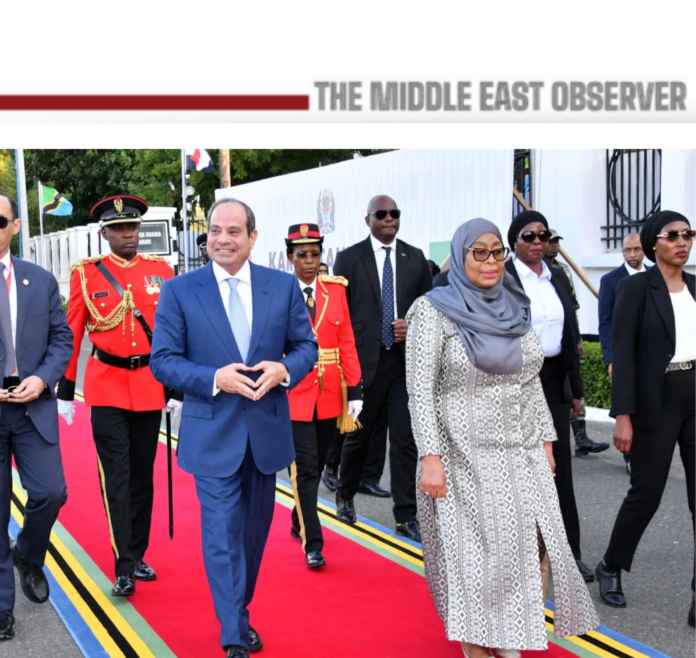
President Abdel-Fattah El-Sisi’s visit to Dar es Salaam signals Cairo’s ambition to transform years of infrastructure diplomacy into a broader commercial strategy spanning agriculture, logistics and regional supply chains.
President Abdel-Fattah El-Sisi’s visit to Dar es Salaam marked the latest stage in that strategy. Beyond the signing of transport and renewable-energy cooperation agreements, the talks centred on agriculture, livestock, ports, maritime services and industrial partnerships that could eventually position Tanzania as an entry point for Egyptian businesses into some of Africa’s fastest-growing markets.
Tanzania offers scale, growth and regional access
Tanzania’s appeal rests on a combination of economic growth, agricultural resources, political continuity and Indian Ocean access.
The country’s economy expanded by an estimated 6 per cent in 2025, up from 5.5 per cent a year earlier, according to the African Development Bank’s African Economic Outlook 2026. Growth was supported by agriculture, mining and construction, alongside stronger investment and domestic consumption.
The AfDB expects growth to moderate to 5.4 per cent in 2026 as conflict in the Middle East affects energy costs and supply chains, before recovering to 6.1 per cent in 2027 on the back of infrastructure investment and improvements to the business environment. Inflation is forecast to rise from 3.3 per cent in 2025 to 3.8 per cent in 2026, remaining within the Bank of Tanzania’s target range.
Private-sector credit expanded by 20.3 per cent in 2025, while non-performing loans declined to 3.1 per cent from 4.4 per cent a year earlier. Foreign reserves rose to the equivalent of 4.9 months of imports, while the current-account deficit narrowed to 2.4 per cent of gross domestic product, supported by gold and agricultural exports and tourism earnings.
The fiscal deficit widened slightly to 3.4 per cent of GDP, reflecting infrastructure and election-related spending. Public debt remains sustainable, according to the AfDB, although the country faces a moderate risk of debt distress.
For Egyptian companies, Tanzania offers more than a growing national market. Its ports serve several landlocked economies in eastern and central Africa, while its membership of both the East African Community and the Southern African Development Community gives investors access to overlapping regional markets.
Egypt brings industrial and infrastructure capacity
Egypt enters this strategy from a position of considerable industrial strength. As the Arab world’s most populous country and one of Africa’s largest manufacturing economies, it has developed competitive capabilities in engineering, pharmaceuticals, construction materials, electrical equipment, food processing and infrastructure delivery.
Expanding access to African markets has therefore become an increasingly important component of Cairo’s export-diversification strategy, particularly as Egypt seeks to generate foreign-currency revenue and reduce dependence on a limited number of traditional markets.
Tanzania represents one element of a broader Egyptian commercial push across Africa. Egyptian companies have expanded their presence through infrastructure, energy, water and construction projects, often supported by government diplomacy, export finance and technical cooperation.
The Julius Nyerere Hydropower Project in Tanzania, constructed by an Egyptian consortium led by Arab Contractors and Elsewedy Electric, demonstrated Egypt’s capacity to deliver large-scale strategic infrastructure in sub-Saharan Africa.
The next phase of Cairo’s policy appears aimed at building longer-term industrial, agricultural and logistics partnerships capable of generating recurring trade rather than one-off construction contracts.
Framework agreements open a broader project pipeline
The formal outcome of the presidential talks was the signing of two memoranda of understanding.
The first covers transport cooperation, including possible work in ports, railways, roads, maritime services and logistics. The second establishes a framework for cooperation in electricity and renewable energy, including technical expertise, training and potential future infrastructure projects.
These instruments provide government-level frameworks but are not, based on the information disclosed, financed construction contracts, investment concessions or binding commercial commitments.
Separate discussions covered agricultural land development, strategic crops, livestock production, port expansion and direct shipping services. El-Sisi called for faster implementation and directed Egyptian officials to work with their Tanzanian counterparts to remove administrative obstacles.
No final acreage, investment value, ownership structure or implementation timetable was announced for the proposed agricultural ventures. The initiatives should therefore be viewed as an emerging investment pipeline rather than completed deals.
Agriculture anchors the commercial agenda
Agriculture emerged as one of the most commercially consequential areas of cooperation.
Egypt and Tanzania are considering a large-scale venture intended to combine Egyptian capabilities in irrigation, land reclamation, seed development and mechanised cultivation with Tanzania’s land, water and agricultural resources.
The proposed project could initially supply the two domestic markets before expanding into export production. The talks also covered possible Egyptian participation in livestock assets, including the development of Ruvu Ranch.
A commercially integrated livestock venture could extend beyond animal production into veterinary services, feed manufacturing, meat processing, refrigeration and distribution. Such a model would create more local value than exporting live animals or unprocessed agricultural commodities.
The economic rationale is complementary. Tanzania has considerable agricultural potential but requires further investment in irrigation, storage, processing and transport. Egypt has developed expertise in water-efficient cultivation and large-scale land development but faces acute constraints on freshwater and cultivable land at home.
In principle, Egyptian capital and technology could support production in Tanzania while providing Egyptian companies with access to food, feed and agricultural supply chains.
The risks remain substantial. Land tenure, water rights, crop selection, local participation and purchase agreements would have to be resolved before large-scale production could begin. Investors would also require clarity on foreign-exchange arrangements, profit repatriation and the treatment of exports during periods of domestic food pressure.
Trade contracts despite stronger Egyptian exports
The investment push comes from a relatively low base in bilateral commerce.
Egyptian exports to Tanzania increased by 3.2 per cent year on year to $11.1mn during the first quarter of 2026, compared with $10.8mn in the corresponding period of 2025, according to Egypt’s Central Agency for Public Mobilization and Statistics.
Imports from Tanzania, however, fell 75.8 per cent to $1.2mn from $5mn. The decline reduced total bilateral trade by 21.6 per cent to $12.3mn, compared with $15.8mn a year earlier.
The figures point to a widening imbalance. Egyptian products continued to gain ground in Tanzania, but the contraction in Tanzanian shipments left the overall trading relationship smaller and more dependent on exports from Egypt.
Electrical machinery, equipment and related parts were Egypt’s largest export category, generating $3.1mn during the quarter. Salt, sulphur and related materials accounted for $1.8mn, followed by plastics and plastic products at $1.1mn.
Other exports included sugar and confectionery, iron and steel products, chemicals, mineral fuels, pharmaceuticals and prepared food. The mix highlights sectors that could benefit from improved shipping, warehousing and distribution links.
Tobacco remained Egypt’s largest import from Tanzania at about $591,000. Other purchases included vegetable textile fibres, fish and seafood, oil seeds, coffee, tea and fruit.
The modest figures underline both the opportunity and the challenge. Political ties and existing infrastructure cooperation have yet to produce deep commercial integration, while a viable logistics corridor will need to stimulate new production and two-way trade rather than merely redirect limited existing cargo.
Ports and shipping move to the centre of the strategy
The most ambitious proposal advanced during the visit was the creation of a maritime and multimodal trade corridor linking Egypt with Tanzania.
Cairo offered to contribute to the expansion and development of the Port of Dar es Salaam, while the two governments discussed a direct shipping service between Egyptian Red Sea ports and Tanzania’s commercial capital. The initiative could eventually connect maritime transport with railways, roads, inland terminals and logistics centres.
Dar es Salaam is not merely a national port. It handles cargo moving to and from several landlocked economies in eastern and central Africa, giving any investment in its capacity and efficiency a broader regional dimension.
For Egyptian manufacturers, more reliable maritime connections could improve access to Tanzania and neighbouring markets for electrical equipment, pharmaceuticals, fertilisers, construction materials, processed food and engineering products.
Northbound cargo could include agricultural commodities, coffee, tobacco, livestock products and processed food.
The commercial rationale extends beyond bilateral trade. Supported by efficient customs procedures, competitive shipping services and integrated logistics infrastructure, the proposed corridor could shorten supply chains linking North Africa with East Africa while improving Egyptian access to inland markets served through Dar es Salaam.
For Tanzania, greater connectivity could reinforce its role as a regional logistics hub and support the development of export-oriented agriculture and manufacturing.
Direct shipping, however, is commercially viable only when there is sufficient and consistent cargo in both directions. Without adequate freight volumes, operators may continue to rely on larger established routes and trans-shipment hubs.
The governments will therefore need to develop trade, port capacity, customs systems, financing and logistics infrastructure together. A shipping route without sufficient cargo generation would be unlikely to become commercially sustainable.
Energy cooperation builds on the hydropower project
The bilateral relationship’s principal commercial foundation remains the Julius Nyerere Hydropower Project.
The development gave Egyptian companies experience operating at scale in Tanzania and provided Cairo with a prominent example of Egyptian infrastructure delivery in sub-Saharan Africa.
The new electricity and renewable-energy memorandum could create follow-on opportunities in generation, transmission, equipment supply, technical services and training. Tanzania’s economic expansion and industrialisation plans are likely to require continued investment in energy infrastructure.
No additional power station, generation target or investment budget was announced during the visit. The memorandum’s significance lies in the potential market it opens rather than in an immediately executable transaction.
Regional integration raises the strategic value
The proposed corridor has implications beyond bilateral trade.
The East African Community comprises Tanzania, Kenya, Uganda, Rwanda, Burundi, South Sudan, the Democratic Republic of the Congo and Somalia. Their combined population is estimated at between 330mn and 350mn, creating a substantial consumer and industrial market.
East Africa remains among the continent’s strongest-performing regions, with institutional forecasts placing regional growth close to 6 per cent in 2025 and 2026, supported by infrastructure development, services and regional commerce.
The African Continental Free Trade Area is intended to connect these markets by lowering tariffs and reducing barriers to intra-African trade. At its launch, the World Bank described the agreement as encompassing about 1.3bn people and $3.4tn in combined economic activity.
For Egyptian investors, Tanzania could in principle become a production and distribution base serving eastern, central and parts of southern Africa. Agricultural goods could be cultivated and processed locally, while Egyptian companies could use Tanzanian facilities for packaging, assembly and regional distribution.
For Tanzania, Egyptian investment could support domestic processing and reduce dependence on exports of unprocessed commodities.
The commercial potential remains constrained by fragmented customs procedures, inconsistent product standards, limited trade finance and inadequate transport links. The benefits of the AfCFTA will depend not only on tariff reductions, but on whether goods can move across borders at predictable cost and speed.
The Egypt-Tanzania initiative therefore provides a practical test of whether political support and infrastructure investment can overcome the barriers that continue to restrict intra-African commerce.
Business forum seeks private capital
El-Sisi and Tanzanian President Samia Suluhu Hassan attended an Egypt-Tanzania Business Forum bringing together government officials and company representatives.
The Egyptian president urged private businesses to convert political understandings into investable projects and directed officials to address administrative and regulatory obstacles.
Interest was reported in agriculture, infrastructure, energy, manufacturing, pharmaceuticals, healthcare and transport. No comprehensive list of signed private-sector agreements or committed investment values was released.
Unlike government-funded infrastructure projects, private investments advance only where commercial returns, financing structures and regulatory certainty are clearly established. The pace at which feasibility studies evolve into bankable projects will therefore provide the clearest measure of whether the visit has produced a lasting commercial agenda.
Investors will be watching for subsequent announcements involving land allocations, port concessions, financing mandates, joint ventures and engineering contracts.
The economic logic underpinning closer Egypt-Tanzania cooperation is compelling.
Egypt offers industrial capacity, engineering expertise and export-oriented manufacturers seeking new markets. Tanzania provides political stability, sustained economic growth, agricultural resources and strategic access to East Africa’s expanding consumer base.
If successful, Tanzania could become a model for how Egypt broadens its commercial footprint across Africa—not by exporting infrastructure projects alone, but by creating integrated production, trade and logistics networks.
Related news:
Egypt and Rwanda Move to Build African AI Partnership
Egypt, Eritrea Reaffirm Coordination on Red Sea Security and Horn of Africa Stability
Read also:
Wizz Air Opens 27 Weekly Poland Routes to Egypt’s Red Sea Resorts
Tatweer Medical Plans $100m Investment to Expand Egypt’s Medical Technology Manufacturing