

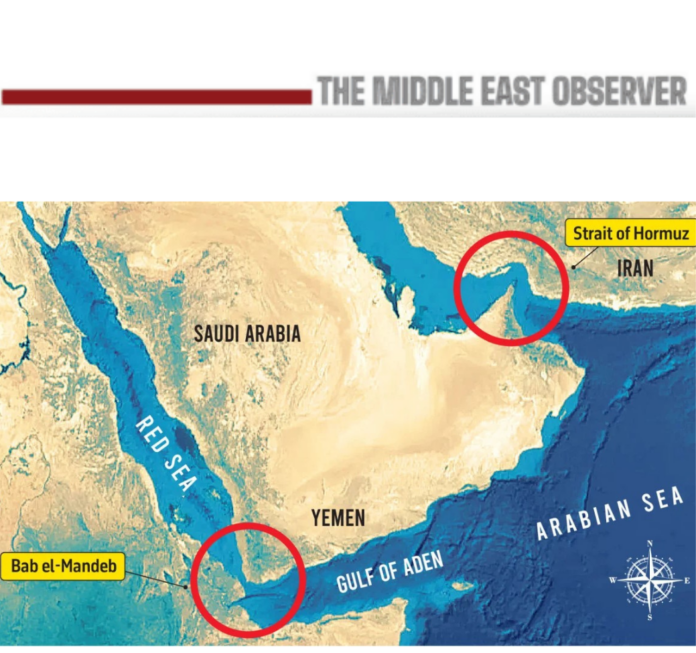
Global oil and gas trade is being reorganised around the security of pipelines, ports and maritime chokepoints as conflict forces producers and consumers to accept longer voyages, higher freight charges and less efficient supply chains.
The Strait of Hormuz and Bab el-Mandeb together influence roughly one-quarter of global seaborne oil trade, while Hormuz alone carries about one-fifth of worldwide LNG shipments. Disruption around either passage can alter prices; simultaneous pressure on both is changing the geography of energy trade.
The latest escalation came when Yemen’s Iran-aligned Houthis said they had attacked Saudi Aramco facilities at Jizan and Yanbu. Reuters verified footage showing smoke near the 400,000-barrel-a-day Jizan refinery, while Saudi forces intercepted missiles aimed at oil installations in Yanbu, the kingdom’s principal Red Sea export hub and main alternative to Hormuz.
Saudi Arabia consequently faces risks on both of its principal maritime routes. Gulf exports are constrained by sharply reduced traffic through Hormuz, while barrels transferred through the kingdom’s East-West pipeline to Yanbu must pass close to Houthi-controlled territory before reaching Asian markets through Bab el-Mandeb.
The result is a form of strategic regionalisation. Saudi crude is being rerouted through Egypt, Chinese refiners are securing Russian oil unusually early, US LNG cargoes are following higher prices towards Asia, and Venezuelan heavy crude is returning to US Gulf Coast refineries.
The market is not becoming less global. It is becoming less direct, more expensive and increasingly dependent on infrastructure capable of bypassing military and political risk.
Two Chokepoints Reshape the Oil Map
An average of 20.9mn barrels a day of crude, condensate and petroleum products passed through Hormuz during the first half of 2025, equivalent to about one-fifth of global petroleum-liquids consumption and one-quarter of maritime oil trade. Approximately 11.4bn cubic feet a day of LNG also used the passage.
Asia bears most of this exposure. About 89% of the crude and condensate passing through Hormuz was destined for Asian markets, with China, India, Japan and South Korea accounting for almost three-quarters of the total.
Saudi Arabia initially responded to the disruption by increasing movements through its East-West pipeline to Yanbu. Since April, the kingdom has shipped more than 4.5mn barrels a day of crude and fuel from the Red Sea port, about 70% of it destined for Asia.
Energy Aspects estimates that more than 3mn barrels a day of Saudi crude could require longer routes if Bab el-Mandeb becomes effectively inaccessible.
“The impact is going to be massive in the first month,” Matt Smith, commodity research director at Kpler, said of a potential closure. Asian buyers could face delivery delays of about one month as vessels sail around the Cape of Good Hope.
Egypt has therefore become increasingly important as a bypass.
The SUMED pipeline, connecting Ain Sokhna on the Red Sea with Sidi Kerir on the Mediterranean, has capacity of approximately 2.5mn barrels a day. Alongside the Suez Canal, it allows crude to cross Egypt without sailing through Bab el-Mandeb.
Saudi Aramco has offered additional cargoes from Sidi Kerir as threats to southbound Red Sea shipping intensify. Loadings from the terminal averaged about 427,000 barrels a day in 2026, down from 735,000 barrels a day in 2025, leaving room for additional movements.
South Korea’s SK Energy has chartered a very large crude carrier to load 2mn barrels from Sidi Kerir in August for delivery to Ulsan. Shipping sources placed the lump-sum freight cost at $18.5mn, illustrating the financial premium now attached to route security.
For Asian buyers, moving Saudi crude north through Egypt can still require vessels to continue westwards around Africa before turning east. The route is inefficient, but it becomes commercially rational when the shorter passage is unsafe.
Physical Crude Prices Signal Immediate Scarcity
The tightening is clearest in physical oil markets rather than longer-dated futures.
Dated Brent, used to price much of the world’s physical crude trade, reached $105.70 a barrel on July 23. North Sea Forties crude climbed to $108.77 the following day.
Spot premiums for Dubai crude over swaps doubled to $12.74 a barrel, while Oman’s premium rose to $12.62. Abu Dhabi’s Murban grade traded at a premium of $19.04, its strongest since early April.
These premiums measure what refiners are prepared to pay above benchmarks for prompt barrels. Their rise indicates competition for particular grades at specific locations even as futures traders remain uncertain about how long the disruption will last.
“Supply considerations are once again at the forefront of thinking,” said Tamas Varga, an oil broker at PVM.
The squeeze has been compounded by events outside the Gulf. Kazakhstan reduced production after suspected Ukrainian drone attacks forced the closure of the Caspian Pipeline Consortium’s Black Sea export terminal. One industry estimate placed Kazakh output at about 406,000 barrels a day, roughly half its previous level.
Immediate scarcity nevertheless coexists with the possibility of renewed oversupply.
A Reuters poll of eight analysts estimates a 1.5mn-barrel-a-day global deficit in 2026, but a 1.9mn-barrel-a-day surplus in 2027 if Gulf exports recover, production expands in the Americas and Chinese demand remains subdued.
The US Energy Information Administration expects US crude output to average 13.8mn barrels a day in 2026 and 14mn in 2027.
Oil can therefore remain abundant over the medium term while becoming acutely scarce in the wrong grade, at the wrong port or on the wrong side of a disrupted route.
Refining Becomes the Next Bottleneck
Crude availability is only part of the problem. The capacity to convert oil into diesel, jet fuel and gasoline is under greater strain.
Asian refining margins for gasoil and jet fuel have risen above $65 a barrel, from just over $20 before the latest conflict. Refineries in Europe and the US are already operating close to capacity, limiting their ability to compensate for lost production elsewhere.
The International Energy Agency had expected global refinery runs to reach 81.6mn barrels a day in the third quarter, led by an Asian recovery. Delayed Middle Eastern cargoes now threaten that outlook.
“There is simply not enough capacity in the world to deal with the double whammy of Hormuz closure and Russian export bans,” said Neil Crosby, an analyst at Sparta Commodities.
Ukrainian attacks have reduced Russian refinery operations, while Moscow has extended restrictions on gasoline exports to protect domestic supply. Deputy prime minister Alexander Novak said fuel conditions remained difficult in several regions, particularly Siberia.
Russia is consequently exporting crude to Asia while struggling to produce enough finished fuel for parts of its domestic market. The distinction between upstream resources and downstream processing capacity has become central to the crisis.
LNG Creates a Three-Region Market
While crude remains more globally fungible, LNG demonstrates how geopolitical disruption can divide energy markets into distinct regional price zones.
The average price of LNG for September delivery into north-east Asia rose to $22 per million British thermal units on July 24, from $20.10 a week earlier and its highest level in four months.
Kpler has shifted its assessment of Hormuz from an expected de-escalation to a prolonged-crisis scenario. It expects Qatar’s 2026 LNG exports to fall below 27mn tonnes, compared with about 80mn tonnes in 2025, and forecasts the Asian JKM benchmark averaging $19.50 per million Btu during the second half.
The disruption is also changing long-term contracting. Asian and European buyers are seeking lower prices, stronger delivery guarantees and greater flexibility from Qatar and the UAE, which together account for about one-fifth of global LNG export capacity. Higher war-risk insurance costs may increasingly be incorporated into Gulf supply contracts.
US exporters have become the principal swing suppliers. Asia is expected to import a record 4.23mn tonnes of US LNG in July, about three times the February volume, while European receipts are projected to fall to their lowest since November 2024.
“Looking at current LNG prices, Asian prices are higher than European ones,” said Hans van Cleef, head of energy research at EqoLibrium, adding that uncontracted cargoes were therefore moving towards Asia.
Europe’s total July LNG imports are projected at 6.9mn tonnes, down from 8.72mn tonnes a year earlier and their lowest since September 2024.
The result is an Asian market paying heavily to replace disrupted Gulf supply, a European market competing to rebuild storage and a comparatively insulated US market supported by abundant domestic production.
China Uses Demand Flexibility as Strategic Leverage
China’s response demonstrates how a large consumer can use inventories, import reductions and purchasing power to limit exposure.
Chinese crude imports fell 41.3% year on year in June to 7.12mn barrels a day, their lowest level since October 2016. Refinery utilisation dropped to 57.72%, close to a 10-year low, amid weak domestic demand and restrictions on refined-product exports.
These reductions helped moderate global prices by limiting Chinese participation during expensive periods, although they also reflected softer industrial consumption rather than strategic policy alone.
Beijing is now returning selectively to the market. Two major Chinese refiners bought most Russian ESPO Blend cargoes available for September loading from Kozmino at discounts of only $1-$3 a barrel below Brent, compared with about $4 for August cargoes.
ESPO can reach northern China quickly from Russia’s Pacific coast and avoids both Hormuz and Bab el-Mandeb. China is also sourcing barrels from Africa and Latin America, maintaining a diversified portfolio while retaining the ability to reduce purchases when prices become unattractive.
That flexibility gives Beijing greater leverage than most importers, but it does not amount to replacing Gulf oil with Russian supply. It is a strategy of diversification, inventory management and opportunistic purchasing.
Russia’s Eastern Pivot Remains Constrained
Russia benefits from China’s search for secure supplies, but Moscow needs Chinese demand more urgently than Beijing needs any single Russian source.
Gazprom supplied 38.8bn cubic metres of gas to China through the Power of Siberia pipeline in 2025, slightly above the route’s original capacity.
Russia and China have discussed expanding existing deliveries and constructing Power of Siberia 2, which could carry a further 50bn cubic metres annually from Yamal through Mongolia. Pricing and other commercial terms remain unresolved, and no implementation timetable has been agreed.
The existing route draws largely from eastern fields, while much of the gas formerly sold to Europe originated in western Siberia. Redirecting that supply would require new pipelines, years of construction and substantial capital.
China therefore appears to hold the stronger commercial negotiating position.
Europe Bears the Highest Adjustment Cost
Europe’s dependence on seaborne LNG leaves it particularly exposed as US cargoes move towards higher Asian prices.
European storage sites were only 54% full on July 22, well below their five-year seasonal average and at their second-lowest level in 15 years. Anders Opedal, chief executive of Equinor, said the continent might not reach even 80% before winter.
LNG accounted for roughly 30% of Europe’s gas imports in 2025, but cargoes previously delivered from the US are increasingly being redirected towards Asia.
The immediate risk is not necessarily that Europe will exhaust its supplies. Lower consumption, Norwegian pipeline deliveries, interconnection capacity and emergency measures provide substantial protection.
The larger threat is price.
Europe must bid against Asian buyers while rebuilding stocks from an unusually low starting point. Dutch TTF gas exceeded €62 per megawatt-hour on July 22, almost 50% higher over the preceding month.
Higher gas prices feed into electricity markets and weaken the competitiveness of chemicals, fertilisers, metals, glass, ceramics and other energy-intensive industries.
Europe has reduced its dependence on Russian pipelines, but part of that exposure has been replaced by dependence on global shipping, Asian demand and US export economics.
Trump’s 64% Claim Exceeds Conventional Oil Measures
The US is considerably better insulated from Hormuz than Europe or Asia.
During the first half of 2025, it imported about 400,000 barrels a day of crude and condensate through the strait, equivalent to about 7% of crude imports and only 2% of domestic petroleum-liquids consumption.
President Donald Trump nevertheless overstated that advantage when he said on May 27 that adding Venezuela meant the US had “I think, 64% of the world’s oil”.
The claim does not correspond to standard measures of production or reserves.
The EIA forecasts US crude production at 13.8mn barrels a day in 2026, while Venezuela is producing about 1.2mn barrels a day. Together, the countries account for roughly one-fifth of global crude production, not 64%. Their combined reporting proves crude reserves also amount to about one-fifth of the global total, although differences in national reporting methodologies make the comparison approximate.
Trump’s underlying strategic point is more defensible than his percentage. Venezuelan heavy crude is well suited to complex US Gulf Coast refineries designed to process dense, high-sulphur grades.
Venezuela exported more than 1.2mn barrels a day of oil and fuel in June, with about half of recent shipments directed to the US. Phillips 66 has resumed direct purchases from PDVSA, while Chevron exported about 293,000 barrels a day of Venezuelan crude during the second quarter.
Venezuelan supply strengthens US refining security and reduces dependence on distant Gulf cargoes. It does not insulate American consumers from global crude prices, product shortages or rising shipping costs.
Logistics Becomes a Core Energy Price
The immediate market question is no longer whether the world has sufficient oil and gas in aggregate. It is whether the required barrel or cargo can reach the right refinery, terminal or storage facility at an economically sustainable cost.
That calculation is already shaping physical crude premiums, LNG destination choices, tanker freight, war-risk insurance and refinery margins. It will increasingly influence capital allocation towards bypass pipelines, export terminals, storage capacity and flexible shipping contracts.
Producers with multiple routes will command a resilience premium. Buyers able to switch suppliers or draw on inventories will gain negotiating leverage. Assets exposed to a single choke point will require higher returns, additional insurance or political protection to attract investment.
As geopolitical risk becomes embedded in freight, insurance and infrastructure costs, logistics is no longer merely the mechanism through which energy is delivered. It is becoming a central determinant of energy value.
Related news:
Beyond Hormuz: How the Gulf Crisis Is Redrawing the Middle East’s Energy Map
Iran War Costs Global Companies Over $25 Billion as Energy and Shipping Pressures Intensify
Read also:
Egyptian startups secure $3.5mn as investors favour infrastructure