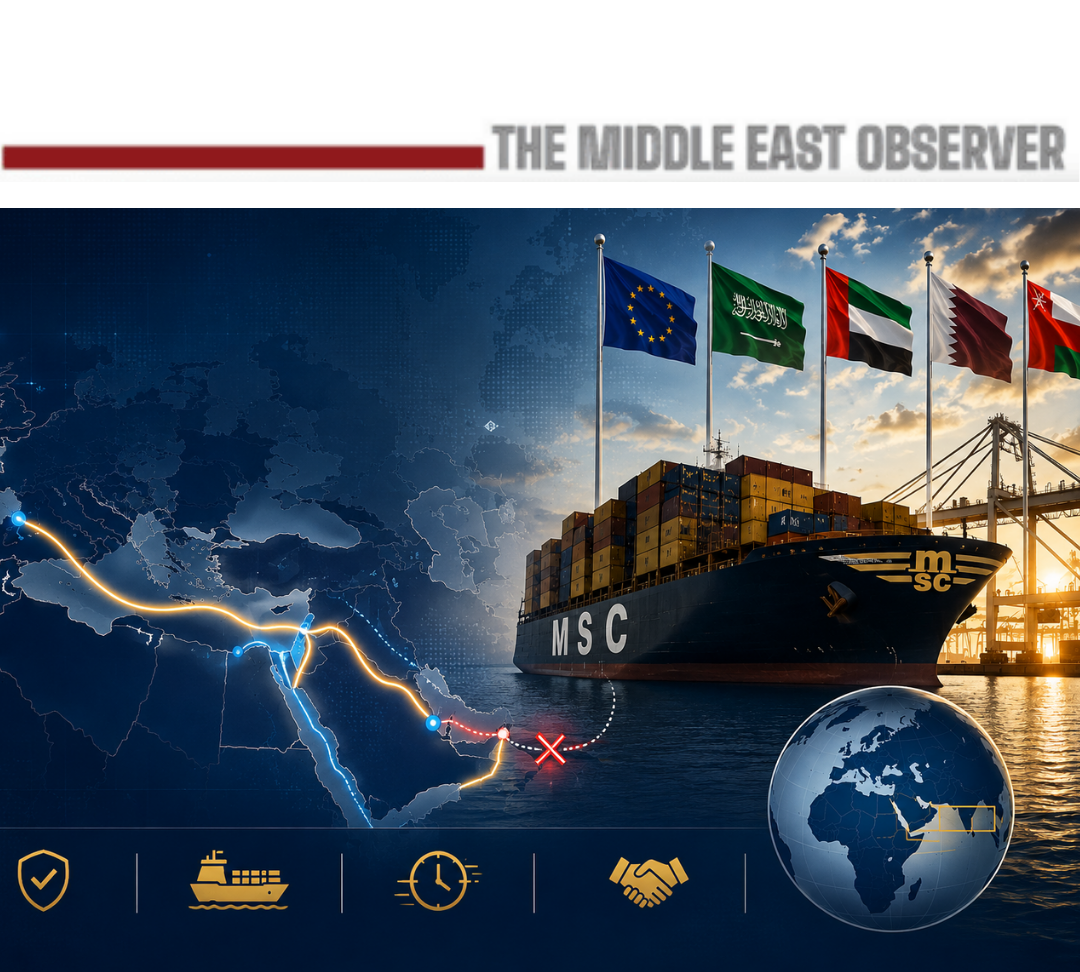
Thousands of tanker trucks now cross Iraq towards Syria’s Mediterranean coast carrying fuel that only months ago would have left the Gulf by sea. Their journey illustrates a fundamental shift in Middle Eastern energy logistics triggered by the disruption of the Strait of Hormuz. What began as an emergency response to one of the world’s most strategically vulnerable maritime chokepoints is rapidly reshaping regional energy trade and accelerating investment in alternative pipelines, ports and export corridors.
For decades, around one-fifth of global oil and liquefied natural gas (LNG) supplies transited the Strait of Hormuz, making it indispensable to Gulf producers. The 2026 crisis demonstrated that energy security depends not only on hydrocarbon reserves, but increasingly on the resilience and diversity of the infrastructure connecting those reserves to international markets.
Rather than replacing Hormuz, regional governments are creating a more diversified export network designed to ensure that energy continues reaching global markets even during periods of geopolitical disruption.
Syria: From Conflict Zone to Mediterranean Energy Gateway
Perhaps the most unexpected beneficiary of the Hormuz crisis has been Syria.
Seeking alternatives to Gulf export terminals, Iraq began transporting fuel oil—not its principal crude grades—across western Iraq into Syria using thousands of tanker trucks. Iraq’s state oil marketer SOMO contracted approximately 650,000 tonnes of fuel oil per month for export through Syria during the second quarter of 2026, with more than 600,000 tonnes shipped via the Mediterranean port of Baniyas in June alone.
Although trucking remains significantly more expensive than pipelines, it provides Iraq with uninterrupted access to Mediterranean markets during periods of Gulf instability.
The operation has transformed Syria into a major transit hub, generating customs revenues, port activity, logistics demand and renewed investment in storage, maintenance and marine services. More importantly, it has revived interest in restoring the historic Kirkuk–Baniyas pipeline, which once transported Iraqi crude directly to the Mediterranean before becoming inoperative following decades of conflict.
The United States has publicly supported discussions to rehabilitate the corridor, viewing it as a strategic alternative to Hormuz. While major technical, financial and political challenges remain—including infrastructure rehabilitation, sanctions and security concerns—the pipeline’s strategic value has increased dramatically.
Beyond enhancing energy security, pipelines reduce transportation costs, lower marine insurance premiums, improve delivery reliability and strengthen the long-term bankability of upstream energy investments. Truck convoys remain an effective emergency measure, but permanent pipeline infrastructure offers the commercially sustainable solution.
Fujairah: The UAE’s Strategic Lifeline
If Syria represents the Mediterranean alternative, Fujairah has become the UAE’s gateway beyond Hormuz.
Located on the Gulf of Oman, outside the Strait itself, Fujairah is connected to Abu Dhabi’s oil fields by the Habshan–Fujairah Pipeline, capable of transporting approximately 1.5–1.8 million barrels per day directly to international waters.
Originally developed as a strategic safeguard, the pipeline has become one of the UAE’s most valuable national assets.
Fujairah today functions not only as an export terminal but also as one of the world’s leading oil-storage, bunkering and blending centres, enabling producers and traders to maintain inventories outside Hormuz while serving global shipping markets.
Recognising its growing importance, ADNOC is constructing an additional bypass pipeline expected to enter service in 2027, while DP World is reportedly studying further expansion of Fujairah’s port infrastructure. Collectively, these projects are transforming the emirate into a regional energy and logistics hub comparable in strategic importance to Rotterdam or Singapore within their respective trading systems.
Yanbu: Saudi Arabia’s Red Sea Advantage
Saudi Arabia entered the crisis with the Gulf’s strongest alternative export infrastructure.
The East–West Pipeline (Petroline) stretches approximately 1,200 kilometres from the Kingdom’s eastern oil fields to the Red Sea port of Yanbu, with an effective capacity approaching 7 million barrels per day.
Constructed during the Iran-Iraq War of the 1980s, the system allows Saudi crude to bypass Hormuz entirely, providing direct access to the Red Sea, the Suez Canal and European markets.
During the latest disruption, Saudi Arabia substantially increased the share of crude exports routed through Yanbu while studying plans to expand East-West pipeline capacity by an additional 2 million barrels per day.
The Kingdom’s decades-old investment has evolved into a strategic insurance policy. While competitors constrained by Hormuz face higher costs or export interruptions, Saudi Arabia retains greater flexibility to maintain contractual deliveries, protect government revenues and preserve market share.
Qatar: LNG Without an Alternative
No Gulf producer illustrates Hormuz dependence more clearly than Qatar.
As one of the world’s largest LNG exporters, accounting for approximately 20% of global LNG trade, Qatar relies almost entirely on LNG carriers departing from Ras Laffan, all of which must transit Hormuz.
Unlike crude oil, LNG cannot simply be diverted through existing oil pipelines. It depends on an integrated chain of liquefaction plants, specialised loading terminals and purpose-built LNG carriers.
Following attacks on energy infrastructure, QatarEnergy declared force majeure on LNG exports after approximately 17% of national LNG production capacity was disrupted.
The crisis demonstrated that Qatar’s challenge is less about production than export resilience. Future strategy is therefore likely to focus on strengthening infrastructure protection, expanding strategic storage, increasing shipping flexibility and diversifying commercial arrangements rather than attempting to construct entirely new export routes requiring enormous investment and many years to complete.
Kuwait: Geography Still Matters
Kuwait faces similar structural constraints.
Almost all of its crude exports leave through Gulf terminals inside Hormuz, leaving the country without an independent bypass route.
The crisis forced production reductions following attacks affecting refining infrastructure, prompting discussions with Saudi Arabia over potential future access to expanded Red Sea pipeline capacity.
Although such arrangements remain under consideration, they reflect a broader regional trend: Gulf producers increasingly view export infrastructure as a collective resilience network rather than purely national assets.
The Next Infrastructure Investment Cycle
The Hormuz crisis is expected to trigger one of the Middle East’s largest energy infrastructure investment programmes in decades.
The commercial rationale extends well beyond crisis management. Alternative export corridors reduce transportation risk, lower insurance costs, improve revenue certainty and protect government income during periods of geopolitical instability. These characteristics are making strategic infrastructure increasingly attractive to governments, sovereign wealth funds and long-term institutional investors.
Demand is expected to accelerate across virtually every segment of the energy logistics chain, including cross-border pipelines, export terminals, storage facilities, pumping stations, industrial ports, logistics parks and marine services. Engineering firms, pipeline contractors, port operators, shipping companies and infrastructure developers are therefore positioned to benefit from what could become a new regional investment cycle focused as much on resilience as on commercial returns.
Echoes of the Tanker Wars
The current transformation echoes the “Tanker War” phase of the Iran-Iraq conflict during the 1980s, when repeated attacks on commercial shipping first exposed Hormuz’s strategic vulnerability.
Saudi Arabia responded by constructing the East-West Pipeline.
Four decades later, the same strategic logic is driving a new generation of investment extending from Syria’s Mediterranean corridor to Fujairah’s Indian Ocean terminals and expanded Red Sea infrastructure. The objective is no longer simply diversification, but redundancy—ensuring that no single choke point can disrupt the region’s energy exports.
A New Energy Geography
The Hormuz crisis is likely to be remembered not simply as a geopolitical confrontation but as the catalyst for a fundamental restructuring of Middle Eastern energy logistics.
Syria’s emergence as Iraq’s Mediterranean gateway, Fujairah’s consolidation as the UAE’s strategic outlet beyond Hormuz and Yanbu’s growing importance as Saudi Arabia’s Red Sea export hub demonstrate how rapidly infrastructure can reshape regional trade. At the same time, the experiences of Qatar and Kuwait show that abundant hydrocarbon reserves alone no longer guarantee uninterrupted access to international markets.
For decades, the value of an energy producer was measured primarily by the size of its reserves. The Hormuz crisis suggests that the next era will be defined just as much by the resilience of the infrastructure that delivers those reserves to global markets. In the emerging energy order, pipelines, ports, storage terminals and logistics corridors have become strategic assets every bit as valuable as the oil and gas they carry.
Related news:
Fitch Sees Brent at $70 as Hormuz Reopening Reshapes Oil Outlook
Oil Prices Hold Near $114 as Hormuz Tensions continue to threaten Supply Lines
Read also:
WE Partners with Grofa to Deliver Smart Infrastructure for New Urban Development
Egypt Bets EGP 12bn on Vaccine Hub to Cut Imports and Expand Regional Reach