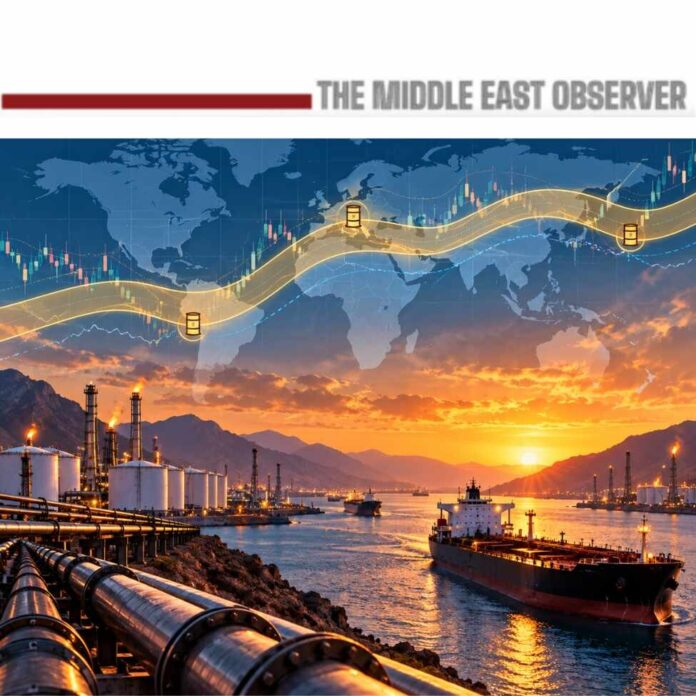
The world’s major economies are moving beyond emergency oil releases towards a broader mechanism for containing the Iran war’s energy shock through the northern winter.
It is not a formal oil-price band. No government or producer group has specified a target Brent price, and there is no evidence of a negotiated G7-OPEC+ corridor.
But an increasingly coordinated combination of strategic reserves, refinery intervention, open export channels, recovering Gulf supply and domestic fiscal support is beginning to perform the economic function of a stabilisation system: preventing geopolitical disruption from passing unchecked into wholesale fuel prices, inflation and household energy bills.
The system’s first horizon runs through January and into early February 2027.
And its most important consequence may ultimately be fiscal rather than purely energy-related. Governments are increasingly absorbing a larger share of the shock themselves.
G7 Builds the Wholesale Price Defence
The clearest development came on October 2, when G7 leaders agreed to coordinate the release of 100mn barrels of crude oil and refined products over four months through the International Energy Agency, while front-loading a substantial volume of diesel during the first 20 days.
They also agreed to coordinate refinery maintenance, temporarily raise refinery utilisation where feasible, encourage additional refined-product production and refrain from imposing energy-export restrictions among G7 economies.
The distinction between crude and diesel is crucial.
This is not a 100mn-barrel diesel release. The programme encompasses crude and refined products. Diesel is being accelerated because the centre of the energy shortage has shifted.
Middle Eastern crude exports have recovered substantially from their post-war disruption, while refined-product flows remain severely constrained. The IEA says pressure is now particularly acute in diesel as disruption to Middle Eastern refining combines with Ukrainian attacks on Russian refineries and an already tight global products market.
That makes refinery throughput, product inventories and distribution capacity — rather than crude availability alone — the critical bottlenecks.
The policy response has changed accordingly.
Governments are no longer simply releasing crude and waiting for prices to fall. They are intervening across the petroleum chain:
release inventories → accelerate diesel supply → maximise refinery throughput → coordinate maintenance → prevent export restrictions → restore Gulf transport routes.
That amounts to a significantly more sophisticated form of market defence.
The 100mn Barrels Are Not Entirely New
There is also an important qualification to the headline number.
The October programme should not automatically be read as 100mn entirely additional barrels on top of the IEA’s previous emergency action.
IEA members agreed on March 11 to make a record 400mn barrels of emergency oil stocks available after the Middle East conflict disrupted global supply. By October 2, IEA Executive Director Fatih Birol said around 325mn barrels — more than 80% — had already been released.
The G7’s October statement explicitly calls for the “immediate and full implementation” of those March commitments and says the four-month release takes into account commitments already fulfilled. S&P Global characterised the latest action as effectively setting a deadline for the remaining tranche of the March programme rather than creating a wholly separate 100mn-barrel package.
That does not diminish its importance.
What changed on October 2 was how the remaining firepower will be deployed: over a defined four-month period, with diesel front-loaded and accompanied by refinery and trade-policy measures.
The intervention has therefore evolved from emergency stock liquidation into something closer to managed market stabilisation.
Washington Forced the Pace
US pressure was central to that shift.
The Trump administration had pressed France and Germany — which hold a large share of Europe’s strategic diesel inventories — to release emergency stocks as US and European diesel prices climbed.
Washington went further: it raised the possibility of restricting US diesel exports if European partners failed to act. Such a move could have protected some US domestic supply in the short term but risked worsening Europe’s shortage and fragmenting an already stressed global products market.
The G7 compromise effectively chose coordinated intervention over protectionism.
Europe releases diesel. The US keeps exports flowing. G7 economies refrain from imposing restrictions on one another.
That is significant because energy crises can escalate when governments attempt to protect national consumers by trapping supplies domestically. The October agreement seeks instead to maintain international circulation while using strategic inventories to suppress extreme price movements.
For President Donald Trump, the political incentive is clear. High fuel prices have become a domestic issue ahead of the November US midterm elections.
But the resulting mechanism reaches much further than US politics.
Hormuz Recovery Provides the Exit Route
Emergency stocks can suppress a price spike. They cannot replace Gulf production indefinitely.
The second pillar of the strategy is therefore the progressive restoration of physical Middle Eastern exports.
The G7 specifically called for the restoration of full navigational rights through the Strait of Hormuz, while France noted improving flows both through Hormuz and Saudi Arabia’s Red Sea export system.
This creates the intended sequence:
strategic inventories bridge the disruption; additional refinery output addresses the diesel shortage; unrestricted trade moves products towards deficit markets; alternative Saudi export routes reduce dependence on Hormuz; and recovering Gulf shipping gradually restores normal supply.
If the sequence holds, governments do not need to replace lost Middle Eastern barrels indefinitely.
They need to buy enough time for the physical market to repair itself.
That is why the four-month horizon matters.
Beginning in early October, it carries the intervention through the heart of the northern-hemisphere winter and into approximately early February 2027.
From Commodity Shock to Government Shock
The second half of the stabilisation system operates away from trading screens.
Governments are not only intervening in wholesale oil markets. Many are also preventing high global energy prices from reaching consumers in full through fuel subsidies, price caps, tax reductions, rebates and other support measures.
The UN Development Programme warned in June that developing economies were already using such mechanisms extensively to protect households and businesses from the Middle East energy shock.
That changes who ultimately carries the cost.
Without intervention, a $20 increase in fuel prices largely appears directly as higher transport costs, household bills and corporate expenses.
With intervention, governments absorb part of that increase through lower tax revenue or higher expenditure.
The inflation shock is reduced.
The fiscal shock rises.
UNDP estimates that global fossil-fuel subsidies could exceed $1tn in 2026, and could reach about $1.43tn if oil averages around $110 a barrel. It warned that the fiscal burden is already forcing some governments to divert resources from health, education and infrastructure. Nearly half of the world’s poorest countries are already either in debt distress or at high risk of it.
That gives the emerging energy-price corridor a less visible balance sheet.
At the wholesale level, strategic petroleum reserves are being spent.
At the retail level, fiscal reserves are being spent.
The Next Risk Is Energy, Debt and Food Together
That matters because governments are entering this winter with another constraint: borrowing costs remain unusually high.
US Treasury yields recently climbed to levels not seen in decades, with the 10-year yield reaching about 5.34%, while fiscal concerns have also pushed borrowing costs higher in several other major economies.
For heavily indebted emerging and developing economies, the problem is sharper.
Governments may therefore enter 2027 simultaneously financing higher fuel subsidies, refinancing debt at expensive rates and attempting to preserve social spending.
A third pressure is now approaching.
The World Meteorological Organization says the current El Niño is expected to become very strong, with a nearly 100% probability that conditions will persist through February 2027. The event is expected to alter rainfall and temperature patterns significantly and increase risks of drought, floods and extreme heat.
Agricultural markets are already showing sensitivity.
The FAO Food Price Index rose 1.5% in September and 5.8% from a year earlier, with cereal prices increasing 5.1% during the month and sugar 6.1%. FAO cited transport disruption and adverse weather, including strengthening El Niño conditions, among the pressures facing agricultural supply.
FAO analysis also identifies significant agricultural vulnerability to El Niño across parts of Southern Africa, the Sahel, South and Southeast Asia, Central America and the Caribbean.
This creates a potentially dangerous three-way squeeze:
high energy costs + elevated sovereign borrowing costs + El Niño-driven food pressures.
Why Early 2027 Becomes the Pressure Point
The timing is unusually important.
The G7’s four-month energy bridge runs almost exactly into the period when a very strong El Niño is expected to peak and when its agricultural consequences could become more visible.
That means early 2027 could become the moment when three policy burdens converge.
Governments may still be subsidising fuel.
Debt-service costs may remain elevated.
And food prices could be absorbing weather-related supply pressure.
Countries dependent on imported food and imported energy would be especially exposed because the same government balance sheet may have to cushion both shocks simultaneously.
The objective of energy intervention is therefore becoming broader than simply reducing Brent or diesel futures.
It is about preventing an energy-price shock from amplifying an already difficult inflation–interest-rate–food-price cycle.
OPEC+ Forms the Other Side of the Market
Producer policy remains another part of the equation.
OPEC+ retains mechanisms for managing supply as Middle Eastern production and exports recover, while its developing 2027 quota structure will help determine how much oil reaches the market next year.
That should not be confused with formal coordination between consuming governments and producers.
There is no evidence of a G7-OPEC agreement to maintain Brent within a prescribed range.
But their independent interventions can nevertheless create something resembling a corridor.
At the upper end, consuming governments can deploy emergency inventories, refinery measures and fiscal protection when prices become economically or politically intolerable.
At the other end, producers retain mechanisms for adjusting supply if a full recovery eventually creates excessive downward pressure.
The result is an informal price-management architecture without an agreed price target.
The World Is Buying Time, Not Solving the Crisis
The central change is therefore conceptual.
The international response is no longer based on the assumption that the Iran conflict must first be resolved before energy prices can stabilise.
Governments are instead attempting to disconnect geopolitical risk from consumer energy prices long enough for the physical market to heal.
The October-February window gives Gulf exports time to recover, refiners time to rebuild product supply, governments time to manage inventories and OPEC+ time to establish its 2027 production framework.
But the stabilisation has a cost.
The Iran-war energy shock has not disappeared.
It is being redistributed.
Part of it is moving from spot markets into strategic reserves.
Part is moving from consumers into subsidies and tax concessions.
Part is moving from inflation statistics onto sovereign borrowing requirements.
That may succeed in preventing another uncontrolled oil and diesel price spiral through winter.
But it also means that the ultimate absorber of the global energy crisis is increasingly the government balance sheet.
And by early 2027, that balance sheet could be confronting energy support, high debt-service costs and climate-driven food pressure at the same time.
The world’s emerging oil-price corridor may therefore carry markets through winter.
The larger question is how much fiscal capacity governments will have left when they reach the other side.
Related news:
Egypt–Eritrea Energy: Cairo Launches $23m Solar Projects to Support Power Supply
AI Is Advancing Faster Than Governments Can Build the Rules Around It
Read also:
EGYPT SOUNDS GLOBAL ENERGY ALARM AS EGYPES 2026 OPENS AMID WAR SHOCKS
Bitcoin Slides Toward $65,000 as Trade Policy Uncertainty Jolts Risk Assets