

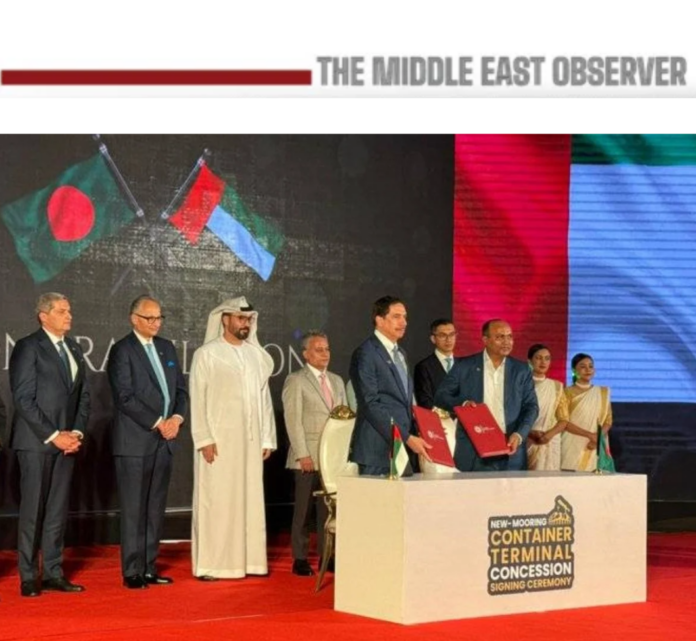
The 15-year concession promises faster trade and foreign investment, but questions over financial transparency, employment protections and the value of a strategic public asset remain unresolved.
Bangladesh’s $150 million port-modernisation agreement with Dubai-based DP World faces a test of public financial returns and job security, after labour leaders suspended a planned indefinite hunger strike without resolving their objections to the transfer of operating rights over one of the country’s busiest container terminals.
The agreement, signed on October 8, grants DP World a 15-year concession to operate and modernise Chattogram Port’s New Mooring Container Terminal (NCT) and its overflow yard. The terminal handled approximately 1.39 million twenty-foot-equivalent units (TEUs) in fiscal 2025–26, accounting for about 39% of the port’s reported container traffic.
The concession gives the Dubai government-owned operator control of day-to-day terminal operations while Bangladesh retains ownership of the land, infrastructure and core assets. A further 15-year extension is possible by mutual agreement, subject to contractual conditions.
The financial equation
DP World will pay the Chattogram Port Authority (CPA) approximately Tk600 crore ($50 million) upfront, with 25% due upon signing and the remainder before operations begin. It has also committed more than Tk1,000 crore in modernisation spending during the first decade.
Bangladesh’s Shipping Minister Shaikh Rabiul Alam has described the project as involving $150 million in fresh investment. However, other published accounts describe a broader package of investment and associated commitments, including approximately $90 million earmarked for equipment, technology and upgrades.
The figures have not been reconciled through a publicly available itemised investment schedule, leaving uncertainty over the precise amount and timing of new capital expenditure.
CPA will also receive a share of container-handling revenue or royalties, variously described as 40%–67% per TEU, alongside a fixed annual payment of approximately Tk10 crore.
A minimum-volume provision linked to 1.23 million TEUs annually, potentially declining to 1 million when additional terminal capacity becomes operational, is intended to protect public revenue as competition among terminals increases.
But the complete concession contract has not been published. The detailed calculation of revenue shares, covered income streams, permitted deductions, investment enforcement and termination arrangements therefore remains unavailable for independent assessment.
The distinction matters because NCT is an established, publicly developed asset rather than a new terminal being financed from scratch.
CPA reported total port revenue of Tk6,629 crore in fiscal 2025–26, but that figure covers its wider operations and cannot be treated as NCT’s standalone earnings.
Assessing the concession’s financial value consequently requires more than comparing upfront payments with investment commitments. It also requires establishing how much Bangladesh could earn under alternative management arrangements, after accounting for operating expenses, maintenance obligations and future capital requirements.
Labour concerns remain unresolved
Port workers staged a symbolic hunger strike on October 12 and threatened an indefinite protest from October 19, demanding cancellation of the concession and guarantees protecting existing employment.
Following October 18 talks with Shipping Minister Rabiul Alam, a 16-member labour delegation agreed to suspend the planned action.
Labour coordinator Humayun Kabir told The Daily Star that ministers had undertaken to address the workers’ demands and proposed further discussions.
The agreement’s suspension of industrial confrontation did not resolve the underlying dispute. Workers remain concerned that foreign management and automation could affect jobs, wages and the terminal’s future earnings.
The government says existing local employees will retain their employment and benefits, while training will support the transition to modern equipment and digital operations.
Those assurances will ultimately depend on how the concession’s employment provisions are implemented and enforced.
Modernisation against an improving baseline
The commercial rationale rests on Chattogram’s importance to Bangladesh’s export economy, particularly its garment manufacturers, which depend on reliable cargo handling and predictable shipping schedules.
The port ranked 364th among 400 container ports in the World Bank–S&P Global Container Port Performance Index for 2025, highlighting significant scope for improving vessel-handling efficiency.
Yet performance has already shown improvement. Average container-vessel turnaround fell to 2.38 days in fiscal 2025–26 from 2.58 days a year earlier, while container throughput rose to approximately 3.52 million TEUs.
The improvements demonstrate that modernisation is not starting from a static baseline. Future performance should therefore be measured against recent progress, not only historical congestion levels.
The government expects new equipment, digital tracking, better crane productivity and faster truck movements to reduce delays. Disclosed targets envisage truck waiting times falling towards two hours in the first year and one hour by the third year.
DP World Chairman Essa Kazim has said the company intends to connect NCT to its international ports and logistics network, potentially strengthening Bangladesh’s access to global supply chains.
Lower shipping delays could improve exporters’ competitiveness, but faster terminal handling will not automatically produce lower logistics costs. Customs procedures, inland transport, terminal charges and shipping-line practices will also determine the savings businesses ultimately receive.
The concession is part of Bangladesh’s wider restructuring of port operations, alongside Saudi-backed management at Patenga Container Terminal and the planned Laldia Container Terminal being developed by Denmark’s APM Terminals.
The next test
The government expects DP World to begin work within six months of signing and move towards full operations within two years.
For Bangladesh, the agreement’s financial and economic value will depend on investment delivered, operating efficiency achieved, jobs protected and revenue retained by the public authority.
The central question is whether international management can generate enough additional trade efficiency and public financial returns to justify granting long-term operating rights over an already productive national asset.
That judgment will require measurable results and greater visibility into the concession’s financial obligations—not merely the investment figures announced at signing.
Related News:
DP World Opens Egypt’s First Integrated Logistics Distribution Centre at Sokhna
DP World’s logistics expansion in Egypt
Egypt Draws Gulf and Asian Storage Interest as Global Supply Chains Shift
Gulf investment and regional logistics infrastructure
Read Also:
SCZONE Awards 25-Year Concession for Digital Truck Platform
Private infrastructure concessions and port efficiency
Maersk Targets Full Return to Suez Canal by March 2027
Shipping efficiency and global trade connectivity
