
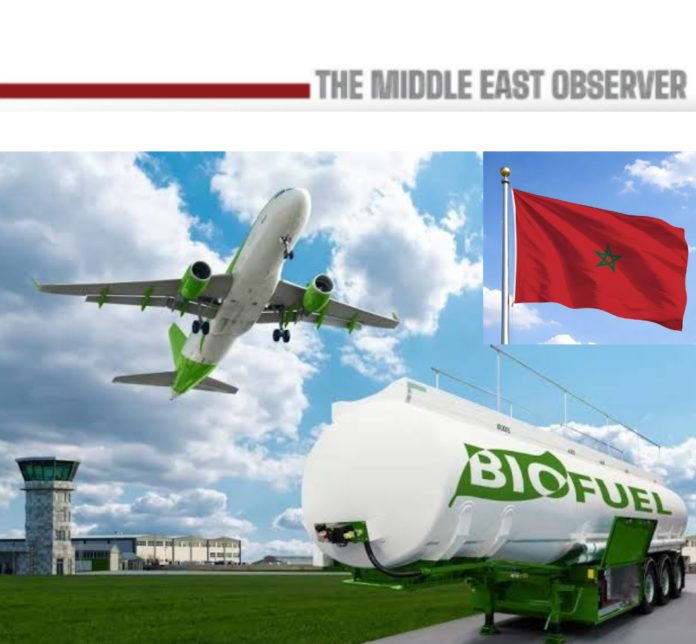
The proposed Moroccan plant follows a $212.4m Egyptian development, taking the two projects’ combined estimated investment to $451.4m as Europe’s cleaner aviation-fuel requirements create new opportunities for regional producers.
Qatar-based Green Sky Capital is advancing plans for a $239 million sustainable aviation fuel (SAF) plant at Morocco’s Nador West Med industrial and port complex, extending its North African investment strategy beyond a separately financed $212.4 million facility in Egypt. The two developments represent a combined estimated investment of $451.4 million, positioning the company to supply international aviation-fuel markets as European regulations accelerate demand for lower-carbon alternatives.
The Moroccan project, known as Manara Morocco, is seeking up to $105 million in financing from the European Bank for Reconstruction and Development (EBRD), whose October 14 disclosure lists the investment as under review, with a decision scheduled for December 2. The proposed financing includes an $85 million tranche and a further $20 million uncommitted tranche, with support envisaged from the Green Climate Fund and European Union guarantees.
The project’s investors include Qatar’s Al Mana Holding and Saudi Arabia’s Vision Invest, alongside Green Sky Capital Management, linking Gulf infrastructure capital with Morocco’s industrial development and Europe’s energy-transition market.
The Nador facility is expected to produce sustainable aviation fuel alongside renewable diesel, naphtha and bio-propane, using waste-derived oils and fats. While the EBRD describes a 200,000-tonne annual SAF facility, the project’s detailed environmental assessment estimates approximately 176,000 tonnes of SAF annually, in addition to other renewable fuels. The difference remains to be clarified.
The plant is provisionally scheduled to begin operations in August 2028, subject to financing, environmental approvals and construction progress.
Egypt provides the first commercial foundation
Green Sky Capital’s Moroccan investment follows a more advanced development at Ain Sokhna, within Egypt’s Suez Canal Economic Zone.
In May, the Emerging Africa & Asia Infrastructure Fund and investment manager Ninety One announced a $142.9 million debt-financing package for the Egyptian project, which has a total estimated cost of $212.4 million.
The facility, developed through SAF Fly Egypt, is designed to produce 200,000 tonnes annually of renewable fuels, including SAF, renewable diesel, bio-propane and bio-naphtha. Production is targeted for the end of 2027.
Energy company Shell has agreed to purchase the Egyptian plant’s products under take-or-pay arrangements and act as its primary feedstock supplier, providing a commercial foundation for the financing.
Both developments will employ hydroprocessed esters and fatty acids (HEFA) technology supplied by France’s Axens, converting waste oils and fats into aviation and other renewable fuels.
Their locations provide access to Mediterranean shipping routes, placing Green Sky Capital’s proposed facilities near European fuel markets while creating opportunities for industrial processing, logistics and exports in Egypt and Morocco.
The company has not publicly established whether the two plants will share customers or operate under an integrated regional sales strategy.
Europe’s aviation rules strengthen the market
The investment plans coincide with a regulatory shift in the European aviation industry.
Under the European Union’s ReFuelEU Aviation regulation, sustainable aviation fuel must account for at least 2% of aviation fuel supplied at covered EU airports from 2025, rising to 6% by 2030 and 70% by 2050.
A September report by the European Union Aviation Safety Agency found that SAF accounted for 2.8% of reported aviation-fuel supplies in 2025, equivalent to approximately 1.1 million tonnes.
Prices nevertheless remain a substantial constraint. SAF averaged €1,925 per tonne in 2025, compared with €640 for conventional aviation fuel, according to the agency.
This premium strengthens the importance of production costs, reliable feedstock supplies and long-term purchasing agreements. The agency also expects European production capacity to expand sufficiently to meet the overall 2030 blending target, meaning North African suppliers will face competition rather than a guaranteed shortage-driven market.
Feedstock dependence tests Morocco’s ambitions
The Moroccan project’s environmental assessment identifies another commercial challenge: dependence on imported raw materials.
The proposed plant would process approximately 200,000 tonnes of waste-derived oils and fats annually. About 40% would come from domestically collected used cooking oil, with the remaining 60% imported as used cooking oil and soap-stock acid oil.
Its hydrogen would also be produced from natural gas, making lifecycle emissions, feedstock certification and traceability important considerations in assessing the fuel’s environmental performance and eligibility for regulated markets.
The assessment anticipates approximately 162 permanent jobs, alongside 400 workers during peak construction. It also identifies freshwater requirements and further environmental and safety assessments that must be addressed before full implementation.
Morocco’s development remains at an earlier financing stage than Egypt’s. Its preliminary timetable envisages construction beginning in November, although the EBRD’s published financing decision is scheduled for December.
For Green Sky Capital, the two projects represent an opportunity to establish a renewable-fuels presence across North Africa’s Mediterranean industrial corridors. Whether that ambition translates into a competitive export business will depend on securing financing, maintaining certified waste-oil supplies and delivering production at costs international aviation customers can sustain.
Related News:
- Japan Targets 400MW in Tunisia as Renewable Energy Investment Accelerates
- Egypt Expands Mediterranean Energy Hub as $24.9bn Import Bill Tests Resilience