

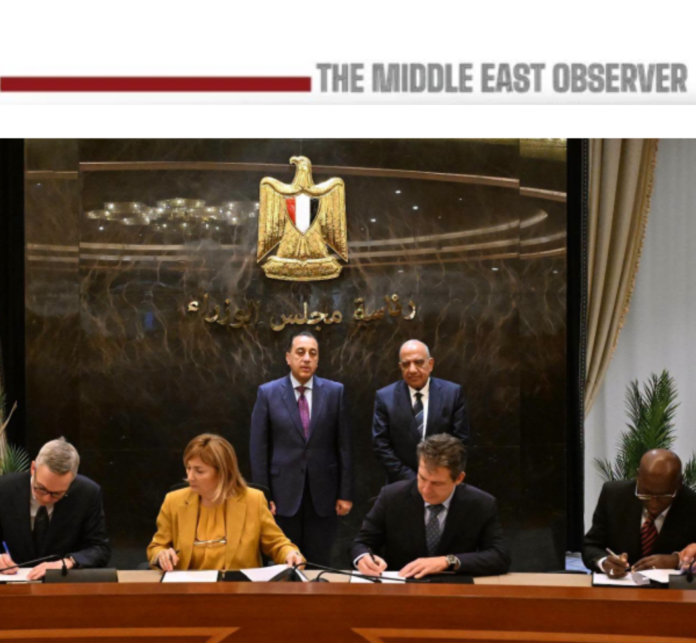
CAIRO — Egypt has signed preliminary financing agreements for a $650 million solar power project in Qena that could create 2,500 construction jobs and supply a third of Egypt Aluminium’s electricity needs, linking renewable energy investment to industrial production and export competitiveness.
The October 26 agreements advance Norwegian developer Scatec’s Dandara project, which will combine 1 gigawatt of solar capacity with 200 megawatt-hours of battery storage across two phases.
The European Investment Bank, European Bank for Reconstruction and Development (EBRD) and African Development Bank (AfDB) are participating in financing arrangements. Separate agreements cover the project’s grid connection and the National Bank of Egypt’s participation in the project company.
According to the AfDB, Dandara’s first phase — comprising 500 megawatts of solar capacity and 100 megawatt-hours of storage — is expected to generate 1,373 gigawatt-hours of electricity annually.
The bank also forecasts approximately 2,500 construction jobs, 23 permanent operational positions and annual carbon dioxide reductions of around 500,000 tonnes. These estimates apply to the first phase, not the entire development.
Why Aluminium Exports Matter
Aluminium production requires substantial electricity, making energy reliability, pricing and carbon emissions important to industrial competitiveness.
Dandara is intended to supply renewable electricity to Egypt Aluminium under a 25-year power purchase agreement.
According to the EBRD, approximately 60% of the company’s aluminium exports are destined for the European Union, where the Carbon Border Adjustment Mechanism entered its definitive phase in January 2026.
Lower-carbon electricity could help the producer manage emissions-related trade requirements and protect its position in European markets.
The AfDB estimates that the project could also help safeguard more than 6,000 existing jobs associated with Egypt Aluminium, separate from the construction positions expected to be created.
However, the project’s effect on production costs remains uncertain because the electricity tariff and projected financial savings have not been publicly disclosed.
A Wider Investment Strategy
Four days before the Dandara agreements, Scatec and the EBRD announced a renewable energy investment platform owned 60% by Scatec and 40% by the European lender.
The EBRD committed up to $221 million to the platform, including approximately $170 million in equity and the remainder in project-level guarantees.
The platform is expected to hold around 60% of Dandara’s first phase, alongside stakes in other renewable energy developments.
Its wider portfolio targets 2.7 gigawatts of solar generation, 900 megawatts of wind power and 4.2 gigawatt-hours of battery storage in Egypt.
These are planned capacities, not operational assets. The platform’s financial commitment supports several projects and should not be added directly to Dandara’s $650 million investment value.
The structure is designed to attract long-term capital and distribute investment risks across multiple renewable energy developments.
Returns, Risks and Next Steps
The AfDB approved financing of up to $66 million for Dandara’s first phase in July, including $20 million in concessional funding. The bank estimated that phase’s total cost at more than $290 million.
Full operation of the first phase is expected in early 2028, although a completion date for the entire two-phase development has not been confirmed.
The project could reduce reliance on gas-fired electricity and lower emissions associated with aluminium production. Its financial return, however, cannot yet be reliably calculated without disclosed electricity prices, operating costs and final financing terms.
Completing financing, building the facilities and ensuring reliable industrial electricity supply remain the principal challenges.
For Egypt Aluminium, the critical test will be whether Dandara delivers competitively priced, lower-carbon power under its long-term supply agreement.
For investors, the next milestones are financial close, construction progress and confirmation of the operating timetable.
If delivered as planned, Dandara could offer a model for linking Egypt’s renewable energy expansion directly to industrial production and export competitiveness.
Related Articles:
Read Also: