Watching a Christopher Nolan film has become something of a family tradition. Whenever he releases a new movie, we make time to see it together. Last weekend, we went to VOX Cinemas at Mall of Egypt to watch The Odyssey, eager to see how Nolan would reinterpret one of the foundational works of world literature.
The film delivered what audiences have come to expect: striking visuals, compelling performances, and masterful storytelling. Yet what stayed with me after the credits rolled was not the cinematic achievement itself, but what it revealed about cultural confidence.
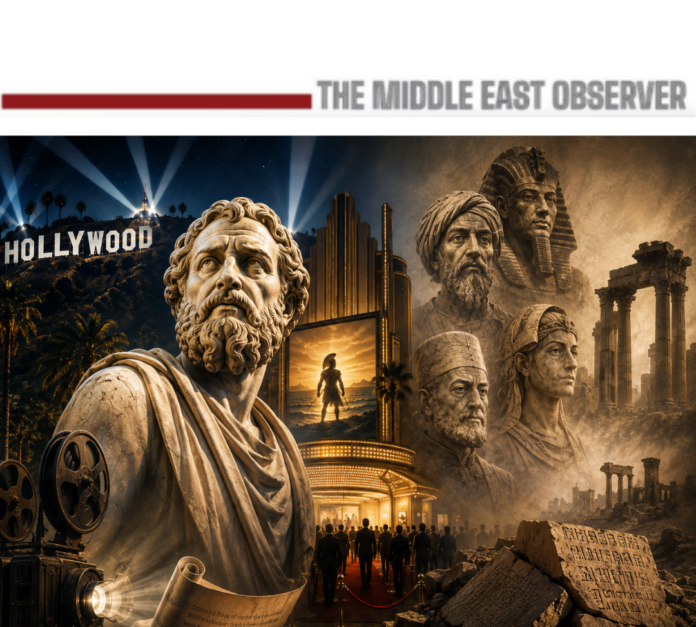
Why does Hollywood continue to return to its ancient epics while Arab cinema rarely revisits its own?
That question lingered long after we left the theatre.
Nearly three millennia after it was composed, The Odyssey continues to resonate with audiences across generations. Directors reinterpret it, actors bring new dimensions to its characters, and advances in filmmaking continually reshape its presentation. Yet the story itself endures because it explores universal themes—courage, loyalty, sacrifice, perseverance, and the longing for home—that remain as relevant today as they were in antiquity.
Hollywood understands a simple but powerful truth: great stories do not become obsolete. They endure because each generation finds new ways to tell them.
This explains why filmmakers repeatedly return to Homer, Shakespeare, the legends of King Arthur, and countless other literary classics. These works are not regarded as museum pieces confined to the past. They are treated as living cultural assets that continue to shape contemporary storytelling.
The Arab world possesses an equally rich narrative heritage.
From the legendary knight and poet Antar ibn Shaddad to the epic Al-Sirah Al-Hilaliyyah—one of the world’s longest oral epics and recognized by UNESCO as part of humanity’s intangible cultural heritage—our history is filled with stories of remarkable depth and dramatic power. The lives of Saif ibn Dhi Yazan, Sultan Baibars, and Al-Zir Salem offer equally compelling material, combining heroism, political intrigue, romance, and conflict in ways that could captivate global audiences.
Yet relatively few of these stories have been reimagined for modern cinema.
Arab television has produced several successful historical dramas, but feature films have largely favored contemporary social issues, comedy, and crime. Those genres have produced many outstanding works and remain essential to any vibrant film industry. However, they should not define it entirely.
Historical epics serve a broader purpose. They preserve collective memory, strengthen cultural identity, and introduce national heritage to international audiences. They also provide younger generations with stories that connect them to their own history while demonstrating that local narratives can carry universal appeal.
Hollywood does not revisit Homer because it lacks original ideas. It returns to Homer because it recognizes that timeless stories can be continually reinterpreted for modern audiences.
The challenge facing Arab cinema is not a shortage of source material. It is a shortage of sustained investment, creative ambition, and long-term commitment to bringing these narratives to life at an international standard.
Imagine a contemporary adaptation of Antar ibn Shaddad produced with world-class production values. Imagine Al-Sirah Al-Hilaliyyah developed as a multi-film franchise or prestige streaming series for global audiences. Such projects could introduce international viewers to Arab heroes with the same familiarity that Odysseus, Achilles, or King Arthur enjoy today.
This is neither unrealistic nor unattainable. The region possesses talented filmmakers, accomplished actors, expanding production capabilities, and growing investment in the creative industries. What remains essential is the confidence to view our literary and historical heritage not simply as a record of the past, but as a foundation for future storytelling.
As I left the cinema that evening, I realised that The Odyssey represented more than another successful Hollywood production. It demonstrated how a civilisation keeps its cultural legacy alive—not by preserving its greatest stories in books alone, but by continually reimagining them for new audiences.
The Arab world has never lacked heroes.
Perhaps the next great epic is not waiting to be written. Perhaps it is waiting to be rediscovered.
Related news:
Africa Arrives: Egypt’s Historic Run Signals a New Era for African Football
Arab leaders to participate in Egypt’s ‘Historical Event’
Read also:
Generation Gap: Are Authentic Social Values Declining Across Generations?