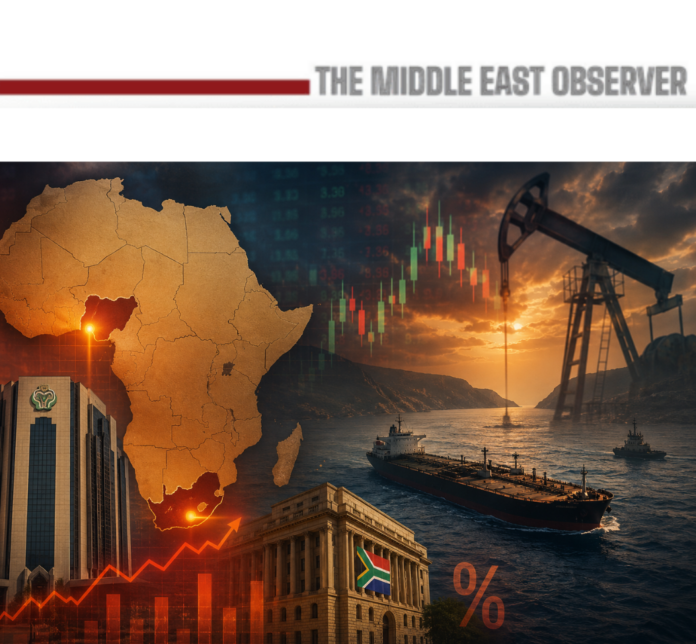
Africa’s latest inflation shock is exposing a problem interest rates cannot solve alone, as central banks confront price pressures increasingly driven by imported fuel, food supply, weak monetary transmission, foreign-exchange constraints and fiscal pressures.
South Africa brought the challenge into focus this week when the Reserve Bank raised its policy rate by 25 basis points to 7.25%, with inflation at 4.4% and renewed fuel pressures threatening to delay a return to its 3% target until late 2027.
The tightening comes despite projected economic growth of only 1.2%, highlighting a difficult trade-off facing African monetary authorities: containing second-round inflation without deepening weakness caused by external supply shocks.
The IMF expects median inflation in Sub-Saharan Africa to rise to about 5% by end-2026 from 3.4% at end-2025 as higher oil, gas, fertiliser and shipping costs pass through economies already vulnerable to imported inflation.
But the policy response is increasingly extending beyond benchmark rates.
South Africa, where imports now account for about 61% of refined-fuel supply compared with roughly 22% in 2019, is considering more than $8bn of investment to revive the Sapref and Mossel Bay refining facilities.
Greater domestic capacity would not eliminate exposure to international crude prices, but could reduce dependence on imported refined products and strengthen fuel-security resilience.
The distinction is critical: the Reserve Bank can restrain the inflationary consequences of an energy shock, but energy policy determines how exposed the economy is to that shock.
Nigeria faces a different constraint.
The Central Bank of Nigeria this week reset its Monetary Policy Rate to 23% from 26.5%, primarily as an operational recalibration after the benchmark had diverged materially from prevailing money-market rates.
The adjustment highlights a wider African problem: a policy rate is effective only if it transmits through liquidity conditions, deposit pricing, lending rates and ultimately economic activity.
IMF research has found that rate changes generally pass into short-term and lending rates across Sub-Saharan African frontier markets, but their effects on inflation, output and exchange rates remain weaker than in more developed economies.
Africa therefore faces not only an interest-rate challenge, but a monetary-transmission challenge.
Ghana illustrates another increasingly important dimension: foreign-exchange resilience.
The country is using gold purchases and export revenues to rebuild reserves and strengthen monetary buffers. GoldBod generated about $1.3bn in foreign exchange in August, with almost half directed towards Bank of Ghana reserve accumulation.
For commodity-producing economies, the implication is significant. Durable currency stability requires credible monetary policy alongside sufficient FX generation, export earnings and adequate reserve buffers.
Elsewhere, policymakers are combining rates with broader structural measures.
Ethiopia raised its policy rate to 16% while reforming credit controls and foreign-exchange rules. Zambia’s improved inflation outlook has benefited from a stronger maize harvest and a more stable currency, allowing monetary easing while the government temporarily reduced fuel taxation.
Egypt provides a further example of the limits imposed by external shocks. The Central Bank has maintained deposit and lending rates at 19% and 20%, respectively, while acknowledging that energy costs, fiscal adjustments and geopolitical disruptions can keep inflation above target beyond the period in which monetary policy can exert full control.
The emerging African challenge is therefore not to broaden central-bank mandates.
It is to prevent monetary policy from being forced repeatedly to compensate for structural weaknesses elsewhere in the economy.
Central banks must preserve credibility, control liquidity and prevent temporary shocks from becoming embedded in inflation expectations. Governments must address the conditions generating those shocks through stronger energy security, competitive domestic production, agricultural productivity, credible fiscal policy, deeper financial markets and stronger foreign-exchange generation.
The African Development Bank is moving in the same direction, establishing a framework capable of deploying up to $5.1bn to help countries absorb energy and fertiliser shocks while financing longer-term resilience.
The issue is becoming one of economic coordination rather than monetary policy alone.
Interest rates remain essential for containing inflation expectations, supporting currencies and preserving monetary credibility. But they cannot produce fuel, expand harvests, generate export dollars, rebuild infrastructure or repair dysfunctional credit markets.
Africa’s next disinflation cycle will therefore depend less on how high interest rates can rise than on how effectively its economies reduce the structural shocks that make high rates necessary.
Related news:
El-Sisi Advances Debt-for-Development Vision for Africa’s Economic Future
African Development Fund secures record $11bn replenishment amid global aid pressures
Read also:
Eagle Hills Plans $12bn Ras Malé Development as Maldives Broadens Tourism Model
Abu Dhabi Comic Con Shows Fandom Becoming a Middle Eastern Industry