

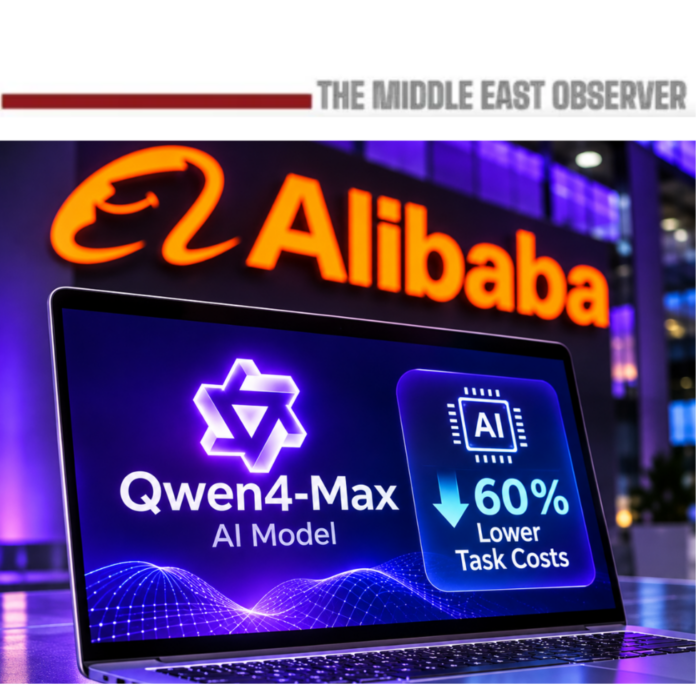
Alibaba launched its Qwen4-Max artificial intelligence model on November 16, 2026, introducing a 2.4-trillion-parameter system that the Chinese technology group says reduces average task costs by approximately 60% compared with its predecessor. The model ranked sixth on the Code Arena programming leaderboard, strengthening Alibaba’s challenge to US developers OpenAI and Anthropic as competition intensifies over AI performance, efficiency and pricing.
The Hangzhou-based company said Qwen4-Max is its most capable model to date, designed for complex programming, professional workflows, visual reasoning and scientific research. It supports text, image and video inputs and can process up to one million tokens of context, allowing it to handle lengthy documents, software projects and multistep tasks.
Alibaba’s Work360 benchmark, which evaluates performance across 721 specialized fields, showed Qwen4-Max outperforming its predecessor, Qwen3.8-Max, while using 35% fewer tokens in high-effort reasoning mode. The company reported an approximately 60% reduction in average task costs, although the results reflect its own testing rather than an independently established industry-wide comparison.
The efficiency gains are attributed to an updated mixture-of-experts architecture. Although the model contains 2.4 trillion parameters, it activates approximately 71 billion for each token processed, reducing the computing resources required for individual operations.
Alibaba said Qwen4-Max achieved competitive results in coding and agent-based tasks, including tests against models developed by Anthropic and China’s Moonshot AI. However, performance rankings vary across benchmarks, and the results do not establish that the model is superior to all competing systems.
The company has made Qwen4-Max available through QwenCloud’s Token Plan and application programming interfaces, as well as its QwenWork and QwenStudio platforms. Its cloud infrastructure supports integration with software built around OpenAI- and Anthropic-compatible APIs, potentially making it easier for developers to test the Chinese model within existing applications.
Unlike several earlier Qwen releases, the flagship model is not available with downloadable open weights. Alibaba said smaller open-weight versions of the Qwen4 family would follow, although it did not announce specific release dates.
Beyond coding, Alibaba is positioning Qwen4-Max for industrial and professional applications, including three-dimensional design, manufacturing, finance, legal work and healthcare research.
In one manufacturing demonstration, the company said the model reduced manual workpiece programming time from approximately 475 minutes to 24 minutes by using iterative checks to identify machining problems. The result illustrates a potential application of AI in industrial production, but should not be treated as a general productivity improvement across manufacturing operations.
Alibaba also introduced additional safety measures aimed at reducing the model’s potential misuse in cybersecurity and other sensitive areas. According to the company, internal testing found no evidence of significant high-risk capabilities, although the findings have not been independently verified.
The launch forms part of Alibaba’s broader investment in artificial intelligence, spanning foundation models, cloud computing and semiconductor development through its T-Head chip unit.
Chief Executive Eddie Wu has identified artificial general intelligence as a long-term priority and set a target of developing 20 gigawatts of global data-centre capacity by 2032.
As Alibaba, Tencent, Moonshot and DeepSeek intensify competition with US AI developers, Qwen4-Max offers businesses another option for demanding AI workloads. Its commercial impact will depend on whether the performance and cost advantages reported by Alibaba translate into consistent results for customers.
Related News:
OpenAI launches AI shopping wallet, raising stakes for fintech payments
Austrian Central Bank Turns to Chinese AI in €5mn Cost Challenge to US Models
Read Also:
Austrian Central Bank Turns to Chinese AI in €5mn Cost Challenge to US Models
Journify Raises $12mn to Expand AI Advertising Platform into US and Europe