

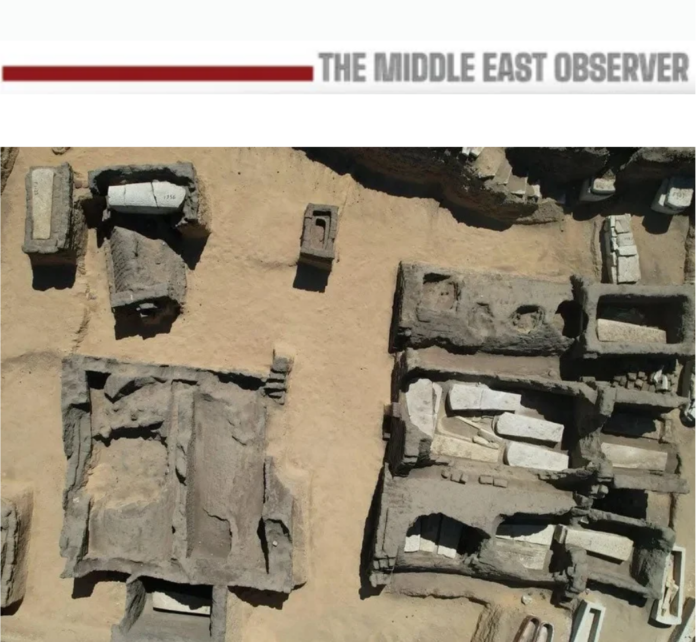
CAIRO, Egypt has formally announced the discovery of an extensive ancient cemetery at Kom Abu Billo in Menoufia Governorate, where an Egyptian archaeological mission uncovered hundreds of coffins, gold funerary objects and burial structures offering a rare insight into how ordinary Egyptians prepared their dead for the afterlife more than 2,200 years ago.
The Supreme Council of Antiquities said the cemetery, belonging to ancient Terenouthis, dates principally to the third and second centuries BC under the Ptolemaic dynasty, with evidence of burials extending from the Late Period into the early Roman era.
Unlike the monumental tombs of pharaohs and nobles, the cemetery appears to have served predominantly middle-class Egyptians. Hisham El-Leithy, secretary-general of the council, said preliminary assessments of the burial objects supported this interpretation. The concentration of coffins in an open burial courtyard is unusually extensive for the site, with further structures extending beneath the surrounding sand.
Excavators recovered stone and anthropoid pottery coffins, remnants of wooden coffins, vaulted mud brick tombs and human remains bearing traces of embalming resins and painted funerary coverings. Among the finds were gold tongues, jewellery, protective amulets, scarabs and numerous ushabti figurines intended to serve the deceased in the afterlife.
The religious objects reveal a society preserving its Egyptian identity under Greek rule. Figurines combining the imagery of Isis and Aphrodite, alongside representations of Horus and other Egyptian deities, illustrate the interaction of Greek and Egyptian beliefs. The gold tongues, meanwhile, were intended symbolically to enable the deceased to speak in the afterlife.
The discovery also highlights Terenouthis’s historical position near Wadi El Natrun, a major source of natron used in mummification. Earlier excavations identified remains of the ancient settlement and a temple dedicated to Hathor, worshipped locally as the Lady of Turquoise.
Although the ministry announced the discovery on 18 November, Egyptian newspaper Akhbar Al-Youm had reported the cemetery and many of its principal finds in October 2024, following excavations that began in September 2023. The latest announcement does not specify how many additional objects have been recovered since.
With further burial structures still buried, archaeologists will continue excavation and scientific documentation, seeking a fuller understanding of the cemetery’s development and the lives, beliefs and social conditions of ancient Terenouthis’s inhabitants.
Related Articles:
- Marina El Alamein Discovery Reveals Ancient Mediterranean Crossroads of Civilisations
- Saqqara Tomb Discovery Raises Questions About Ancient Egyptian Medicine