

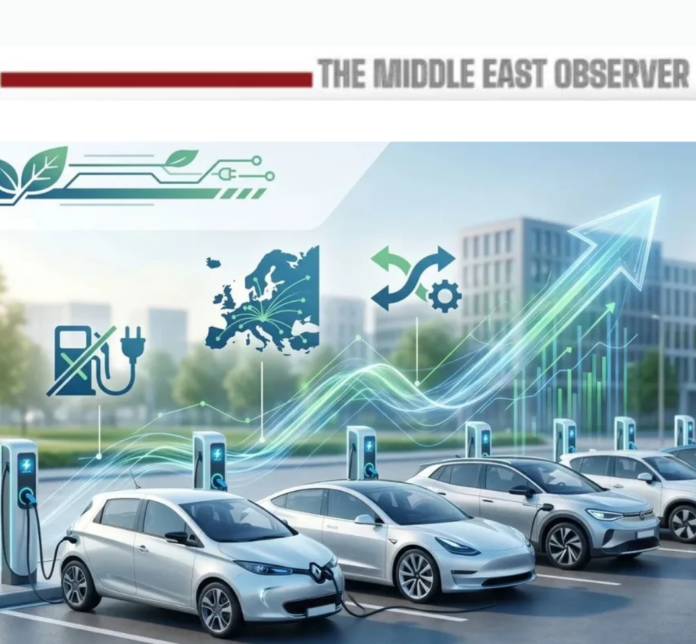
Battery-electric vehicle registrations across Europe surged by more than 60% in October 2026 compared with a year earlier, driven by government purchase incentives, higher oil prices and the growing availability of affordable models, as fully electric cars captured nearly a third of new vehicle sales across 18 major European markets.
Data released on Wednesday, November 18, by E-Mobility Europe, New AutoMotive and Fair Automotive showed that battery-electric vehicle registrations reached 295,252 in October, accounting for 32.1% of new car sales in the markets surveyed.
The increase came despite ongoing discussions in Brussels over possible changes to the European Union’s vehicle emissions targets for 2035, which have raised questions about the regulatory framework governing the transition to electric mobility.
Across Europe, battery-electric vehicle registrations reached 2.33 million in the first ten months of 2026, representing a 40.7% increase compared with the same period in 2025.
Germany recorded the highest number of electric vehicle registrations among the markets surveyed, with 94,069 vehicles in October, giving battery-electric cars a 37% market share. France registered 61,958 vehicles, although its market share was higher at 41.5%.
Northern European countries continued to lead the transition to electric mobility, with Norway recording the highest market share at 98.8%, followed by Denmark at 88.4%, Finland at 59.9% and Sweden at 51.1%.
Battery-electric vehicles also accounted for approximately half of new car registrations in Luxembourg, Portugal, Belgium and the Netherlands, reflecting their growing presence in several European markets.
However, adoption remained uneven across the continent. The Czech Republic recorded a market share of 9.3%, compared with 6.2% in Poland and 5.9% in Italy, placing them among the markets with the lowest electric vehicle penetration.
Government subsidies, higher conventional fuel costs and the wider availability of competitively priced electric models have helped support demand, although the figures highlight substantial differences in adoption rates between European countries.
The growth comes as EU policymakers consider easing the bloc’s 2035 vehicle emissions requirements, which currently mandate a 100% reduction in tailpipe carbon dioxide emissions from new cars and vans under the applicable fleet standards.
Despite the regulatory debate, October’s figures show continued growth in Europe’s battery-electric vehicle market, with registrations rising sharply both during the month and over the first ten months of 2026.
Related News:
- 2026 Marks Europe’s Shift From Premium EVs to Mass-Market Electrification
- Tesla Surpasses Audi in Global Car Sales Amid Challenges in the Electric Vehicle Market
5. Read Also:
