

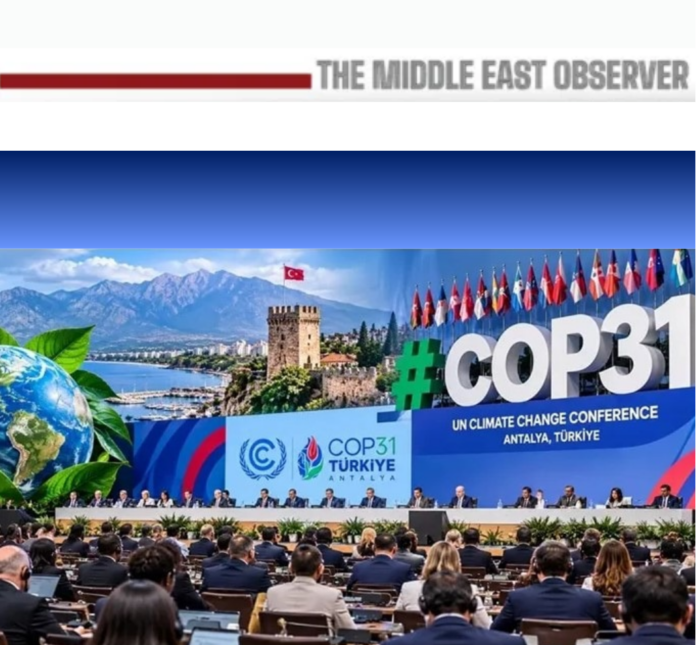
The COP31 UN climate summit ended in Antalya, Turkey, on Sunday, November 22, without its main political agreement after the European Union and several vulnerable nations rejected a final declaration that omitted explicit references to fossil fuels. The record-long conference, hosted by Turkey with Australia leading negotiations, failed to secure consensus among nearly 200 countries despite more than two weeks of talks over fossil fuel commitments, climate finance and emissions targets, although delegates adopted several other decisions.
COP31 President and Turkish Environment Minister Murat Kurum acknowledged that opposition to the proposed Antalya Pact had prevented its adoption. UN Secretary-General António Guterres expressed deep disappointment, while Australian Climate Change Minister Chris Bowen said negotiators had failed to overcome fundamental differences despite efforts to reach a compromise.
Ireland’s Climate Minister Darragh O’Brien, speaking on behalf of the European Union, said the bloc could not support a declaration that failed to mention fossil fuels, the principal driver of climate change. Panama, the Marshall Islands and Vanuatu also opposed the text, alongside the United Kingdom and other countries.
France’s Ecological Transition Minister Monique Barbut warned that the proposed declaration represented a step backwards, while German Environment Minister Carsten Schneider described the draft as unacceptable, reinforcing European opposition to its omission of explicit fossil fuel commitments.
The draft avoided an explicit commitment to move away from coal, oil and gas, referring only indirectly to the agreement reached at COP28 in Dubai in 2023. European, Pacific and Latin American countries demanded stronger language, while oil-producing nations, including Saudi Arabia, opposed explicit fossil fuel phase-out provisions.
Negotiators also disagreed over proposals to accelerate carbon capture and storage technologies. Saudi representative Mohammad Ayoub argued that addressing climate change required considering all available solutions.
The rejected declaration proposed increasing electricity’s share of global final energy consumption to 35% by 2035 and expanding clean energy use. It also reaffirmed the importance of limiting global warming to 1.5°C above pre-industrial levels, a central demand of climate-vulnerable island states.
Climate finance remained another major obstacle, with developing countries seeking stronger financial commitments from wealthy nations. The draft proposed further discussions on tripling adaptation finance by 2035 but omitted a $120 billion funding target sought by developing economies.
Disagreements also persisted over the timing of future Intergovernmental Panel on Climate Change reports. Several countries wanted the assessments published before the 2028 global climate stocktake, while Saudi Arabia and India supported postponing their release until 2029.
The summit, originally scheduled to conclude on November 20, continued into November 22, surpassing COP25 in Madrid in 2019 as the longest UN climate conference on record. Rising energy prices linked to the Middle East conflict and the absence of the United States further complicated the talks.
Despite the failure to adopt the Antalya Pact, delegates approved decisions on the Global Goal on Adaptation, the Adaptation Fund and the Just Transition Work Programme. However, proposed decisions covering mitigation, response measures and the Global Environment Facility also failed to secure agreement.
UN climate chief Simon Stiell warned that the world could not afford a repeat of the breakdown, calling for lessons to be learned and improvements to the international negotiating process ahead of COP32.
Related News:
- COP31: $6bn EBRD Plan Leads Climate Deals as Finance Disputes Persist
- Egypt Secures $563mn for Wind and Solar Projects as Clean Power Expansion Accelerates
Read Also — MEO: