

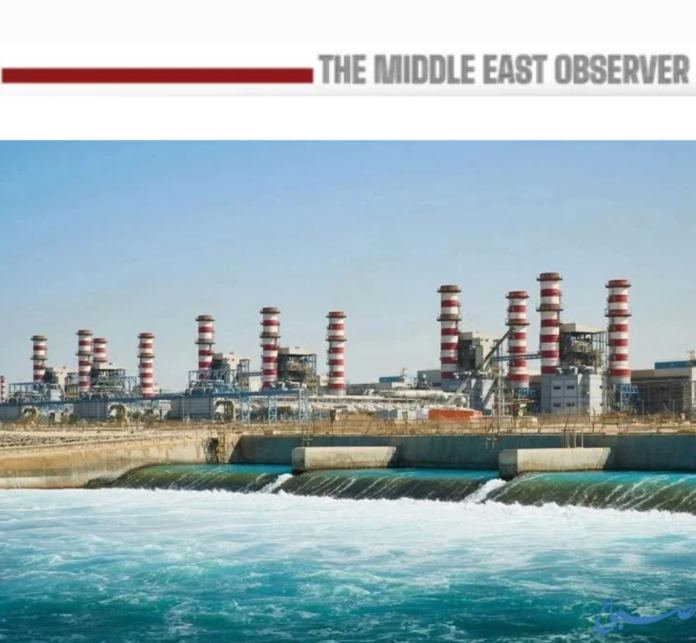
Orascom Construction announced on November 19 the groundbreaking of Jordan’s Aqaba–Amman Water Desalination and Conveyance Project, involving investment exceeding $6.7bn and designed to supply drinking water equivalent to the needs of approximately 40% of the country’s population. The company is participating in two engineering, procurement and construction (EPC) consortia and will jointly operate and maintain the facilities with France’s SUEZ for 26 years following a four-year construction period. Developed by Meridiam and SUEZ under a 30-year concession agreement, the project comprises an 851,000-cubic-metre-per-day seawater desalination plant and a 418-kilometre water transmission system linking the Gulf of Aqaba to Amman.
The groundbreaking ceremony was attended by Prince Faisal bin Al Hussein, Jordanian Minister of Water and Irrigation Raed Abu Saud, and senior officials and representatives of the international companies participating in the development.
Orascom Construction’s first EPC consortium, in partnership with SUEZ, will construct the desalination plant, while the second will deliver the water transmission system. Construction will be undertaken in a single phase.
The company, which is listed on the Abu Dhabi Securities Exchange and the Egyptian Exchange, did not disclose the value of its individual contracts or its share of the overall project investment.
The plant, which SUEZ describes as the world’s second-largest desalination facility, will use reverse osmosis technology and is designed to produce approximately 300 million cubic metres of drinking water annually. A 280 MW solar photovoltaic plant will supply around 30% of the project’s energy requirements.
The project comes as Jordan faces mounting pressure on its freshwater resources. According to the Green Climate Fund (GCF), annual water availability stands at just 61 cubic metres per person, well below the internationally recognised absolute water scarcity threshold of 500 cubic metres. Climate change and population growth are placing additional pressure on the country’s limited water supplies.
The GCF announced on November 18 that its $295mn financing contribution represents its largest commitment to an individual country. The funding is being channelled through the International Finance Corporation (IFC), alongside financing from more than 20 development finance institutions, commercial banks and impact investment funds.
The project is being developed through the National Carrier Project Company (NCPC), owned by Meridiam, SUEZ International and Jordan’s Social Security Investment Fund (SSIF).
According to the GCF, the development is expected to serve more than five million people and generate over 35,000 direct and indirect jobs. Its concessional financing is intended to help maintain water affordability for Jordanian households.
The desalination facility incorporates design measures to address rising seawater temperatures and salinity, alongside measures to protect marine ecosystems and reduce environmental impacts.
Orascom Construction CEO Osama Bishai said the project extends the company’s water infrastructure operations across Egypt, North Africa and the Gulf into Jordan, drawing on its experience as both an infrastructure developer and contractor. The combined capacity of the company’s water-sector projects across the Middle East exceeds 17 million cubic metres per day.
The groundbreaking follows strong third-quarter financial results for Orascom Construction, which reported a 22.5% year-on-year increase in revenue to $1.804bn, while net profit more than doubled to $102.7mn.
ACWA Power Eyes Desalination Membrane Factory in Egypt
Orascom, China’s Guide Automotive to Build EV and Desalination Complex in Ain Sokhna
Read Also:
Egypt Expands Mediterranean Energy Hub as $24.9bn Import Bill Tests Resilience